





Banksy, a famous unknown
Earn 10.00 Reward Points by commenting the blog post
Introduction to Banksy
Banksy, or who Banksy seems to be, is an unknown celebrity. I say “famous” because, there is no doubt that a part of the world’s population knows it. And I also say “unknown” because only a very small number of people know his identity.
Today we delve into Urban Art, the visual artistic expression carried out in the streets and other public spaces. It is about spreading a message, which can be political, cultural or social and can be expressed in mural, theatrical, musical or dance form. Therefore, no discipline is discriminated against.
Urban art, and Banksy in particular, aims to provoke reflection in the public. They have evolved ” graffiti” into a more commercial form, including the message. This “post-graffiti” is done with various techniques (stencils, posters, stickers, murals, graffiti…) not only on walls, but even with 3D shapes.
Although the beginnings had ” spray” painting as the protagonist, soon the stencils, based on the technique of stencilling (cutting hard paper, leaving open spaces where the painting can be projected, obtaining the cut-out image), allowed the message to be amplified.
Some consider it art or an expression of a subculture, others define it as “visual pollution” that breaks the aesthetics of the city. Banksy and others have modified the perception of graffiti, elevating it to the point of making it, for the time being, the last step in the history of art.
In different cities around the world, urban art has discovered great creators. The most well-known are Banksy, John Fekner, Shepard Fairey, Blek le Rat, Jacek Tylicki.

Banksy, image from the movie Exit Through the Gift Shop. Available in 20minutos.es
The Banksy Mystery
Who is Banksy? The mystery that surrounds it and its anonymity are part of this captivating atmosphere. The artist and activist is considered one of the exponents of urban art. His poignant and satirical style deals with issues associated with politics, culture and ethics.
Although his identity is unknown, his works are very famous. Located on walls, ruins, bridges and even museums, their works star in public spaces, distilling black humour and sharp criticism. He has left his mark in many cities around the world, consolidating great fame.
Hypotheses about their identity
But, then, who the hell is Banksy? Damien Hirst? There has also been speculation that Banksy is the Swiss Maître de Casson, although Casson denied this on his website.
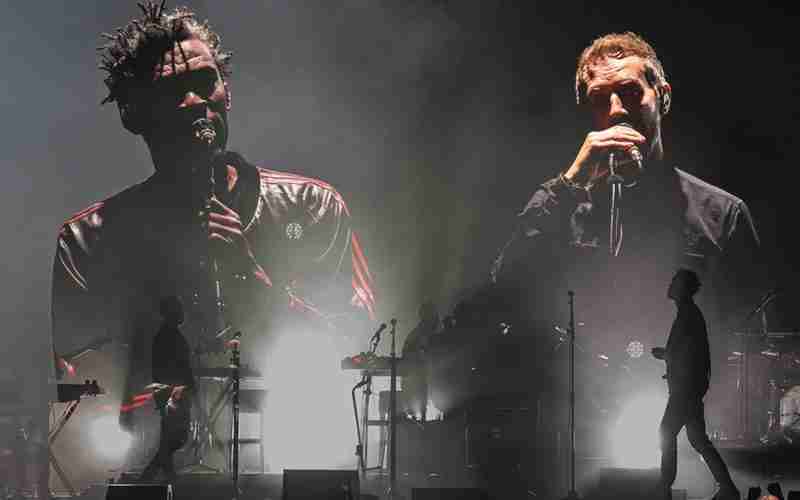
Image of the group Massive Attack in the middle of a live performance. Image available on Binaural.
Is it the singer of Massive Attack, Robert del Naja?? This theory comes from the English journalist Craig William, who, in his observations, locates the appearance of Banksy’s works in the cities where, coincidentally, Massive Attack was going to perform
Banksy is the pseudonym used by British artist Robbie Banks. He is believed to have been born in Bristol in the mid-1970s. A 2016 study by Queen Mary University (London) identifies him as Robin Cunningham. But no one knows if this is true, although, for some art critics, this would be the most plausible theory, since in his first works would be the signature “Robin Banks”.
A leaked BBC interview with Banksy revealed the mysterious artist’s first name. In the 2003 film, journalist Nigel Wrench asked if his name was Robert Banks, to which he replied, “It’s Robbie.” This full interview is available on a BBC online podcast collection called “The Banksy Story”.
From time to time, attempts are made to reveal the identity of the artist, but only “a few trusted friends” know his identity. He has become, despite, or thanks to his anonymity, one of the most influential artists in contemporary art, defying orthodoxy, revolutionizing the art market and producing continuous controversies.
Nonetheless, Banksy’s talent leaves continuous clues about his identity. His character is imprinted in his works and in his quotes: “Art should comfort the disturbed and disturb the comfortable.”
A few notes on his biography
It all stems from Bristol’s underground subculture, where his first works were born. He frequented the DryBreadZ gang (to which he regularly returns), getting his start in street art.
In the late 1980s, with the aerosol boom , he began his work with satirical pieces (usually rats), about politics, pop culture, morality and ethnicity. He begins by combining graffiti, stencils , and stencils, a technique similar to that used by Blek le Rat, the anarcho-punk band Crass, and the Ad Jammmers movement.
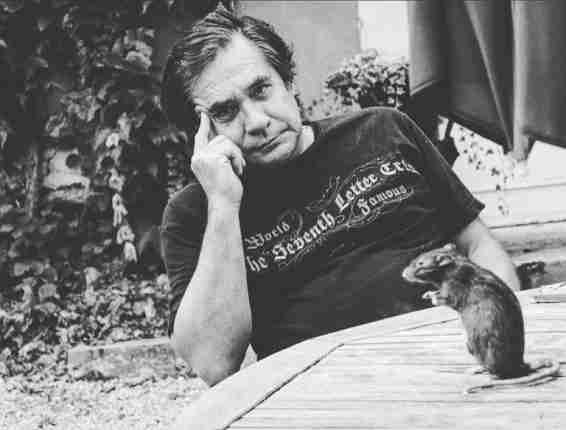
Xavier Prou, Blek le Rat. Image available in bleckleratoriginal.com
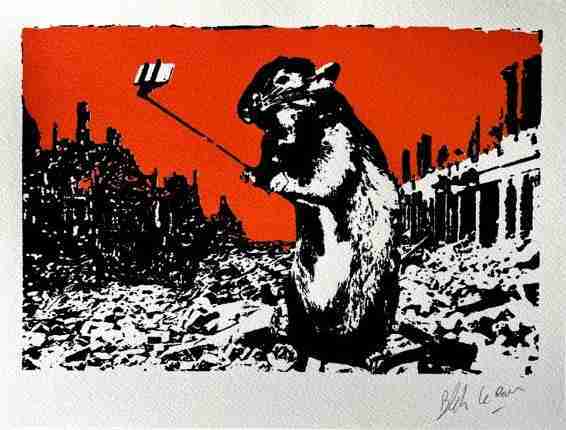
After the Apocalypse, Orange Edition. Seen in bleckleratoriginal.com
Banksy has always acknowledged the influence of Blek le Rat, to the point of stating, “Every time I think I’ve painted something slightly original, I realize that Blek le Rat did it better, just a year earlier.”
The Sunday Times reports that Banksy began using the name Robin Banks, a name that eventually became Banksy. There are 2 cassette covers with his 1993 work, made for the Bristol band “Mother Samosa” that bear this signature.

The Mild Mild West, by Banksy in Bristol. Image from Claudia’s Travels.
One of his earliest works (1999) depicts a bear throwing a flaming Molotov cocktail at police, recalling past riots in Bristol.
Steve Lazarides (photographer) had documented the first works of the young Banksy , he also shared, with Banksy himself, the management of the website where theartist’s “exploits” were posted. He also helped organize the “stunts” that Banksy carried out in famous museums, where he planted his works clandestinely.
An interview by 2003 with The Guardian, describes Banksy how “A white male, 28 years old, casually attired (jeans, T-shirt, a silver tooth, silver chain, and silver earring)” The same media outlet states that Banksy He started out as an artist at age 14, was expelled from school and imprisoned for misdemeanors.
He is believed to be tall, white , and blonde-haired. In the late 1990s he lived in Easton, Bristol. Then, from the year 2000 he moved to London.
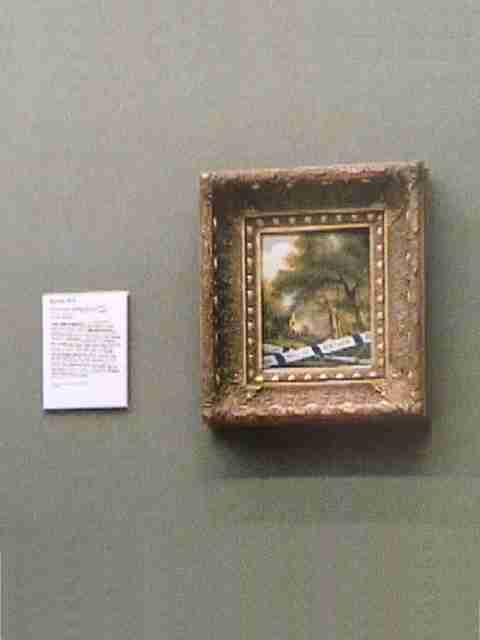
Crimewatch UK has ruined the countryside for all of us. Image by Banksy Unofficial.
Crimewatch UK has ruined the countryside for all of us. Image by Banksy Unofficial.
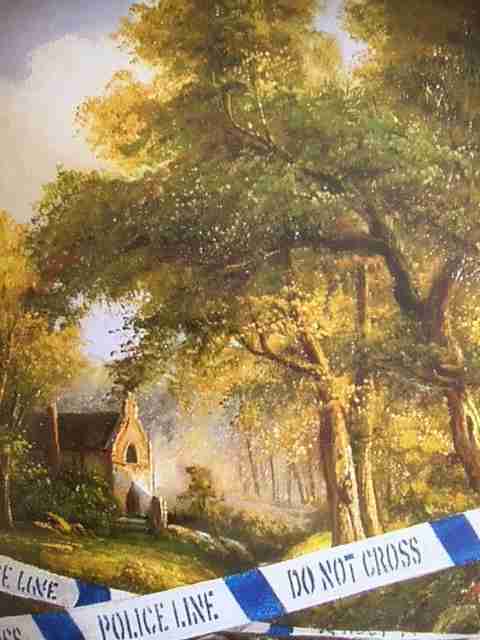
On 17 October 2003, Banksy entered Tate Britain disguised as a pensioner and placed one of his own creations in an empty space on one of the gallery’s walls. On this occasion he placed his painting, Crimewatch UK Has Ruined the Countryside For All of Us, a serene and peaceful landscape covered with police tape. After a few hours, the painting slammed into the ground and the trick was discovered.

Stuffed rat deposited in the Museum of Natural History. Image available on Bansky Explained.
On 7 April 2004, Banksy entered the Natural History Museumin London disguised as a clerk and carrying a stuffed rat in a glass-fronted box.
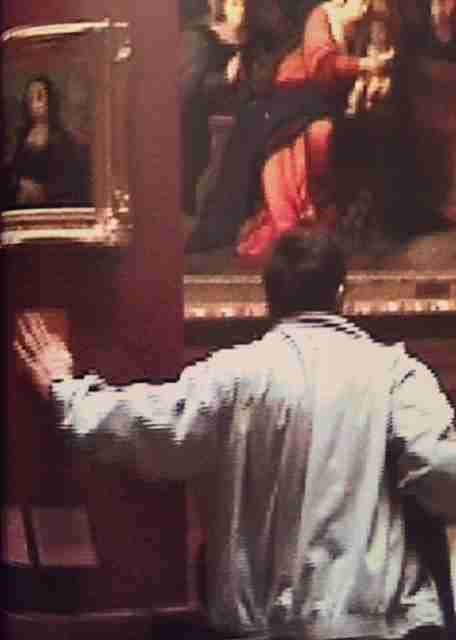
Banksy leaving his Mona Lisa at the Louvre Museum in 2004. Available from Banksy Explained.
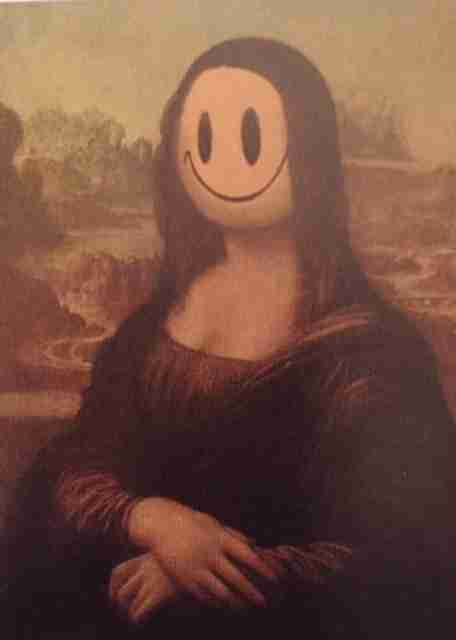
Mona Lisa with a Smile (Banksy), Louvre Museum, 2004. Available from Banksy Explained.
In October 2004, Banksy entered the Louvre Museum where he hung his own version of the Mona Lisa. He replaced his expression with a tangy yellow smiley face. He titled it: Mona Lisa Smile. Two years later, unbeknownst to the length of time the painting was on display, it was sold at auction for nearly £60,000.
At the British Museum, in 2005, he placed a piece of apparent rock art that included a supermarket trolley in a hunting scene. At MoMA he included a portrait of a period woman wearing a gas mask.

1 – Image of Robbo low graffiti on Camden Bridge – London. Urban distortion.

2 – Image of Robbo’s graffiti redecorated for the first time by Banksy. Urban distortion.

3 – Image of Robbo’s graffiti contesting Banksy’s decoration. Urban distortion.

4 – Image of Robbo’s graffiti decorated for the 2nd time by Banksy. Urban distortion.
The year 2009 is famous in London for the extraordinary controversy between Banksy and Robbo (veteran old-school graffiti artist and pioneer in London). On a Robbo graffiti on Regent’s Canal in Camden Town (a mythical piece from 1985), Banksy decided to redecorate it (he painted a wallpaper hiding Robbo’s graffiti). Several weeks later, Robbo responded by drawing the letters “King Robbo” in silver, modifying the direction of the wallpaper. Banksy responded soon by adding the word “Fuc” in front of King Robbo, implying “fucking Robbo” or “fucking Robbo”.
The war went on for a while longer… See the excellent article: War of Egos: Banksy vs. Banksy Robbo.
The book Freedom Through Football: The Story Of The Easton Cowboys & Cowgirls, published in 2012, confirms the first photograph taken of Banksy while doing graffiti in Chiapas, Mexico, in 2001.
In 2013, in protest of the art market, Banksy put some of his works up for sale on the street, at the price of $60. Shoppers, who weren’t fully aware of what they were doing, were in for a pleasant surprise the next day. In fact, the artist posted a video online that talked about this operation, causing the value of those works to skyrocket to $20,000 in one day.
Also in 2013, Banksy held the illegal exhibition “Better Outside Than Inside” in which every day he created a different work on the streets of New York.
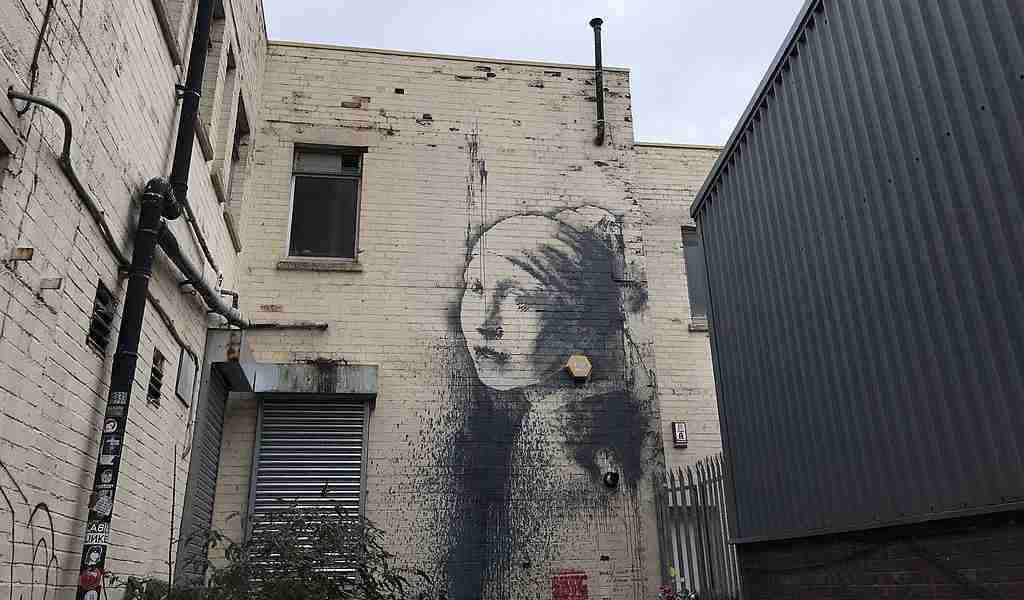
Banksy made the mural called “Girl with a Perforated Eardrum” (2014), as a parody of the painting “Girl with a pearl earring” by Johannes Vermeer, changing the earring for an alarm on the façade of a recording studio in Bristol.
It had great and immediate repercussions, to the point of being stained with black paint after 24 hours. It is not the only time that a work by Banksy is vandalized, therefore, and because of its transcendence, some of his works are covered with transparent vinyls to protect them and be able to repair them.
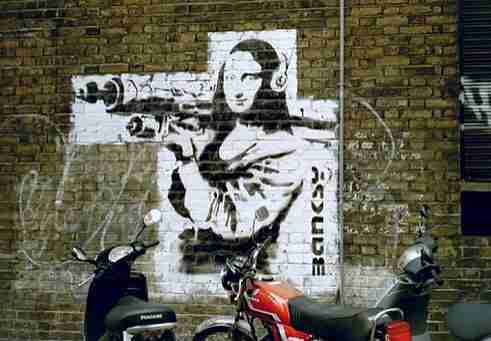
Mona Lisa with Bazooka, Soho. Available from Banksy Explained.
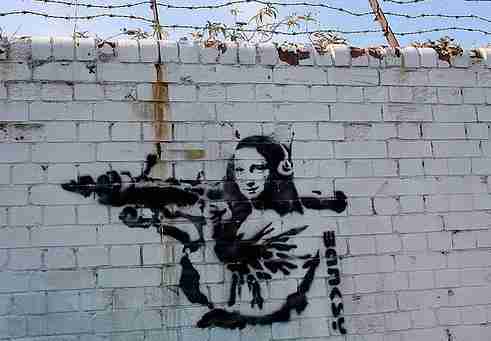
Mona Lisa with Bazooka. Available from Banksy Explained.
The Technique
The type of art you practice Banksy is made, to a large extent, through the use of the technique called stencilling, a very old technique (there are some Palaeolithic manifestations, e.g. handprints), which consists of cutting figures out of cardboard or cardboard and projecting paint to reproduce the silhouettes perfectly in the scene.
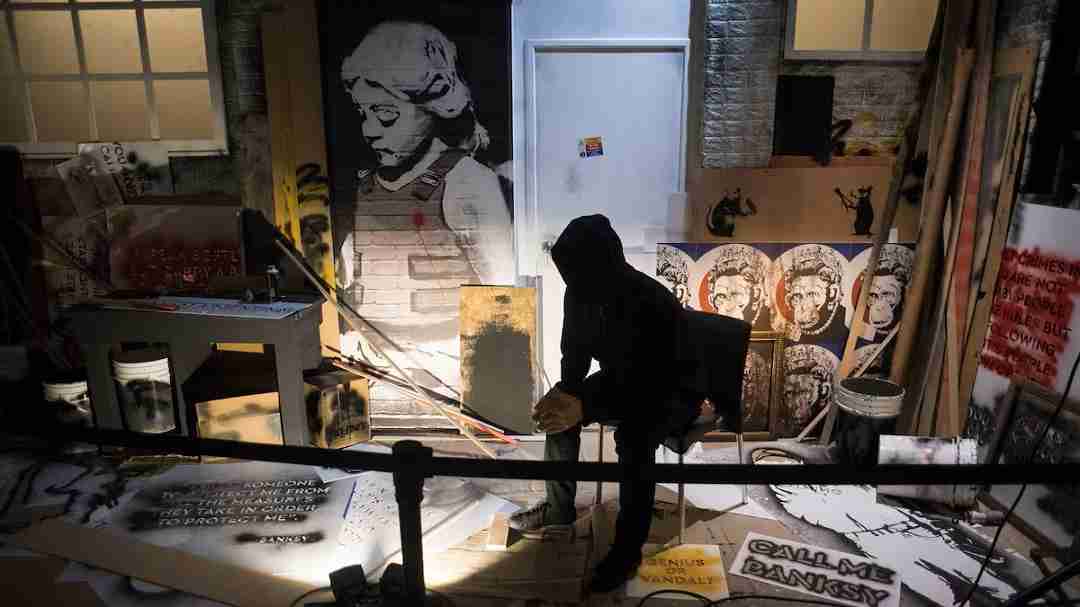
Image of Banksy in a recreation of his workshop. Seen in La Nación.
Banksy die-cuts the images that he is going to leave printed on the walls, which he does in his workshop. When it comes down to it, live live, he rests the stencil on the wall and projects the painting. That’s it: clean, fast and with less risk, as it allows you to escape quickly from the police.
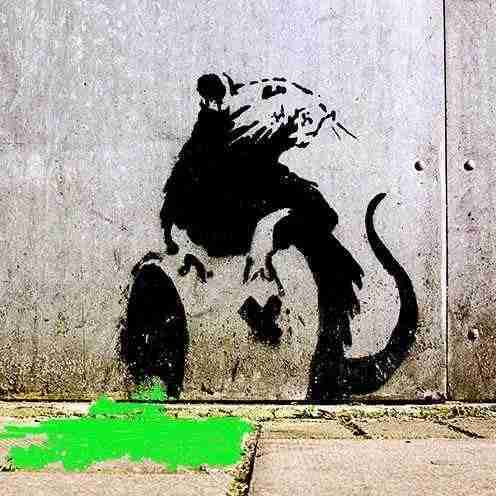
Toxic Rat, Banksy. Seen at The Museum.
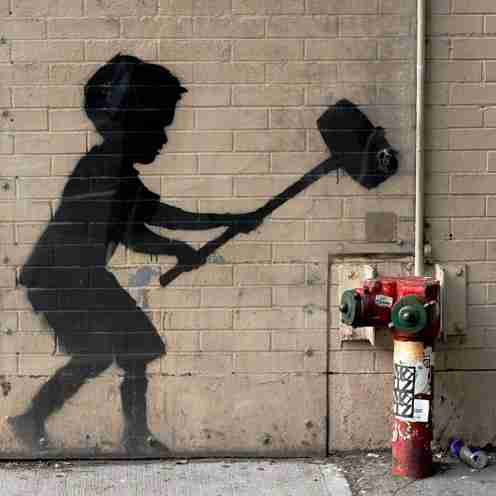
Boy with hammer, Banksy. Seen at The Museum.
He sometimes uses trichome (a combination of three inks) to create attractive contrasts and, with small doses of colour, he also directs the audience’s gaze towards what interests them.
Also interesting is the use of works by other authors (Leonardo Da Vinci, Michelangelo, Johannes Vermeer, etc…). The idea is to move consciences. Taking advantage of the work of a great author, Banksy has an easier time including the message through a note (small drawing, shape, element of public space, etc…). In this way, it will capture the public through the work of the great author and stop them in front of the message with their contribution.
Certainly, this attitude in the production of his works seems a bit exploited, but that’s Banksy. Genius? Vandal? Imitator?… You are the ones who call it an artist, I don’t dare.
And I don’t dare because, I don’t know how to say it, Banksy, as the article progresses, stirs my conscience and, although I am aware of the careful marketing that his works carry, the message is good and, in most cases, it is also true.
We should not underestimate the display of ingenuity and provocation that he develops, placing his works in famous museums “even at the cost” of possible problems. Its careful and economical marketing is one of the most important tools of its refined technique.
Sometimes, for me, he abuses the kindness of an audience that seems to forgive him everything. It is notorious that, for example, in its Palestinian journey it leans too far to one side without properly assessing the problems of the other side. But that’s Banksy.
Still, the best thing about Banksy is the message. He knows how to expose the system and, even putting the highest stratum of society in the continuous criticism, he is adored by the very people he criticizes. On the other hand, in his creations, he likes to use originality and elements to provoke smiles, rage, satire or disappointment.
The artist’s technique has made it possible to dynamize street art, providing it with new tools and new horizons of action.
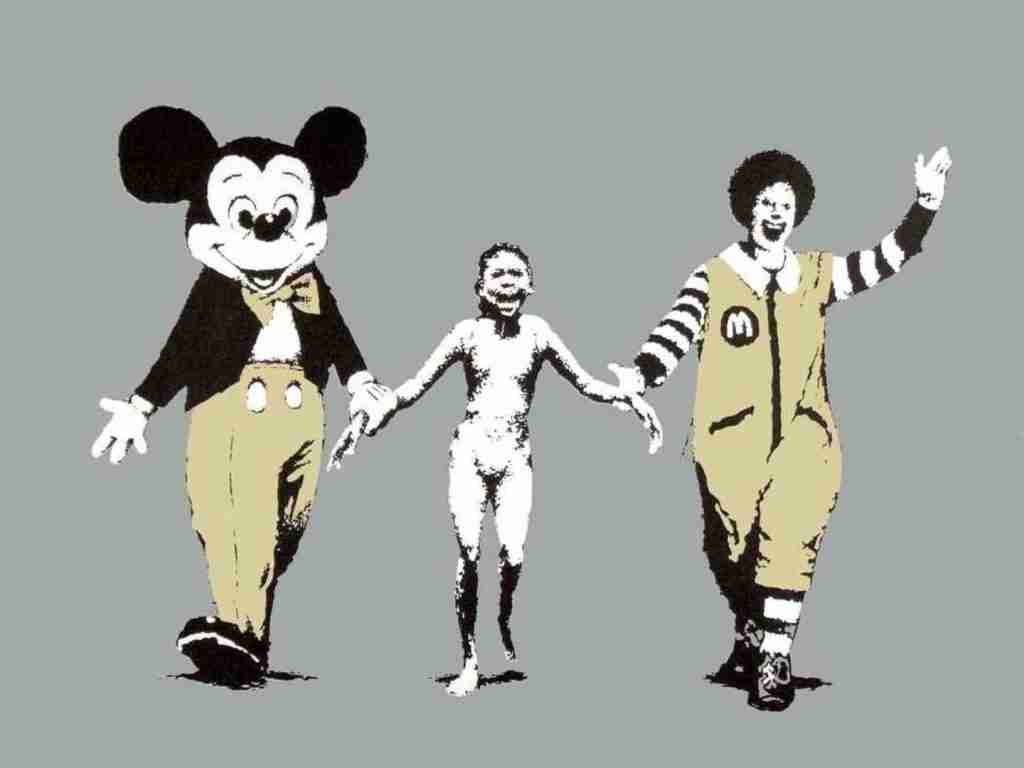
Napalm, 2004. Seen in El Independiente.
The Message
Napalm is one of Banksy’s most poignant and moving prints. A work made to move that ends up shuddering. A declaration of war on war itself, relating it to the capitalist world, colonialism and occupation.
On top of the Pulitzer Prize-winning image, 9-year-old Kim flees naked, scorched by napalm, Banksy deliberately adds two icons of American consumer culture (Micky Mouse and Ronald McDonald), suspiciously smiling.
The continuous denunciation, in the work of this mysterious author, exudes anger, solidarity and scepticism. He is loved and hated, but he leaves no one indifferent. We are not used to receiving such direct messages about our consciousness. And even less, seasoned with the dose of satire that only Banksy knows how to print. That cocktail soaks all souls.
Although Banksy downplays his importance, conceptually, his ideas are very clear:
“Graffiti is one of the few tools you have if you have almost nothing. And even if you can’t think of an image to cure global poverty, you can make someone smile while they pee.”
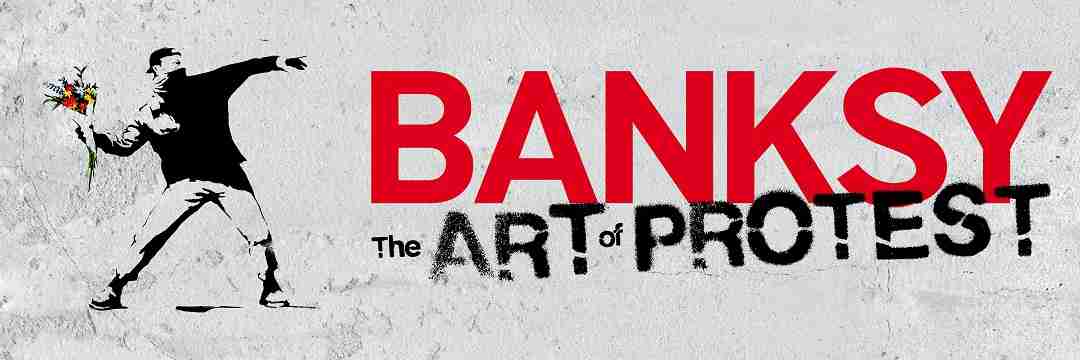
Banksy. The Art of Protest, Exhibition. Seen in the thermal.
In 2018, the exhibition “Banksy. The Art of Protesting” arrived in Spain, more specifically, in Barcelona. After several years of world touring, this exhibition presented more than 70 works by the artist, some of them unpublished. The success of the Catalan call was very relevant, concluding with the phrase “Nobody knows who Banksy is, but everyone knows Banksy’s work”.
Consumerism, war, globalisation, religion, class struggle and the climate crisis are everyday themes in Street Art. Our protagonist usually presents them on the walls of cities, providing the visibility they need.
For Banksy, the message has to provoke. He does not conceive his works only for artistic delight, the social, cultural and political background is present and is the protagonist Banksy’s work criticizes the system, but does the system benefit from his work? Do you leverage marketing to amplify the message or to change the market? Paradoxical, isn’t it?
I don’t think so. This kind of paradox is much studied by the author. In my opinion, in addition to the artistic component, which exists; the message, which is undoubtedly the protagonist; A new art market has also appeared. Certainly, the ephemeral nature of graffiti and Urban Art has been disappearing. The city doesn’t devour all the graffiti, it now has some works. Thanks to the protagonist appearance of the message, everything makes sense. Therefore, it can be valued, as well as reproduced and sold.
Some believe that Banksy is capitalizing on his mystery. Maybe. But, what is indubitable is the work and the message. We can’t abstract ourselves from reality, it’s stubborn. We can like it more or less, or we may not like it. But the work is in the city, in that public space where only those who can end up in jail express their ideas and we, citizens, can admire or criticize them.
If you admire, respect or share any of these works, you may buy a reproduction. If you don’t buy it, and the city doesn’t devour it, you’ll always be able to see it on its wall again. Don’t worry, he won’t move. The inexorable thing, in addition to the passage of time, is that it is now possible to enjoy Street Art not only in the street, but in museums, thanks, among others, to Banksy.
But, it may well be that I am not right (most likely), nevertheless, the question is asked, the market created and the agitated consciences. Would you buy graffiti for your living room?
Selection of works
The truth is that Banksy is a prolific artist. His work is mainly represented by public murals spread across various cities around the world. He has also made other types of works using various techniques. Highlights include his film “Exit through the Gift Shop”, his “Vandalized Telephone Booth“, the extravagant police helmet “Met Ball” and performances such as the placement of the cone on the head of the equestrian statue of the Duke of Wellington, among other works.
His many works allow this modest writer to delight in selecting them for you. It is not an easy exercise, due to the number of works and the different messages. I hope I got it right.
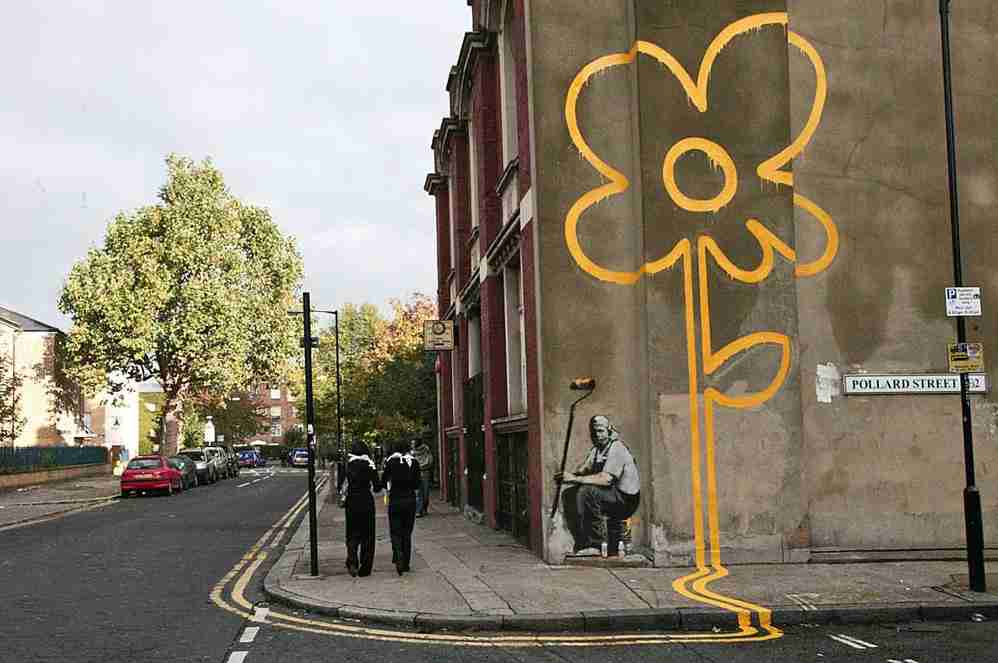
Yellow Lines Flower Painter (2007). As seen in Banksy Explained
Yellow Lines Flower Painter (2007)
Located in Benthal Green , London, andThis work, painted on the side of a workers’ club on the corner of Pollard Row and Pollard Street. It shows a painter in a jumpsuit, whose job it is to paint yellow lines on the pavement, taking a break after painting double lines that rotate, climb up the sidewalk and façade becoming a pretty flower.
Shortly after discovering this work, authorities erased the double lines from the sidewalk. The figure of the painter has been degraded (vandalism) but the flower remains intact.
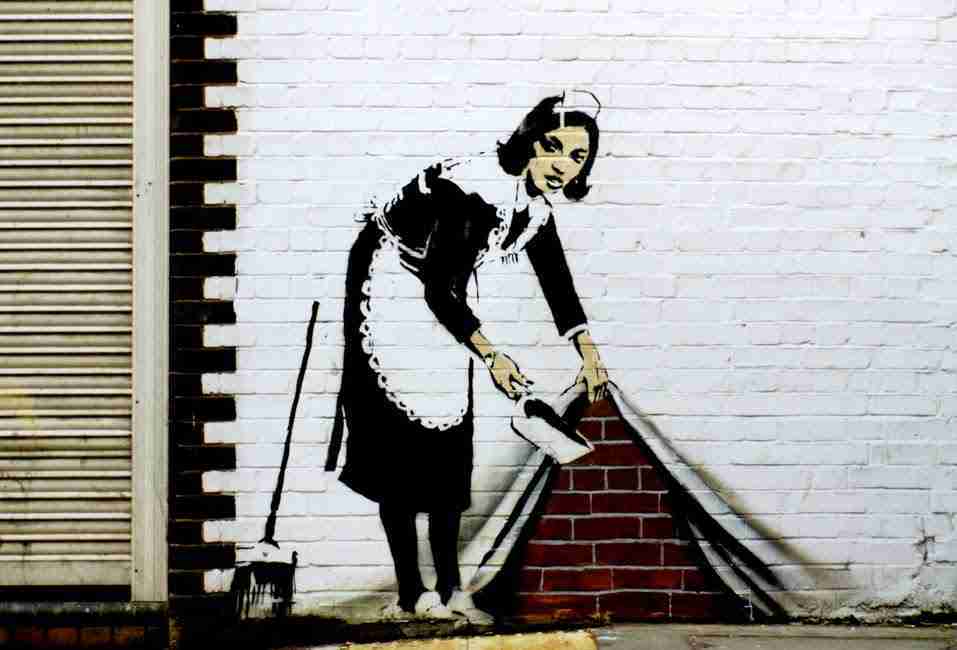
Sweep it under the carpet (2006). As seen in Banksy Explained
Sweep it Under the Carpet (2006)
“Sweep Under the Carpet” appeared on a wall on Chalk Farm Road, north London, in 2006. The bricks were painted on the white wall of the White Cube gallery. The gallery left the painting there for a while, but eventually removed it.
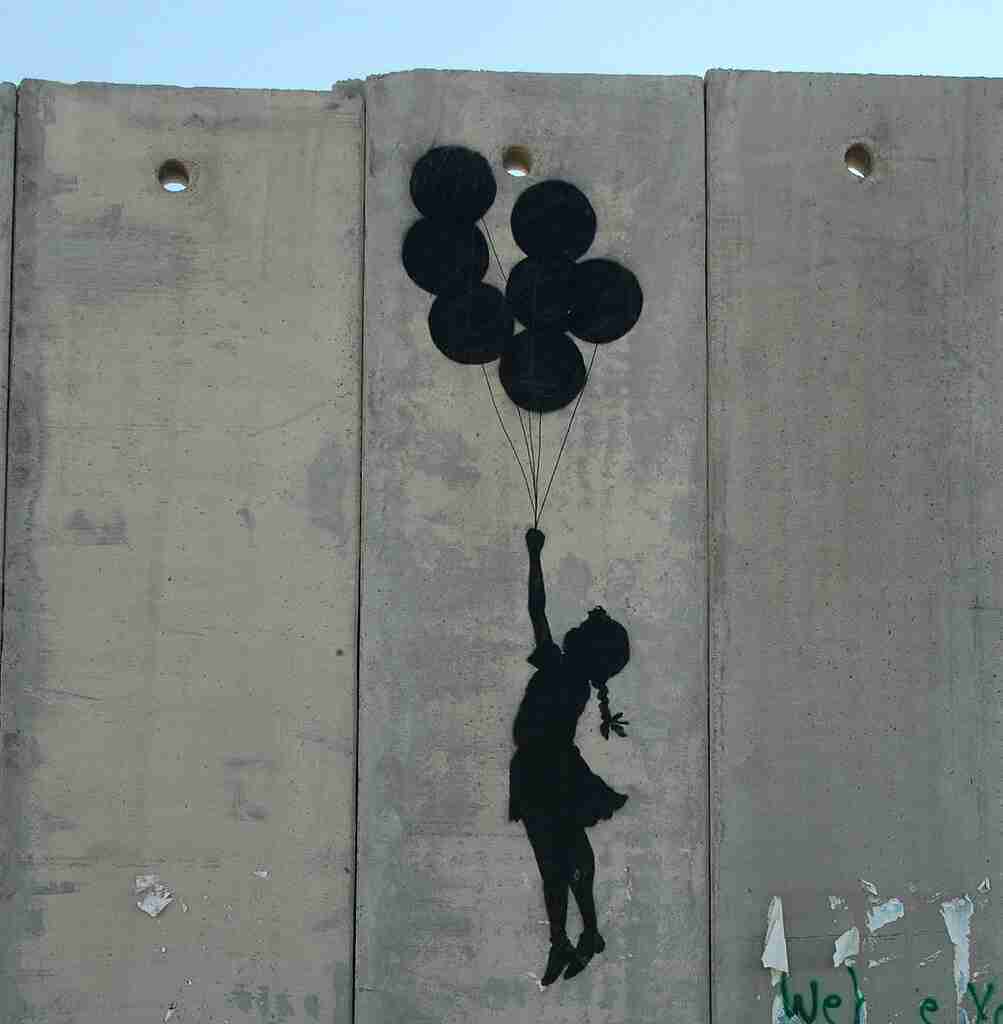
Flying balloon girl (2005). Seen on Wikipedia
Flying balloon girl (2005)
“Girl Flying with Balloons,” also known as Balloon Debate, is a 2005 stencil mural made in the West Bank. It depicts a young woman holding a bunch of seven balloons floating over the 8-meter-high wall, built around the Palestinian enclave near Qalandia Checkpoint. It refers to the Palestinian right to freedom of movement and possibly the Palestinian right of return. It has been described as “poignantly simple”.
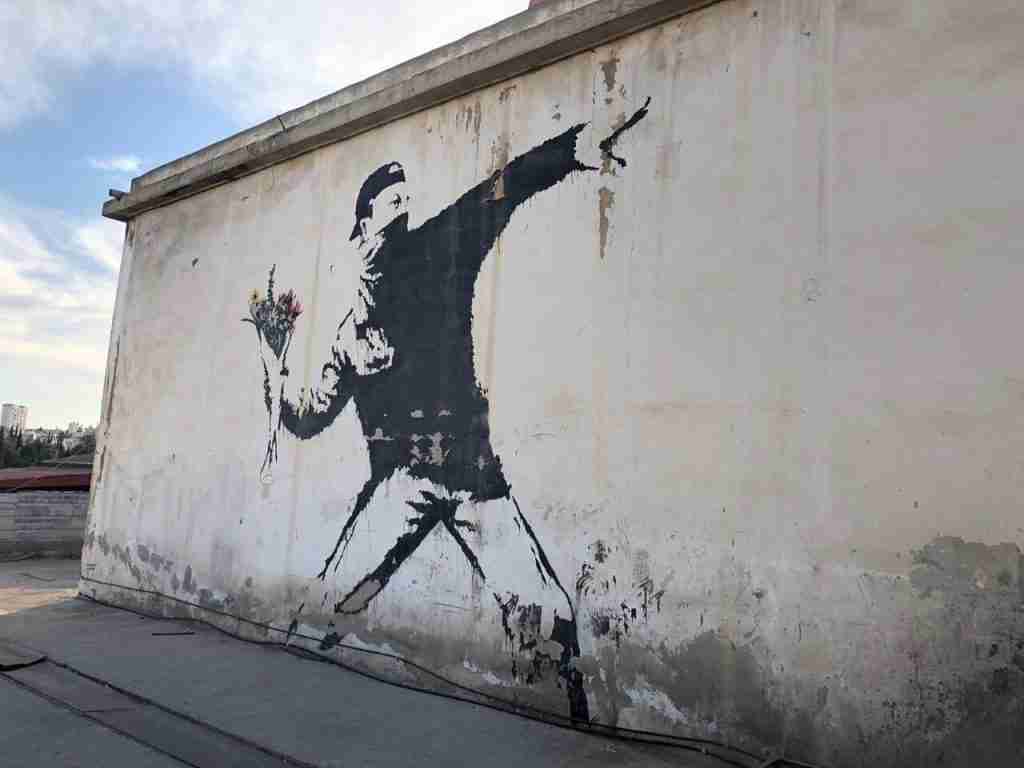
Love is in the air, Flower Thrower. Seen in Public Delivery.
Love is in the air, Flower Thrower (2005)
“Love is in the air, Flower Thrower,” is oneof Banksy’s iconic templates. It shows a masked Palestinian throwing a bouquet of flowers.Thedrawing appeared on a wall next to a Citroen/Peugeot car dealership in Jerusalem. The man, made in black and white, wears a scarf and a baseball cap. The flowers and stem sticking out of the wrapper are in color.
The scene recalls street riots in the 60s and represents, on the one hand, the frustration of young Palestinians and on the other, the invitation to peace.
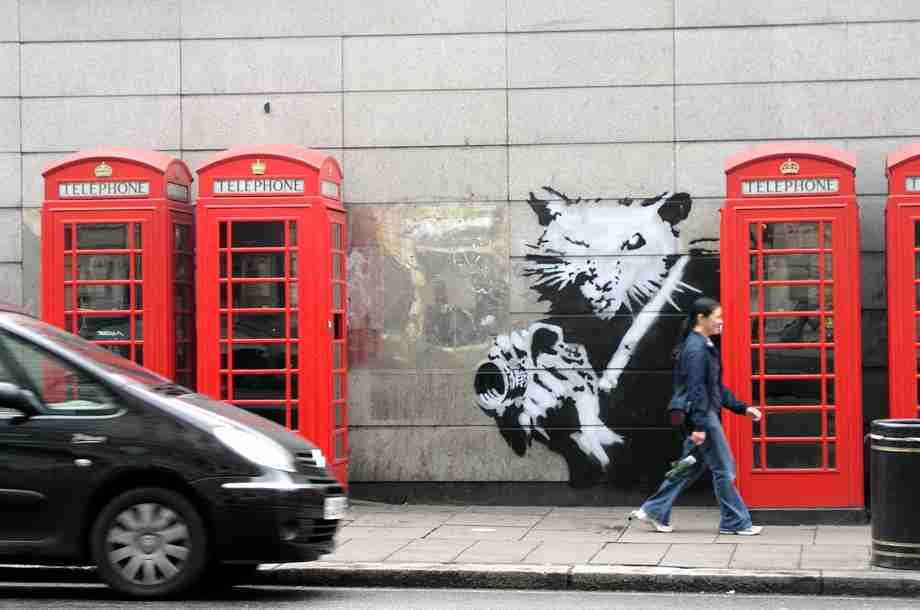
Photographer Rat. Seen in Erratic Phenomena.
Photographer Rat (2001)
The first street artist to paint rats was probably Blek le Rat. “I started spraying some small rats on the streets of Paris because rats are the only wild animals that live in cities, and only rats will survive when the human race disappears and becomes extinct.” Following in his footsteps, Banksy revived the rat symbol with a new element of humor and social commentary.
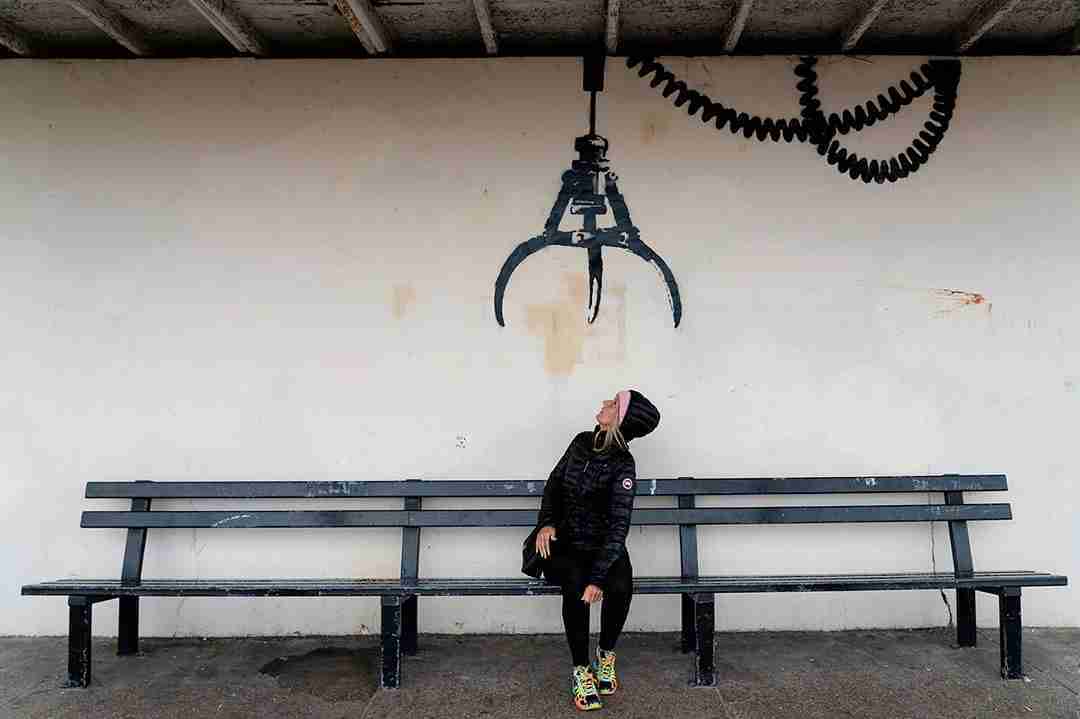
Arcade Claw. Seen on LeicesterShireLive.
Arcade machine claw (Spraycation)
At a bus stop in Gorleston, facing the sea, Banksy depicts a claw from the classic arcade game hanging over the bench. Fruit of the holiday tour “A Great British Spraycation”, which was an alternative holiday to the “staycations”, restricted by the pandemic situation. Of course, with spray.
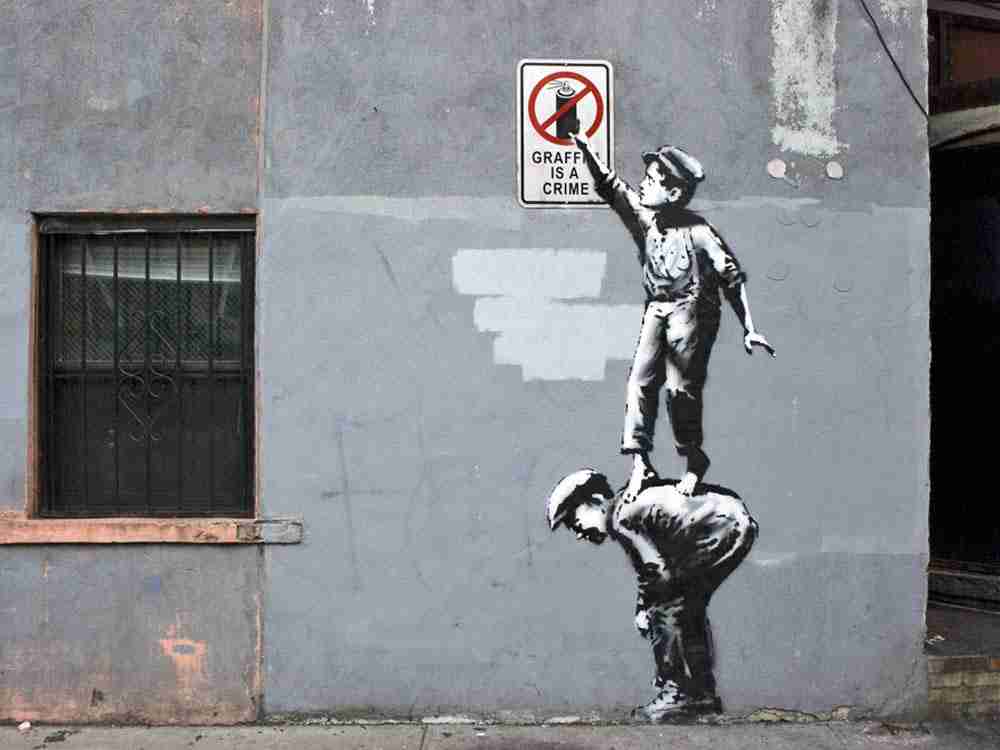
Graffiti is a crime. Seen in the world
Gaffiti is a crime (2013)
At its premiere in Manhattan , Banksy painted a child perched on the back of another taking the spray can of a no-graffiti sign, contradicting precisely that order. ‘Graffiti is a Crime’ , could be read in one of the house’s ironic exhortations.
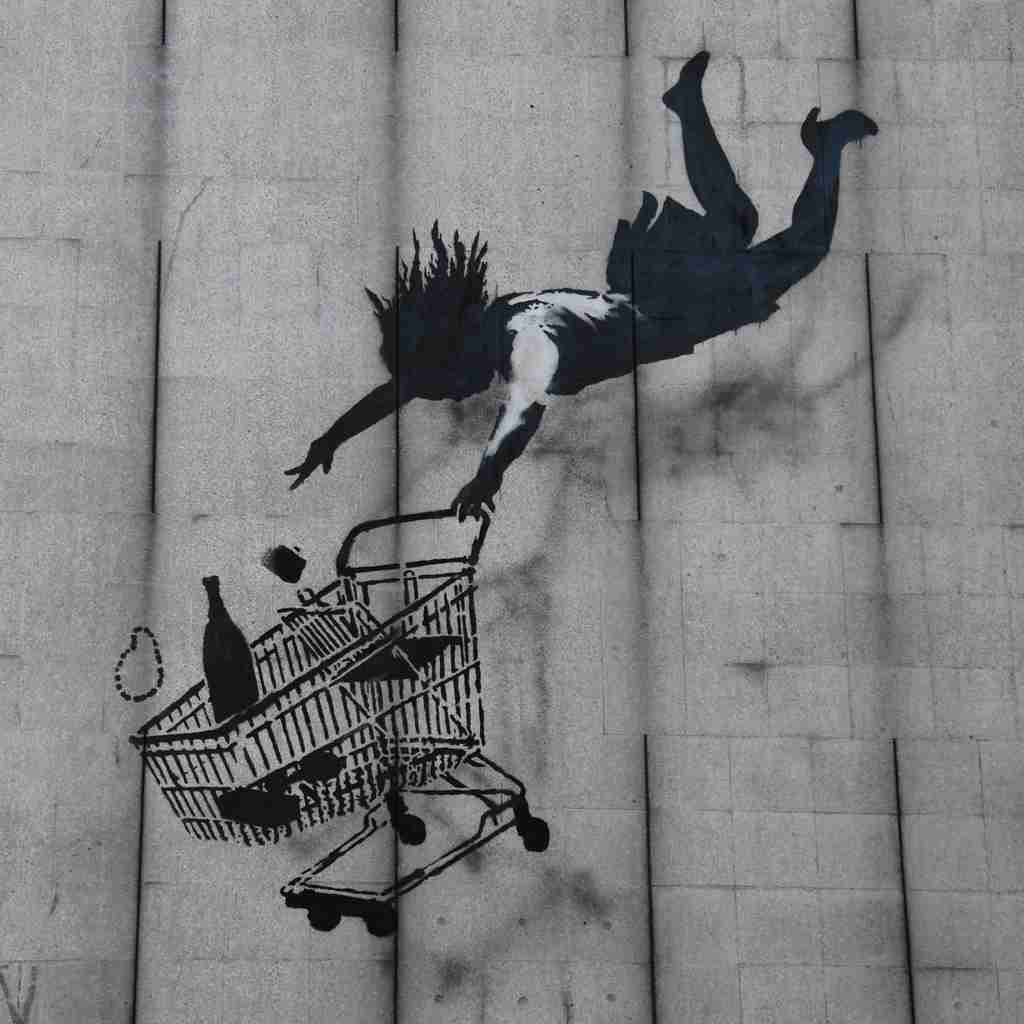
Shop till you drop. Seen in Banksy Explained.
Shop till you drop (2011)
Shop ’til you drop? This seems to be the message that Banksy wanted to leave in this mural in London. Shopping carts, consumerism and capitalism have always been in the author’s sights. In this case, taken to its ultimate extreme, it evokes the desperation to buy. Overstated?
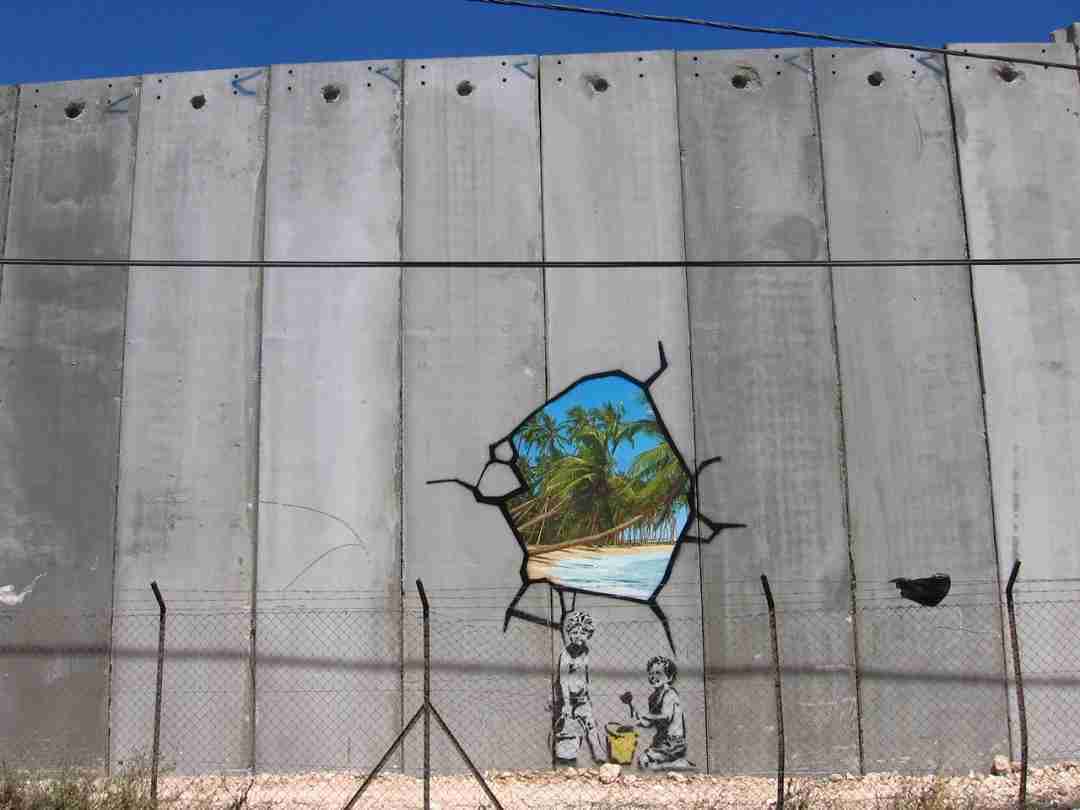
Behind the wall is the beach. Seen in the Independent
Behind the wall is the beach
For Banksy, the West Bank wall is the largest open-air prison in the world. In this work, the artist was able to open a hole from which peace and happiness can be glimpsed. “A wall has always been the best place to post your work.”
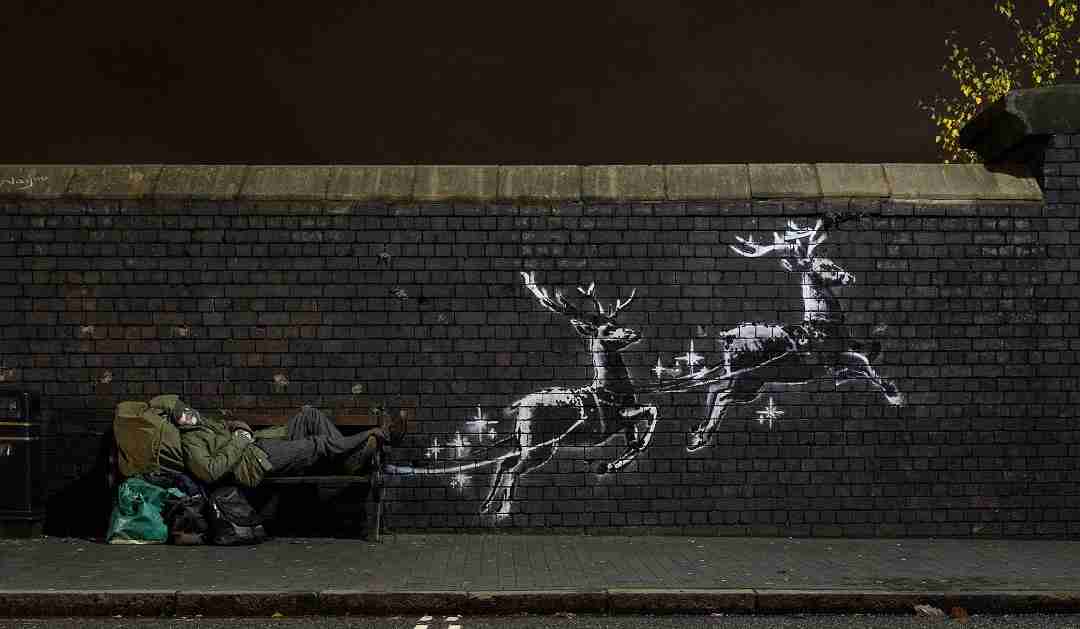
God Bless Birmingham. As seen in The Guardian.
Waiting in Vain (2013)
God Bless Birmingham appeared on a wall in Birmingham’s Jewellery Quarter.A couple of reindeer pull a public bench that homeless people use as a bed. Banksy made a video with this work showing a man named Ryan (pictured) having a drink before placing a bag as a pillow and lying down, to, in his dreams, soar through the skies in a pleasant dream.
Not only did Banksy name Ryan in the video, but he also thanked the locals who spontaneously brought him a hot drink, chocolates, and a lighter during the filming of the short video.
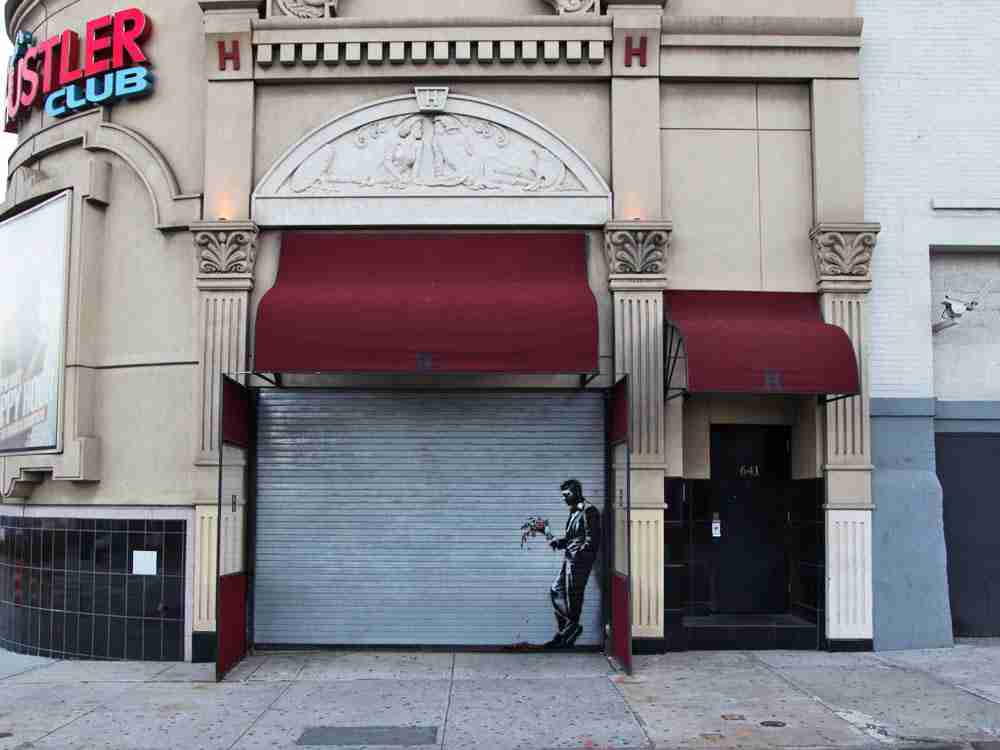
Waiting in vain. Seen in Banksy Explained.
On his American tour “Better Outside Than Inside”, Banksy left us this work at the closing of the Hustler Club in Hell’s Kitchen, in New York. It shows a man waiting with a bouquet of flowers at the door. Highlights include some red petals fallen on the ground and the title “Waiting in vain”. Premonitory?
The Market
Banksy, I don’t know if thanks to that mysterious atmosphere that surrounds him, or to his provocative message, has become the most acclaimed street performer. In addition, his works, far from remaining mere topics for conversation, have created a space of their own within the art market.
Posters, paintings, plates, engravings or figures reproduce his works all over the world. He has become a moving artistic exponent and the market accepts and values him.
Reproductions of his work, authorized or not, are sold all over the world, at higher and higher prices. Admittedly, Banksy (and others) have raised the value of the gafiti in the art market.
He declared in 2006 that “copyright is for losers” and has on multiple occasions encouraged everyone to copy, borrow, or modify his works for fun, academic purposes , or social activism. But that’s not all the case.
On https://www.banksy.co.uk/licensing.html, their official site, under the License tab, says:
Are you a company looking to license Banksy’s art for commercial use? Then you’ve come to the right place: you can’t. Only the Bureau of Pest Control has permission to use or license my artwork. If someone else has given you permission, you don’t have permission. I wrote “copyright is for losers” in my book (copyrighted) and I still encourage anyone to take and modify my art for their personal amusement, but not for profit or to make it look like I’ve endorsed something when I haven’t. Thank you.
Therefore, Banksy’s work, with a few exceptions, retains copyright. I don’t think it’s a bad thing, in fact, I think that the author of a work should have the right to it.
Surely you have already noticed, when reading this article, that it does not present advertising. Advertising provides us with some income for the maintenance of the digital magazine. We wanted to set an example and, preserving copyright, in line with its manifesto, we do not include any type of advertising in this post.
What can be seen is the increase in value of Banksy’s works. Here are some examples:
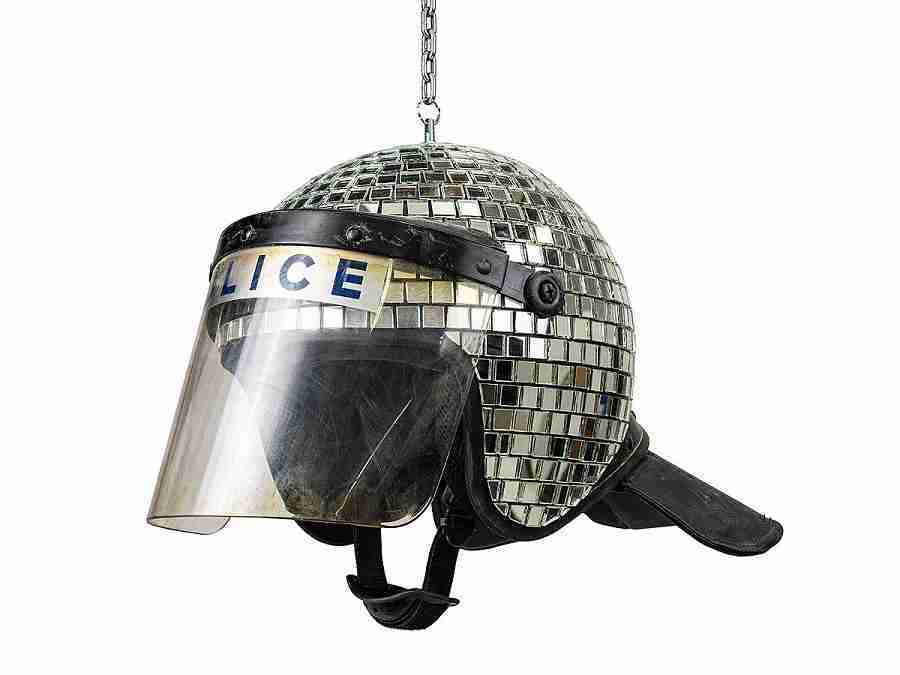
Met Ball. Seen in Banksy Explained.
Met Ball
Met Ball is a lighting system for the home. Made from an old riot police helmet, it is covered with 650 small expedites. It is signed on the inside. Limited edition of 15 units. Price: GBP 500.
On this occasion, Banksy wanted to play with two opposing worlds: the riot helmet represents the authority of the police and the rule of law, on the other hand, the disco ball symbolizes fun and leisure.
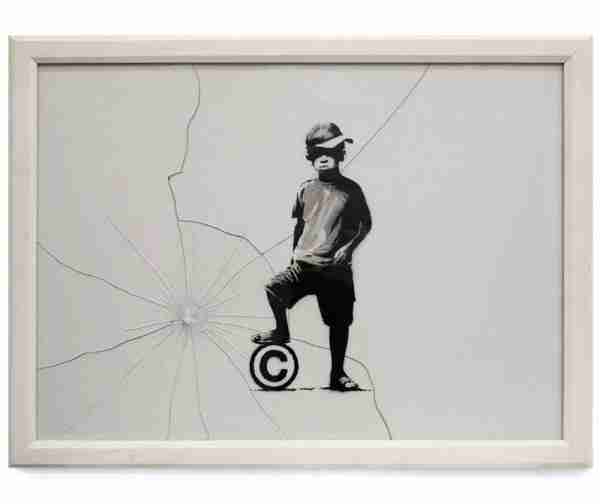
Copyright Child. Seen in Banksy Explained.
Copyright Child (2012)
This work by Banksy appeared on his Instagram account in 2012. There is no information about the original.
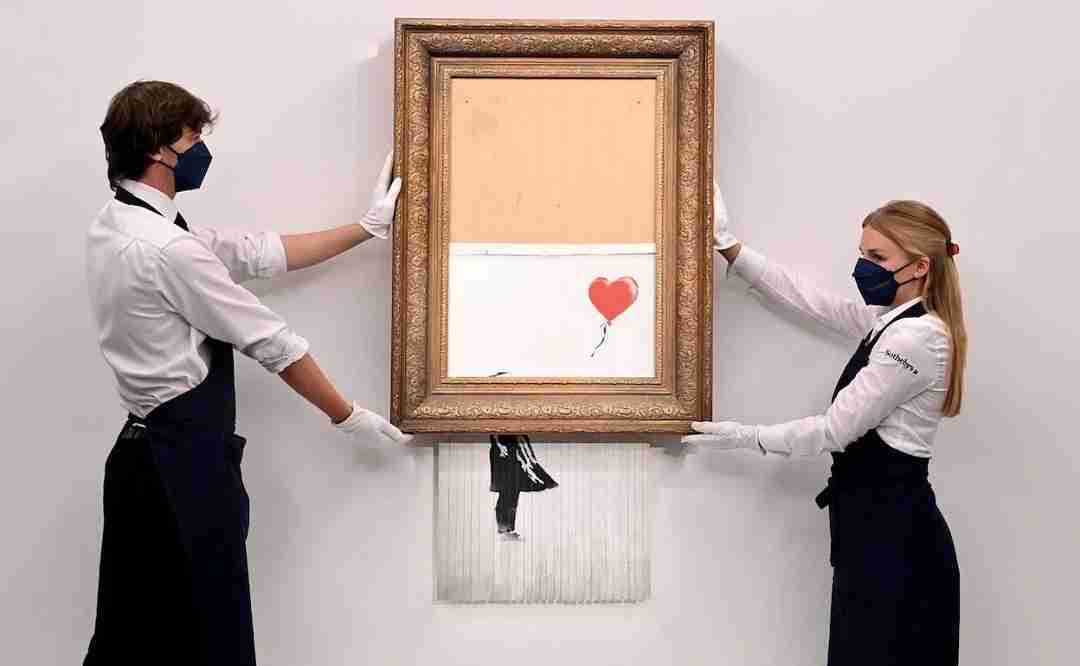
Love is in the bin. seen in the trade.
Love is in the bin (2018)
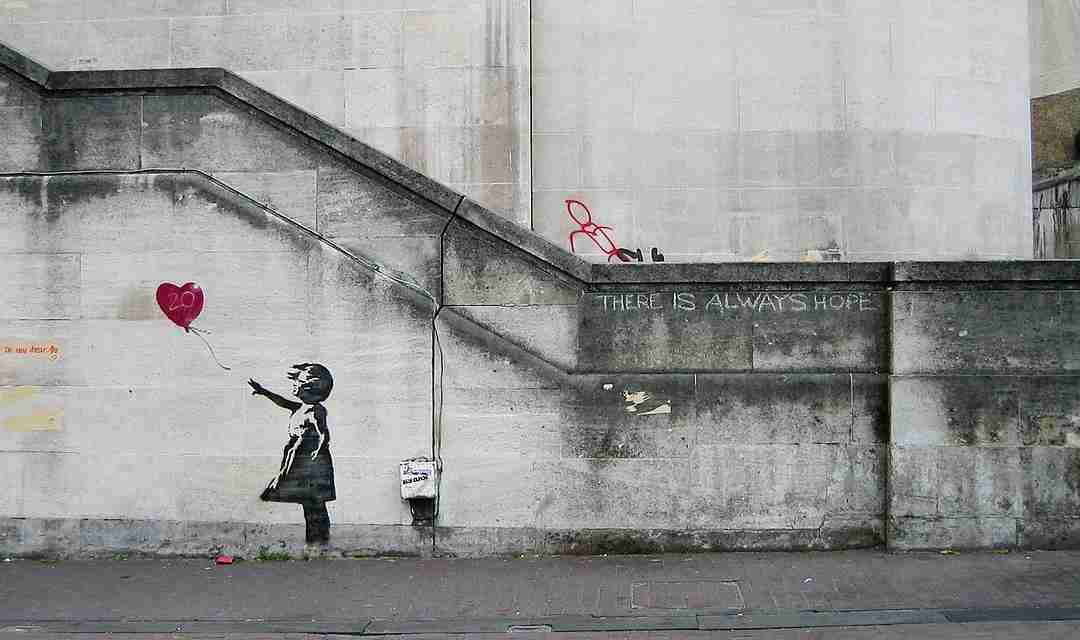
It’s a 2018 art intervention by Banksy at Sotheby’s. According to Sotheby’s, it is “the first artwork in history created live during an auction.” “Girl with a Balloon”, the original artwork unexpectedly self-destructed an instant after being auctioned. The damaged painting was renamed “Love Is in the Trash Can.”
He has been on loan to the Staatsgalerie Stuttgart since March 2019. In October 2021, it was sold at auction for £18,582,000, which Banksy donated to the British health system.
The Legacy
Today, it’s hard to imagine the art world without Banksy. It has revolutionized it, and not only because of its aesthetics, the message has been decisive in stirring consciences. In addition, remaining anonymous has provided him with that aura of mystery that increases interest in his work.
I don’t know what the street art of the future will be like, but I know that a large part of it will be based on the work of this anonymous graffiti artist from Bristol. I am convinced that tomorrow’s street artists will use humour, irony and satire about capitalism, politics and society.
I know they will hone their techniques and probably tackle other topics and issues. But I also know that, from time to time, they will look back and return to Banksy’s world.
Today, considered among the 20 most sought-after artists in the world, he is working on a new critical work. That is why, for his undeniable effort, I recognize his extraordinary value. Although I have not been able to meet the man, the artist has moved me. For me, Banksy will never be an unknown celebrity.
Information, bibliography and media
We use our own and other means with the availability allowed by current legislation and free access to the World Wide Web. (See Terms & Conditions)
Texts: Own, based on information from Alejandra de Argos, El Independiente, Infobae, OK Diario, The Museum, Wikipedia
Images: 20minutos.es, Banksy Explained, Banksy Unofficial, Binaural, Urban Distortion, The Independent, Trade, The World, Erratic Phenomena, The Nation, The Thermal, LeicesterShireLive, Claudia’s Travels, The Guardian, The Museum, Wikimedia Commons, Wikipedia.
- Girl with Balloon (South Bank) – By Dominic Robinson from Bristol, UK – Banksy Girl and Heart Balloon, CC BY-SA 2.0, https://commons.wikimedia.org/w/index.php?curid=73570221
- Girl with a Pierded Eardrum – By EniPort, CC BY-SA 4.0 <https://creativecommons.org/licenses/by-sa/4.0>, via Wikimedia Commons
Videos: s/n.





Thank you very much for the post, it’s amazing.