

In the Prodigious Mind of Thomas Feichtner
Earn 10.00 Reward Points by commenting the blog post
Introduction to Thomas Feichtner
Thomas Feichtner, an exponent in the world of Industrial Design, is the protagonist of this report. In the world of Design it is very difficult to work for brands that are very different from each other. Normally, designers specialize in one type of product: furniture, lighting, graphics, product, etc. This is not the case with Thomas Feichtner, who, in this discipline, has done practically everything.
Thomas Feichtner creates a design based on the simplicity, geometric lines and functionality of the piece. It makes no concession to the superfluous and ignores embellishments and filigrees. Minimalist? Of course. His exercise in synthesis is intense and he strives for the fundamentals: concept and function. Beauty then comes as a consequence of a series of unlikely intersections of lines, the formation of unusual angles and superb execution on suitable materials.
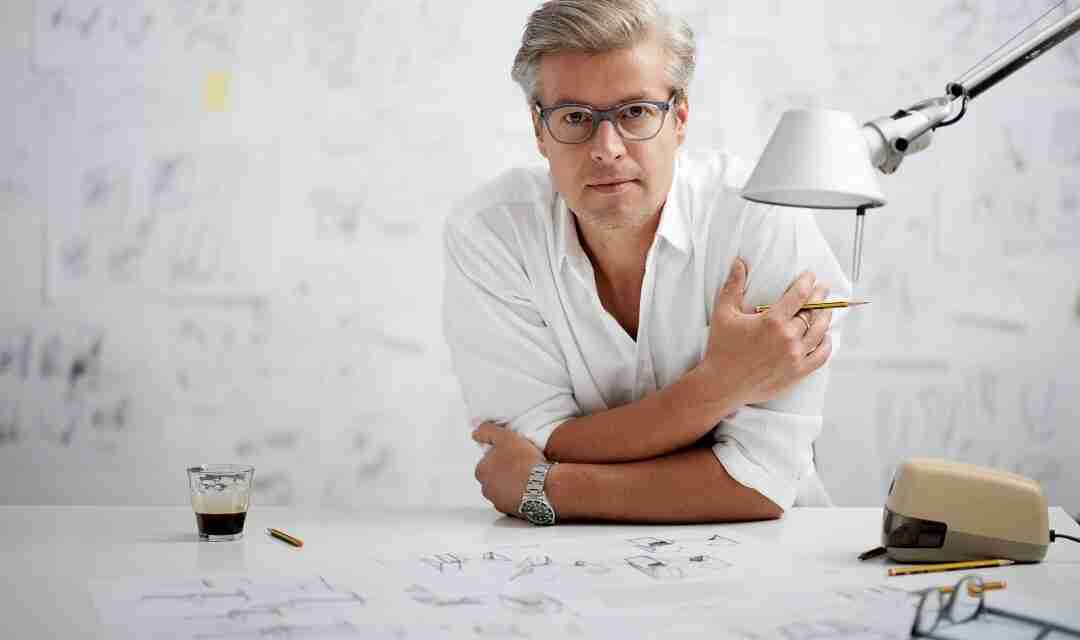
The pencil (he is a pencil magician) is his tool, his prodigious mind directs it with mastery until the formation of the piece. Their spatial vision and perspectives are simply admirable, they have an irresistible attraction and explain, with extreme clarity, the process of formation of the piece. In short, a delight. Check it out.
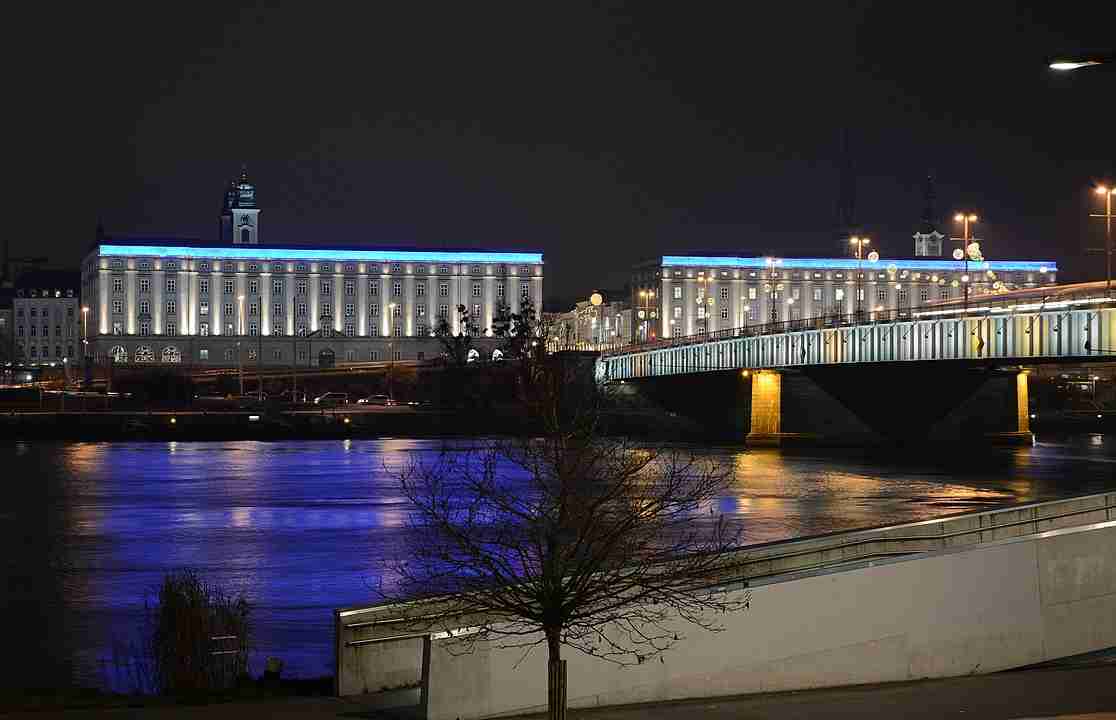
Universidad de Arte y Diseño de Linz. Por Isiwal.
Short Biography
Thomas Feichtner, born in Vitória, Brazil, in 1970, to Austrian parents, is an internationally renowned industrial designer. Director of the Institute of Industrial Design at the Joanneum University of Applied Sciences in Graz (Austria), he studied Industrial Design at the University of Art and Design in Linz.
International brands such as Swarovski, Laufen, Bene, Adidas, Head, Absolut, Lobmeyr and Augarten have published his designs. He has carried out projects in collaboration with manufacturers such as Vitra, Thonet and FSB.
His work, halfway between industry and craftsmanship, mass production and the unique piece, has been acquired by several design collections. He has participated in various international exhibitions such as the Milan Triennale, the Saint Etienne International Design Biennale or the MAK (Austrian Museum of Applied Arts / Contemporary Art in Vienna).
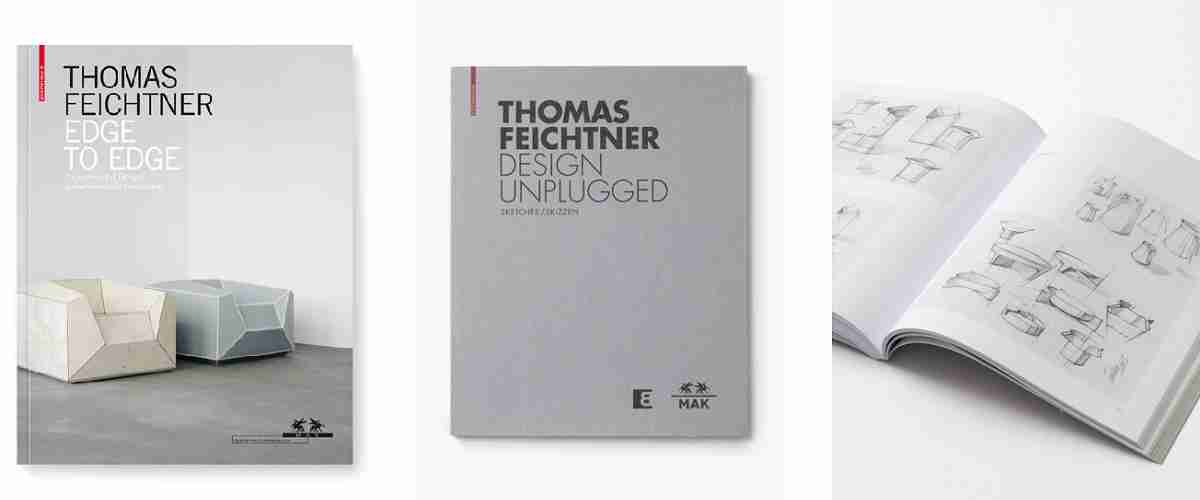
Thomas Feichtner has been awarded several international design awards. In 2011 and 2022 he received the Austrian State Design Award. From 2009 to 2014 he was Professor of Product Design at the Muthesius University of Fine Arts and Design in Kiel and since 2018 he has been a member of the board of directors of DesignAustria, the Austrian design association. In 2010 he published a personal monograph entitled “Thomas Feichtner – Edge to Edge” and in 2016 “Thomas Feichtner – Design Unplugged” published by the MAK.
He lives and works in Vienna and Graz with his wife Simone.

Exhibitions by Thomas Feichtner. 1 2 – Bildraum Bodensee, 3 – NWW, KAPO Showroom, Vienna, 4 – Triennale di Milano.
Exhibitions
Some of the exhibitions that Feitchner has made throughout his long professional career:
- 2015 – Triennale di Milano (Italy).
- 2014 – Arch Moscow, The Central House of Artists, Moscow (Russia).
- 2013 – ICFF New York 2013, Jacob K. Javits Convention Center: New York, USA
- 2012 – Helsinki Word Design, Suvilahti, Austrian Design Net, World Design Capital Helsinki 2012 (Finland).
- 2012 – Tendence, Frankfurt (Germany).
- 2011 – Barcelona World Architecture Festival, Advantage Austria Lounge, Barcelona (Spain).
- 2011 – 100% Design London, London (England).
- 2011 – MaisonObjet Paris, Parc des Expositions de Paris Nord Villepinte, Paris (France).
- 2010 – Musée d’Art moderne de la ville de Paris, Carnets d’inspiration, Paris (France).
- 2010 – International Biennial of Design, Saint Etienne (France).
- 2010 – La Biennale di Venezia, Longing for, Arsenale, 12. Mostra Internationale di Architettura, La Biennale di Venezia 2010 (Italy).
- 2009 – 100% Design Tokyo, Spot on Wien, Flashing Austrian Design and Music, Tokyo (Japan).
- 2009 – World Best Design Seoul, Korea (South Korea).
- 2007 – Tokyo Designer’s Week 2007, Blickfang, Tokyo (Japan).
- 2007 – ICFF New York, Pure Austrian Design, New York, USA.
- 2007 – IMM Cologne, International Furniture Fair, Cologne (Germany).
- 2001 – EXPO Hanover, Hannover (Germany). (IF Design Award 2000).
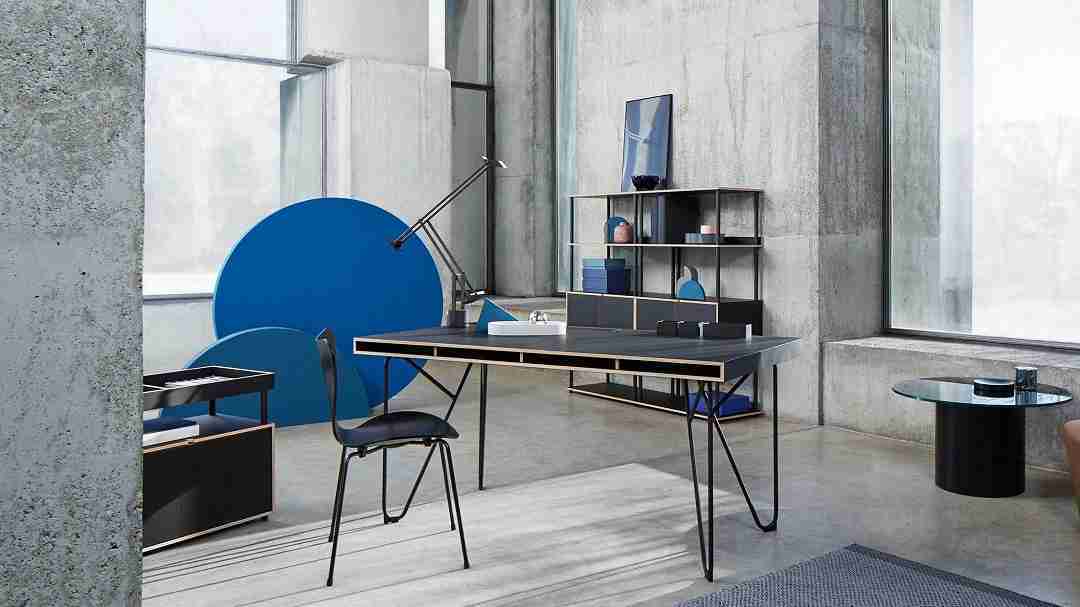
Thomas Feichtner’s Studio work system for Bene. German Design Award 2019.
Awards
Thomas Feichtner’s work has received numerous awards. Below we list some of them:
- German Design Award Winner 2019, German Design Council, Frankfurt, Germany.
- IF Design Award 2018, International Forum Design Hannover, Germany.
- reddot design award 2018, Design Zentrum Nordrhein-Westfalen, Essen, Germany.
- Good Design Award 2013, The Chicago Athenaeum, Museum of Architecture and Design, Chicago, USA.
- Interior Innovation Award 2012, Rat für Formgebung / German Design Council, Cologne, Germany.
- reddot design award 2010, Design Zentrum Nordrhein-Westfalen, Essen, Germany.
- European Design Award 2009, IDA International Council of Graphic Design Associations, Athens, Greece.
- Design Award of the Federal Republic of Germany 2007, German Design Council, Frankfurt, Germany.
- Gustav Klimt Prize 2004, Vienna, Austria.
- reddot design award 2004, Design Zentrum Nordrhein-Westfalen, Essen, Germany.
- IF Design Award 2002, International Forum Design Hannover, Germany.
- IF Design Award 2001, International Forum Design Hannover, Germany.

Newspaper display, created by Thomas Feichtner. Producer: Die Neue, Newspaper. Austria
Creations
Feichtner’s work is a compendium of good work and an exercise in minimalist design. From a process of conceptual reflection (function is the key element of the work), the designer exercises his pen with mastery, defining the scope of the piece in general terms. There is no doubt that observation is a prominent element in the creation process, which is why Thomas Feichtner makes several sketches of the piece before putting the team to work. Sometimes, he makes small scale models to validate the idea.
His creative process is clean, orderly and reflective, starting from a basic idea he composes a figure and studies the viability of his production. His extraordinary knowledge of craftsmanship and industrial production processes allows him, with the stroke of a pen, to identify the ideal material and the right production process for each idea.
His strong conceptual conviction has always led him along paths of economy, sustainability and durability over time. Their designs, I would dare to describe them as such, are forceful, elegant and simple (the most difficult). I have selected some of his works classifying them by their typology. Let’s look at them.

Neubau Chair, armchair designed by Thomas Feichtner. Production: Kohlmaier, Vienna (Austria).
Furniture
One of the main facets of Thomas Feichtner’s design. Its contribution to this segment is clearly inspired by minimalism and purity of designs.
Thomas Feichtner looks at furniture with an eye of renewal, generally hinting at unknown lines and shapes (FX1 or Loungue Chair), when he develops a conceptual series (Fino Collection) he looks for simplicity of design and pure lines. Also, as a result of his high knowledge, he likes to show the assembly or welding technique, making a nod to the craftsmanship of always.
Some outstanding pieces in this facet are:

A-Chair and sketches, Thomas Feichtner.
A-Chair
Proof of the exercise of synthesis that surrounds Thomas Feichtner’s work is this chair. The A-Chair is the pure synthesis: an interesting and studied beech wood frame (square section), allows the support of the back and forearms. The different pieces of the frame (for economy and sustainability) are glued together using a “sawtooth”, giving the whole a great solidity and light weight. A tribute to traditional carpentry.
Chair A was made in cooperation with the Bildraum Bodensee and the Werkraum Bregenzerwald. It was first shown in April 2016 as part of the exhibition “Thomas Feichtner / Design Unplugged” at the Bildraum Bodensee.
Date: 2016. Dimensions: 800 x 560 x 480 mm. (height x width x depth). Material: beech wood. Produced by: Schmidinger Möbelbau.

Basso, modular shelving system, Thomas Feichtner.
Basso, modular shelving system
This racking system, manufactured by Eternit AG and designed by Thomas Feichtner, is made of asbestos-free fibre cement . In this new version, since the 80s, cement has been agglomerated with AR (resistant alkali) fiberglass , improving its mechanical properties. Today, Eternit’s fiber cement is a material with excellent weather resistance, low weight and good rigidity. It is also a sustainable material, respectful of the environment and health.
Throughout history, Eternit has produced fibre cement furniture conceived by renowned designers and architects such as Le Corbusier, Willy Guhl or, lately, Nicolas Le Moigne and Rainer Mutsch. The project “Basso” with Thomas Feichtner, consists of 3 different elements. Stacked on top of each other or next to each other, these prisms are fixed by cylindrical wooden pegs. “Basso” works well indoors and outdoors and is suitable for storing books, folders, wine bottles or firewood.
Its design stands out for its simplicity and transparency. Its name comes from the beginning of Eternit’s collaboration with Thomas Feichtner in Milan, more specifically at the “Bar Basso”.
Date: 2012. Material: Fibre. Produced by: Eternit AG.

Fino collection, solid oak home furniture program. Design: Thomas Feichtner for Anrei.
Fino collection
ANREI is one of the oldest furniture companies in Austria (1894). Founded by Anton Reisinger, it has been producing solid wood furniture for generations. A common interest in traditional craftsmanship and contemporary design led to the collaboration with Thomas Feichtner.
On this occasion, Thomas Feichtner designed a complete collection of solid wood furniture. There are 18 pieces made of oak wood (dining tables, benches, chairs, wardrobes, shelves, a secretary, stools and side tables). The aim was to reduce weight, for which Feichtner devised a kind of chassis, a lightweight sub-construction that joins the legs with the rest of the elements (boards or seat surfaces upholstered in leather).
This “intelligent” connection gives the collection its own identity and the design, a greater sense of lightness, due to the interaction of straights, edges and legs narrowing towards the ground.
Date: 2013. Material: oak wood. Produced by: ANREI.

Fx10 Lounge Chair, armchair designed by Thomas Feichtner for Neue Wiener Werkstätte.
FX10 Lounge Chair
With the idea of creating a compact and seamless armchair, Thomas Feichtner designed the FX10 Lounge Chair. The name FX10 is actually the name of a ski binding that Feichtner previously designed for the ski manufacturer Fischer. Due to the great similarity of the approaches of both designs and in memory of ski bindings, this armchair bears the same name.
The FX10 Lounge Chair has several surfaces, each of which is upholstered and covered with leather. The surfaces come together to form a whole, like the ice blocks of an igloo. No seams or expensive machining required, the FX10 is quick to produce and is easy to repair by simply changing a surface.
In terms of shape, the FX10 Lounge Chair starts from a rectangular prism. The surfaces in contact with the body are formed by joining irregular polygons of 4 sides that coincide on one of their edges, forming a seat, backrest, armrests and leg rests. The top view and front view of this armchair look almost like a mirror. The key is two small triangles, the only surfaces that have three anchor points, which connect the seat shell and the base body.
The FX10 Lounge Chair is mass-produced in Neue Wiener Werkstätte and sold worldwide.
Date: 2006. Material: wood, leather. Produced by: Neue Wiener Werkstätte.

Studio Chair, chair designed by Thomas Feichtner for Bene GmbH
Studio Chair
When Thomas Feichtner designed the Studio Chair , he thought of absolutely everything. He made a chair that can be configured according to his use. The conception of the chair (the essence), is based on 2 curved plywood surfaces, one forms the seat and begins the backrest and in turn, supports the second piece that gathers the back.
In favor of versatile production methods, he devised 2 types of backrest, 3 types of legs (4-legged base, 2 skids or legs with wheels). The seat and backrest are available with or without upholstery (fabric or leather) and the base can be stacked or height-adjustable.
Undoubtedly, an exercise in brilliant, timeless and versatile contemporary design made for the German company Bene. The Studio series is completed by the products Studio Shelf (shelving system) and Studio Table (work and conference tables).
Date: n/n. Material: plywood, steel, leather and fabric. Produced by: Bene GmbH.

Table services designed by Thomas Feichtner. A Porcelain vase, Carafe jug and spice containers Saliera.
Table services
Objects that we use daily, that we see in living rooms, dining rooms and kitchens and that, in most cases, go unnoticed by us. We do not keep in our minds the image of the last salt shaker with which we season meat, the last vase with flowers we saw or the jug with which we pour cold water.
Our designer, Thomas Feichtner, has also dealt with these types of items and has grouped them under a generic heading that he calls “Table services”. I think it is right to bring them together under this heading, since, despite the different uses they represent, they are a graphic example of the place where they carry out their activity.
In this area, Feichtner deploys his know-how with elegant lines, with very studied intersections and eminently functional shapes. They are easy to identify because they maintain the “Feichtner essence”, characterized by their intersections and the formation of really attractive polygons. You don’t have to look far to find, right away, the basic concept that inspires each piece.

Absolut Feichtner glass, designed by Thomas Feichtner for the extraordinary Abolut Elyx vodka.
Absolut Feichtner
Thomas Feichtner was commissioned by Absolut Vodka to design a new glass glass for its best vodka: Absolut Elyx. Absolut’s new creation was a vodka distilled and rectified by hand in the original 1921 copper kettle. For Absolut Elyx, the brand wanted a new glass and cooler that would complement and underline the character of the new vodka.
The concept of the cup is based on previous designs, in which some pieces are supported on 3 legs. This is the case of the A Porcelain Vase vase for Augarten, the Fruit Bowl fruit bowl and the Linz hocker stool. In all cases, this “tripod” concept brings greater stability to each piece.
Feichtner comments: – “I am fascinated by the formal alternation between positive and negative, between breast and cosine. And here, I absolutely wanted to separate the body of the vessel from the surface on which it rests and thus also create a visually independent and self-sufficient object.”
The design then takes on an additional dimension: its geometric character invites exploration and touch. It is a glass that maintains a careful balance between weight, glass thickness and height, which makes it feel in the hand naturally.
The Absolut Feichtner cocktail is made with Elyx, a little wheat syrup, lime juice, a splash of Peychaud’s syrup and a punch of Angostura. It has a light body and a floral aroma that enhances the natural flavor of the vodka. It has a soft copper hue that links it to its origin: the nearly 100-year-old copper teapot No. 51 in Ahus, Sweden.
Date: 2014. Material: glass (suitable for dishwasher cleaning). Produced by: Absolut.

Absolut Cooler cooling vessel, designed by Thomas Feichtner for the extraordinary Abolut Elyx vodka.
Absolut Cooler
Following the general lines of the glass vase, Thomas Feichtner created the Absolut Cooler on the basis of a conical trunk figure made of aluminum with a copper finish.
Date: 2015. Material: aluminum finished in copper. Produced by: Absolut.

Fine, cutlery designed by Thomas Feichtner for Carl Mertens.
Fine
In the thirteenth century, in the German city of Solingen , iron swords and weapons began to be manufactured. Later, knives and cutlery would also be made from high-quality steel. The Solingen cucutería, since then, has been recognized worldwide. In fact, Solingen is the only city in the world that has its name protected as a trademark.
In 1919, Carl Mertens founded his factory for high-quality stainless steel cutlery there. Its products are endorsed worldwide and exhibited in museums such as the MoMa (Museum of Modern Art in New York). A tradition at Carl Mertens is to collaborate with designers in the creation of its collections.
The collaboration with Thomas Feichtner is all about bringing together traditional craftsmanship and contemporary design. The Fina cutlery is based on previous Feichtner designs, such as the Reset glasses (2008), the Shortcut tableware. The goal for Fina was that, over time, an emotional value would be created beyond its usefulness. The design concept is to create a formal connection between individual parts by means of elongated surfaces, narrow radii and pronounced geometric lines.
In all its pieces there is a contrast between the wide body and the thin handle. Hence its name: Fina, synonymous with slenderness and elegance. Fina was first exhibited as part of the Thomas Feichtner, Hands On Design exhibition at the Austrian Cultural Forum in London during the 2011 London Design Festival.
Date: 2011. Material: Stainless steel. Produced by: Carl Mertens.

Fruit Bowl, fruit bowl designed by Thomas Feichtner for Wiener Silber Manufactur, Austria.
Fruit Bowl
Thomas Feichtner, fascinated by the history of Viennese silver, designed this piece for Wiener Silber Manufactur. This bowl is not a rounded body, but a sophisticated intersection of internal and external surfaces.
Looking at the piece, it seems that the fruit could fall through the openings, but, in action, the fruit is wedged in the vertices. The aim is to reduce the contact surface of the fruit with the fruit bowl as much as possible, thus minimising the pressure area and, therefore, damage to the fruit.
Returning to the conceptual design of the piece, the organic shapes of the fruit contrast with the self-supporting structure with a three-legged base (again). With a “technical-futuristic” appearance, it follows the patterns of intersections and lines of Thomas Feichtner, who, for this occasion, recovering the historical concept of the fruit bowl, also turns it into a sculptural object.
The genius of the design lies in the production of the piece from a silver foil and a press. Extraordinary!
Date: 2010. Material: Silver 940/000. Dimensions: 170 x 170 x 200 mm. Produced by: Wiener Silber Manufactur.

Reset
Stamm, founded in 1859, is a publishing house of Austrian design and traditional craftsmanship. In collaboration with Thomas Feichtner and his “Reset” tableware, they have created studied glasses and containers in glass, porcelain and silver, combining contemporary design and the most careful craftsmanship .
The predominant note is the abandonment of the classic characteristics of the vajilla. All sidewalls taper towards the bottom edge, giving a lightweight appearance. Although the base is reduced in surface area, the structure is no less stable than that of another container of the same height. This is because the center of gravity of the part is shifted downwards, restoring stability.
In addition to the provocative design, Thomas Feichtner and Stamm added an additional plus of revolution by naming the collection “Reset”, hinting at a complete reset of the tableware concept and, in turn, promoting a new beginning for the Stamm brand. It was first presented at Vienna Design Week 2009.
Date: 2009. Material: crystal, porcelain and silver. Produced by: Stamm.

Different lamps designed by Thomas Feichtner: One Crystal Chandelier, Coma lamp, Pipes lamp and Tom lamp.
Lighting
Thomas Feichtner also develops his concepts and ideas in the world of lighting. Not as profusely as in other disciplines, but also in lighting you “notice” Feichtner’s pencil. Equally conceptual, dispensing with any ornament or filigree, he designs pieces of enormous simplicity (Balance Light) and of a very interesting versatility (Fractal Light).
In all cases, its accurate choice of materials, ease of production, lighting result and technological update (LED) stand out. He does not mind how the cable is seen and sometimes uses it as a structural element, demonstrating, once again, his commitment to sustainability and economy of materials.
Another very interesting facet of his contribution to lighting is the ease of working with various firms: Preciosa, Interio, Karboxx and J L Lobmeyr.

Balance
In 2009, Thomas Feichtner designed the Balance table lamp with a single light-emitting diode (LED). It was not until 2017 that LED technology made it possible to realize this conceptual marvel. The Italian manufacturer Karboxx together with Feichtner presented it at the International Furniture Fair in Milan that same year.
The lamp is reduced to a wire and a bulb. It is capable of illuminating the entire surface of the desk or directing its light precisely to a point. For this task there is no complex mechanical system or the right ofa reflector, no. Everything is simpler: place the lamp in a horizontal position. It’s simply great, with a simple swing of this lamp you can concentrate the entire beam of light on one point on your desk. On the contrary, that is, in a vertical position, the entire desk will be illuminated. The lamp maintains balance thanks to the rocking.
The construction process is incredibly simple, limiting itself to bending a steel tube and passing the cable through its interior. LEDs do not need a reflector to concentrate the emitted light, so it is easy to place it in the tube.
Date: 2009. Material: steel, LED. Dimensions: 53 x 30 x 16 cms. Produced by: Karboxx.

Fractal Light modular lighting system. Thomas Feichtner for Preciosa.
Fractal Light
Fractal Light System features an industrial aesthetic inspired by nature (tree branches). Endlessly patterned, Fractal is made up of metal branches and hand-cut glass plates , which provide crystal clear light. The tubular metal branches provide the artistic form to the lamp, while concealing the light source.
Fractal is, without fear of being wrong, a reinterpretation of the historic Louis de Preciosa lamp. Louis, a baroque cast brass lamp, is inspired by nature, like Fractal.
The chandelier comes in five different sizes. Individual pieces from Fractal are also available to achieve a contemporary style in a smaller space, or to group them into groups of three, five or seven pendants.
Date: 2020. Material: Steel, hand-cut glass. Produced by: Preciosa, Czech Republic.

Products designed by Thomas Feichtner: Binocular, Water bottle, Bath set and Marine Binocular.
Product
In the field of Product Design, Thomas Feichtner has also made his mark. He has developed some very interesting projects for renowned brands and the objects he has designed are highly appreciated by his users.
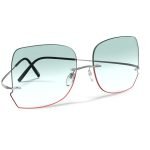
I would highlight its Room Door doors for hotel rooms, the My Silhouette glasses or the Ski FX10 bindings made for Fischer. In all cases, the Austrian designer has shown his know-how and his privileged vision when it comes to conceiving a new product or a reinterpretation of an existing one. We have also selected the following products:

Olympic Torch, Olympic torch designed by Thomas Feichtner for the 2017 Special Olympics Winter Games.
Olimpic Torch
The Special Olympics Winter Games represent the largest sporting event for athletes with mental disabilities. In 2017, Thomas Feichtner designed the Olympic torch for such an important event. It is a conceptual exercise based on the morphology of ice crystals, an identity element par excellence of the Styria region (Austria).
As a result of the meticulous observation that Feichtner always maintains, on this occasion, he based his concept on a hexagon (regular polygon with 6 sides), a figure that is present in every ice crystal. To obtain the torch he prepared three bodies of conical structure “in Crescendo”. The surfaces project onto each other like a mirror while the object tapers towards the lower edge. A game of surfaces full of lines and edges in a memorable approach. A design that gave the athletes and the Styria region its own identity.
Date: 2016 / 2017. Material: aluminum, steel. Produced by: Special Olympics Winter 2017.

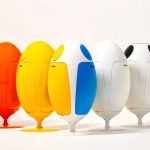
Pandoretta, a 360º sound system designed by Thomas Feichtner in collaboration with Poet Audio.
Pandoretta
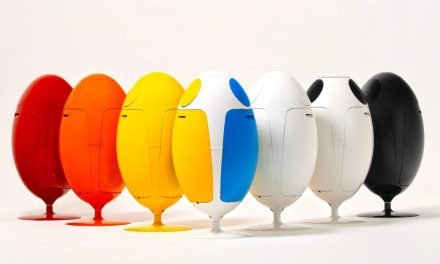
With the most advanced Bluetooth technology, the Pandoretta system allows you to play music wirelessly from smartphones and computers. Thomas Feichtner has designed this 360° sound system for Poet Audio.
With seven speakers and a 170-watt amplifier, it offers high-quality 360º sound regardless of the listener’s position in the space. Feichtner’s idea for this project was to consider the product as a musical instrument, i.e. to create an acoustic body that could project sound evenly and in all directions.
Pandoretta looks the same from every perspective. No control elements are visible (it is intended to be controlled mainly by mobile devices), even so, it is possible to control Pandoreta manually, through hidden control surfaces.
Date: 2013. Material: Stainless steel, oak wood. Produced by: Poet Audio.

Street Light, a lighting proposal by Thomas Feichtner in collaboration with CIS, Ecoworld.
Street Light
This project, carried out in collaboration with CIS (Industrias Cretivas Styria) and Ecoworld, shows us Thomas Feichtner in his purest form. 100% minimalism, conceptual design, simple, sustainable and easy to implement.
It is a steel tube into which die-cast aluminium modules (6) containing the lighting LED are inserted at a distance. The originality lies in the fact that, by gravity, they can be directed at will, directing the beam of light at our convenience.
Date: 2018. Material: Steel, injected aluminum. Project partners: CIS, Ecoworld.

Door Handle, handle designed by Thomas Feichtner for FSB
Door Handle
The FSB 5930 door handle meets the need to create ergonomic fittings that are soft to the touch and useful for opening and closing doors. On this occasion, Thomas Feichtner uses brushed stainless steel , which, in addition to attracting attention, surprises with a very pleasant touch. The edges of its design are visually appreciated but are blurred to the touch, helping the operation.
This design breaks with all the rules of ergonomics and axial geometry, surprising in turn, with a “different” ergonomics and an “unusual” feel.
Date: 2007. Material: Stainless steel. Produced by: FSB, Germany.
Jewelry
Some of them have been Thomas Feichtner’s forays into the world of jewellery and all of them bear his particular stamp. In this area, the designer prefers to mark “his territory”, preparing pieces with unlikely lines. Her jewellery provokes reactions and evokes architectural and geometric concepts, even though these geometries are “impossible”.
I have selected 2 of his works that eloquently explain the “Feichtner” style:

654 Bracelet, jewel designed by Thomas Feichtner for FAB-Atelier, Austria.
654 Bracelet
FAB Atelier is a company that produces jewelry exclusively in digital format. Thomas Feichtner initially designed this jewel as a 3D piece, later printed in silver using digital 3D printing technology.
The idea is based on stable constructions that are made with equal modules, such as honeycombs. The polygons, built individually, form a volume with minimal material consumption. The geometric play changes from a hexagon to a pentagon and a rhombus (6, 5 and 4 sides respectively), which explains its name.
Date: 2017. Material: Silver. Produced by: FAB-Atelier, Austria.

Spline Ring, ring designed by Thomas Feichtner for FAB-Atelier, Austria.
Spline Ring
Continuing with the idea of modular constructions, on this occasion, Thomas Feichtner surprises us with a ring based on 2 types of planes that are linked together. Meticulously designed, the coupling of all these pieces will result in a visually very attractive jewel.
The creation of the volume and, again, the configuration of different angles, allow this ring not to go unnoticed.
Date: 2017. Material: Silver, gold-plated stainless steel. Produced by: FAB-Atelier, Austria.

Some experimental projects by Thomas Feichtner: Crest, Sphere, Axiome Chair and Grazer Hocker.
Experimental
In Thomas Feichtner’s mind, ideas are brewing that, far from leaving abandoned in a drawer, he prefers to turn them into experimental projects. They either stir consciences, improve production processes or create new, more sustainable concepts. These are not impossible ideas but reflections that, sooner or later, will become reality.
Like the title of our article, Thomas Feichtner’s prodigious mind does not rest. In this chapter we have selected 3 experimental projects that will not go unnoticed in the near future. Let’s look at them:

A simple car, an experimental project by Thomas Feichtner.
A simple car
Interestingly, despite the fact that car manufacturers are offering more powerful and faster designs every day, the average speed of cars in cities is lower than that of carriages in the nineteenth century. Normally, a vehicle remains parked for 99% of its useful life, without fulfilling any function and wasting valuable space.
Thomas Feichtner has designed a concept car that aims to drive this debate forward. The proposal conceives a vehicle as a room on wheels, as a mobile workshop or a sales stand. The idea is to change the concept of the car, from being a status symbol to a fully functional object.
Date: 2020.

Carbon Chair, the carbon fiber chair designed by Thomas Feichtner.
Carbon Chair
Thomas Feichtner recurrently reuses concepts in his most advanced designs. I have seen this coincidence in the approaches on other occasions and in other designers. My impression is that, at a certain point, the designer has certain super clear concepts and it’s not that he reuses them often, it’s that they are part of his basic thinking. In the case of Feichtner, the use of three supporting elements in his pieces is often present.
When I studied geometry, our teacher (Gloria, to be precise) asked: Why will a three-legged chair never limp and a four-legged one does sometimes? You got it right. To form a plane you need 3 points in space, four points may not be on the same plane, but three, always. I don’t know if in the case of Thomas Feichtner he uses the 3 legs or supports for this reason, but you won’t deny that it’s a good reason.
In other cases, the designer looks for symmetries, although inverse, and uses them without blushing. For this occasion, after preparing the interior model using 3D CNC, he coated the mold with carbon fiber sheets, drawing a line from top and bottom, positive and negative. The result is a set of interior and exterior surfaces that is repeated in other works. 8 copies of this chair were made and it was part of the Austrian Design Pioneers exhibition during Milan Design Week in 2015.
Date: 2017. Material: carbon fiber. Dimensions: 870 x 1160 x 780 mm. Produced by: Thomas Feichtner Personal Editions.

Public Restroom, public baths for Promenaden Galerien Linz, Austria
Public Restroom
In 2017, the Promenaden Galerien Linz commissioned Thomas Feichtner to design the men’s bathroom. I didn’t want to design the space like an architect, but a single object, like a designer involved in the project. He designed 2 objects: an interactive sink and a piece of concrete as a repetitive wall covering. The toilet was rejected due to sanitary regulations in public buildings. However, the concrete element became the absolute protagonist of the project.
A piece design that, randomly rotated 90º, forms abstract surfaces of very suggestive three-dimensional geometry. The lighting together with the color of the concrete enhance an attractive and relaxing play of shadows . In addition, the relief of the surface participates in a calmer and calmer acoustics.
Date: 2017. Material: concrete. Produced by: Promenaden Galerien Linz, Austria.

Graphic by Thomas Feichtner: Dialogue of Cultures, Linz 2009 European Capital of Culture, Adidas Eyewear and Vienna Airport.
Graphic
Another facet of the designer Thomas Feichtner in which he reveals, once again, his privileged conceptual vision to convey a clear, simple and suggestive message. I insist once again on diversity as a differentiating element of the “Feichtner style”, combining airports, coins, typographies, culture and… I think any topic that is proposed.
One more reflection of the benefits of minimalism well understood. Judge these 2 works:

Euro Coin, design of the €2 coin commemorating the 20th anniversary of Austria’s accession to the European Union.
Euro Coin
Reverse of the two-euro coin commemorating the 20th anniversary of Austria’s accession to the European Union with different structures as haptic recognition elements.
Date: 2014. Material: brass, nickel and cupronickel.

Lencia, a typeface created by Thomas Feichtner
Lencia
In 2002, Thomas Feichtner began developing “Lencia” (at that time with the working title ” Linz Schrift”), named after his hometown of Linz (Latin: Lencium). Feichtner wanted a simple, non-add-on font based on circular segments with vertical and horizontal axes. He approached the project more as if he were designing a product. Lencia follows a grid of radii, angles, cones and intervals, with an optimal result in the recognition of each letter.
Unified styles for antlers, crossbars, sides, and protrusions. The height of the uppercase letters matches the lowercase ascendant, this provides a distinctive character when used in titles. The light, medium , and bold styles each use individual metrics, but are still homogeneous. In 2012 Lencia reappeared on the market with an updated version.
Lencia is available for download on Thomas Feichtner’s website. It is possible to download it for a free trial. It is not allowed to use the typography for commercial purposes. All rights are also reserved.
Date: 2002.
Books
There are two books that Thomas Feichtner has published and collected on his website, where you can also buy them.
These are 2 books about his creative work. The first of them: Thomas Feichtner, Edge to Edge, shows us some of the most significant works of the designer, with an excellent gallery of images and with a story commented by himself. The second of them: Design Unplugged, is an extraordinary compendium of all his sketches. Really impressive.
Opinion
As was predictable, the one who writes to them, on this, as on other occasions, has had fun. You may be surprised that, in the task of writing , one can have fun. And they may be right, and in reality have no reason to amuse. But, behind all this is the didactic work of our magazine and, you will not deny that learning is a privilege and, with an article like this, full of beautiful images, one gets an inimitable natural smile .
I already knew some of Thomas Feichtner’s works, but in the work of this article I have learned much more about this designer. On the one hand, I find very interesting his work with different manufacturers (very different from each other) and also his interest in various design disciplines. I thought that the minimalism of Walter Gropius or Mies Van der Rohe was very limited and was not prone to expand into other areas with good results. This is the case of Thomas Feichtner.
I like his conceptual simplicity in a special way, he looks for the essence in all the projects and when he discovers it he directs all the effort to synthesis, to what is important. His creations, halfway between the contemporary and the handmade, are always revealing. Objects that, by pure and stubborn reason, are irremediable, even if they are implausible.
Feichtner has rejuvenated me for years and has taught me to see, not with different eyes, but with a different attitude. Actually, with him I have learned to look, and now, with each of his sketches I understand his phrase “Design is an alternative, it is an expression of love for things”, for these things, among others, I now feel better.
NOTE: If you liked this article, you can share it on social media. You can also rate it with stars below. If you wish to leave a comment, ask a question or make any suggestion you can do so in the comment box below. Thank you for your attention!
Information, bibliography and media
We use our own means and other means with the availability allowed by current legislation and free access to the World Wide Web. (See Terms and Conditions) Texts: Own, based on information from Bene, Thomas Feitchner . Images: German Design Award, Thomas Feitchner. Videos: s/n.