




Philippe Starck, creativity without limits

Earn 10.00 Reward Points by commenting the blog post
Introduction
When we enter the world of Philippe Starck, we enter a dimension of design that the human being does not appreciate until he reflects carefully on the why of things. In our contemporary society, full of haste, evolution and competition, design is set as a standard. “Good design ” or ” it’s poorly designed” are phrases we often hear pronounced. However, we overlook that design, like our society, has evolved, becoming an indispensable element for the use of things.
The designer interprets the object, light or space in an assumption of use. Study what would happen if you closed the curve of the handle of this cup a little more, since, a little smaller, it might not be practical for large fingers. There is no doubt that the evolution of design, with current technology, has led us to contemplate details that long ago would not have even been considered. Great designers have changed design, making it a discipline as important as architecture, fine arts or engineering. It is no longer enough to present beautiful things, it is necessary to confirm their good use, their sustainability, their duration over time and their social validity.
Philippe Starck entered the world of design and changed it. Not only did it become an icon of design, but it revolutionized concepts that we believed to be imperturbable such as good use, providing values such as versatility and versatility. A visionary?
Philippe Starck, biography (excerpt)
“My father was an aeronautical engineer.For me, that made invention a must.” Philippe Starck.
Born in Paris on January 18, 1949, he studied (he confesses with some apathy) at the Nissim School of Camondo. In 1969, interested in living spaces, he designed an inflatable structure that became his first success at the Salon de l’Enfance. He states , “There is no job in my life!There is only play, curiosity, generosity and vision.” Pierre Cardin succumbed to his iconoclastic design and appointed him Artistic Director of his publishing house.
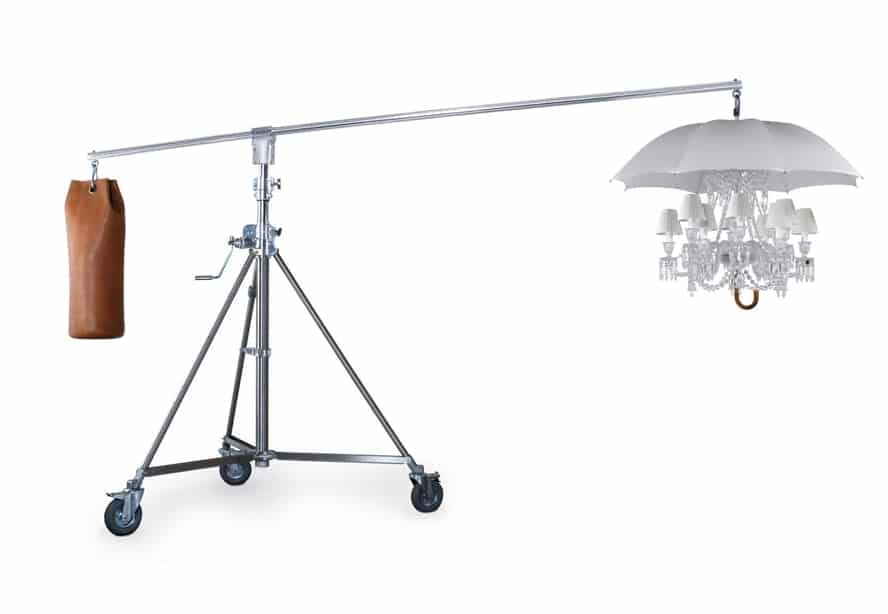
A floating lamp and a portable neon sign were the anteroom, in 1976, of the bold decoration of the nightclub La Main Bleue (Montreuil). In this project, Starck proved that all places are respectable, including those endowed with excenctricity. Subsequently, he completed the legendary Parisian club Les Baines Douches and the Starck Club in Dallas. His first Industrial Design company, Starck Product, was created at the same time, and he began collaborations with the companies Driade, Alessi, Kartell (Italy) and Drimmer (Austria), Vitra (Switzerland) and Disform (Spain).
1983 was the year of his public confirmation as a designer, as the President of the Republic of France, François Mitterrand, commissioned him to decorate his private residence at the Elysee Palace. The following year, the elegant and functional project of Café Costes became the place par excellence. In 1988, the Teatriz restaurant in Madrid shook the whole society of the moment by presenting a multipurpose space with elegance, dynamism and surprise.
In 1991 he participated in the construction of the Groningen Museum. At the end of the 90s he created the catalogue Good Goods de La Redoute, confirming that his spectrum of action is enormous.
More than 10,000 creations to his credit make him a prolific, tireless and inexhaustible designer. His ideas flow at the speed of light and turn design into child’s play in which only he knows how to play.
Design philosophy
I would not know how to explain Philippe Starck’s design philosophy without going into concepts such as freedom, democracy, emotion or surprise.
For Phillipe Starck, man has enough capacity to choose his options, so Starck’s concept of freedom does not invade, it does not encourage. He leaves on the table the drawing of something useful, which not only surpasses the existing, he reinterprets it under a sophisticated neutrality with absolute naturalness. It seems contradictory, right?, but it is not.
It combines the most exquisite luxury in a low-cost everyday object , making truly democratic what seems to be unattainable, achieving very intense levels of emotion . Discovering that a juicer can be an alien in your cupboard, is not only a surprise, but a delicate invitation to drink a unique juice.
I clearly detect the ease of putting himself in the place of others that Starck has. Its main premise is the benefit of the user. What does the user gain from my design?, seems to be the starting point of all his creation. Also, we must highlight his deep empathy and his ” mischievous” vision of the world of design, turning everything into a game to which you are always invited.
I know he would like to do more things although, the diversity of his work is so wide that it leaves few gaps for the competition. He has no limits, he faces any challenge with the naturalness and humility of a novice transmitting an emotion that intoxicates. You have made small objects, buildings, hotels, yachts, lamps, chairs, restaurants, catalogs, smartphones, bathroom toilets, kitchen accessories, cutlery, motorcycles … Does anyone give more?
Diseños icónicos
No es nada fácil establecer unos pocos diseños icónicos de Philippe Starck. Su creación es tan amplia que hay que elevar el número de obras que han pasado ya a la historia como obras maestras. He tratado de recopilar sus mejores proyectos ordenados por tipo de producto: Mobiliario, Diseño Industrial, Iluminación y Vehículos. También he incluido imágenes de todos ellos para poder visualizar la extraordinaria obra de este diseñador.
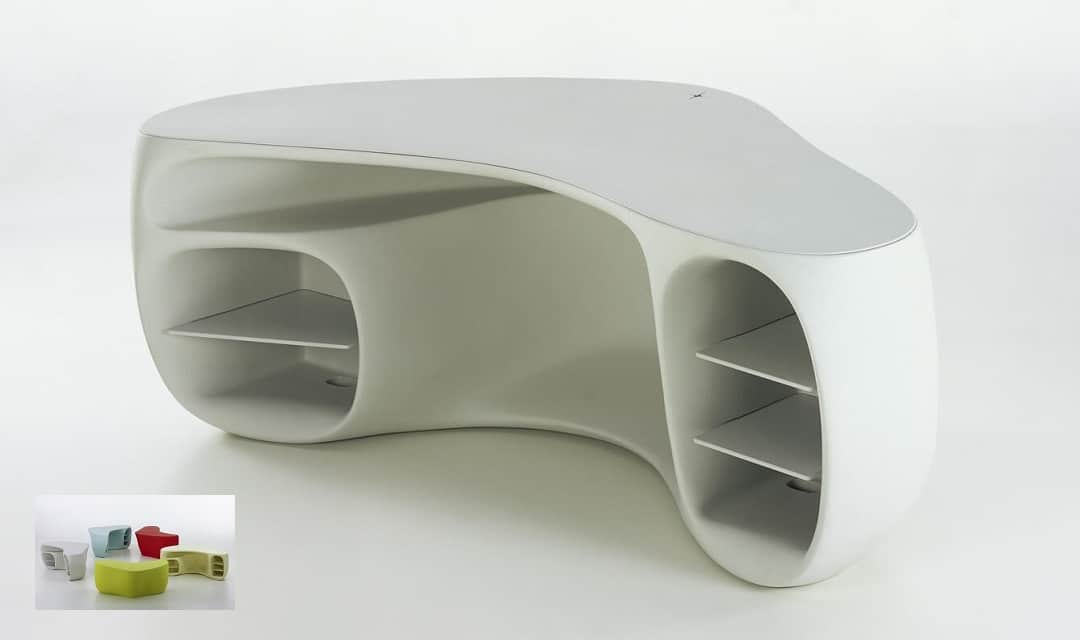
Baobab desk (Vitra)
It is surprising, of course, this work of the early twenty-first century. In this design we see Philippe Starck at its best, turning a section of the trunk of the African Baobab tree into a protest sculpture, a nod to African culture where, around this tree, the great meetings of the tribe are held. A total break with the classic desk made with only one material: plastic. A technical revolution: only 2 pieces and 3 shelves.
Beware, curves are coming! All curves, only 2 planes: the lower and the upper. The lower part, or body of the desk, provides stability, allows wiring and has 3 storage areas with or without shelves. The top, or lid of the table hides the wiring distribution system of the appliances that will remain on the desk. The slight interior concavity of the desk gives the user a plus of defense against his companion, who will remain some time absorbed in the contemplation of this masterpiece of design. Despite its volume, Baobab is light, hollow. Dimensions: 175x120x72 cms. (width x depth x height).
Baobab stands out, in its genre (furniture), for the concern in the economy of materials, the simplicity of the design and its assembly and the provocation of the new, asking for quick step. The range of colors (White, Cream, Tomato Red, Sky Blue and Pistachio Green) contribute very actively to this provocation.
Too bad Vitra no longer produces this beautiful desk, although knowing them, who knows? Maybe they reissue it. There are some used units or exhibition pieces for sale, I have located some with values ranging from € 450 to € 2,500.
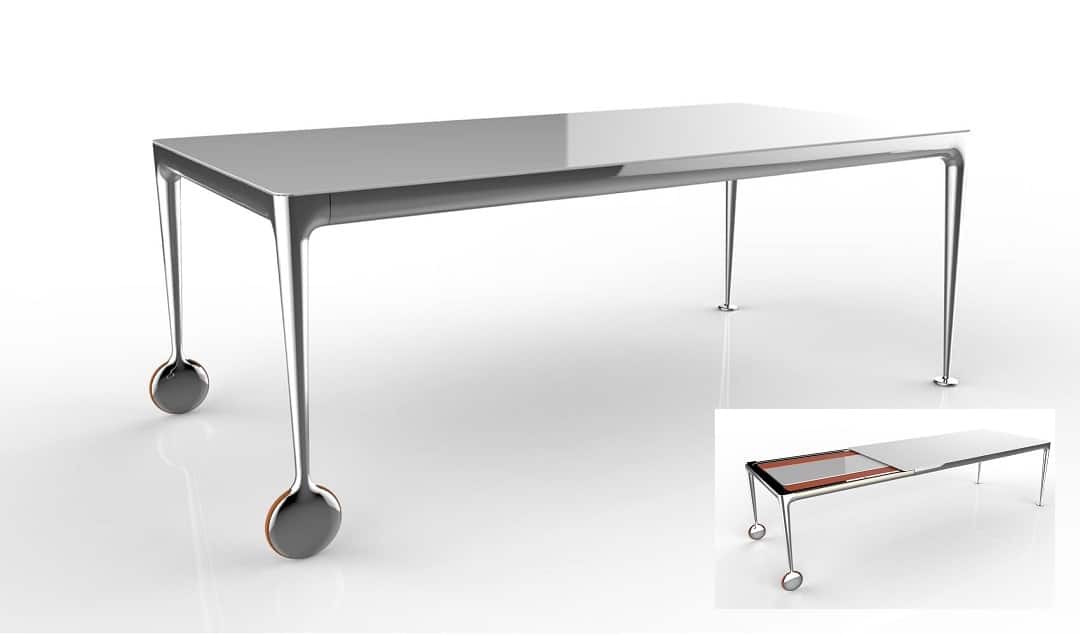
Extending table Big Will (Magis)
The best hosts prefer the Big Will extendable table because, with it, ” when there is room for six, there is room for eight” (Philippe Starck)
Surely one of the most elegant designs of the French designer, Big Will starts from a cast aluminum frame polished or lacquered finish. Their legs are a slender exercise and approach the ground threatening to cross it, giving a feeling of maximum lightness to the table. Two legs are finished in small discs and will remain static at the time of extension. The other two, which end up wrapping a narrow orange or black rubber wheel will shift to increase the size.
The table top can be made of reinforced glass (glossy or satin), wood (American walnut or bleached oak) or stoneware (Calacatta or Marquinia). The extensions, which are stored under the board, are lacquered MDF (glossy or satin). Everything is prepared so that both the board and the extensions are perfectly flush with the aluminum stringers, protecting, in this way, the finishes. The 4 corners are rounded.
The dimensions of Big Will, in its extensible format, are: 200/250/300x100x75 cms. (Length x Width x Height). Prices? From 3.237,00 €.
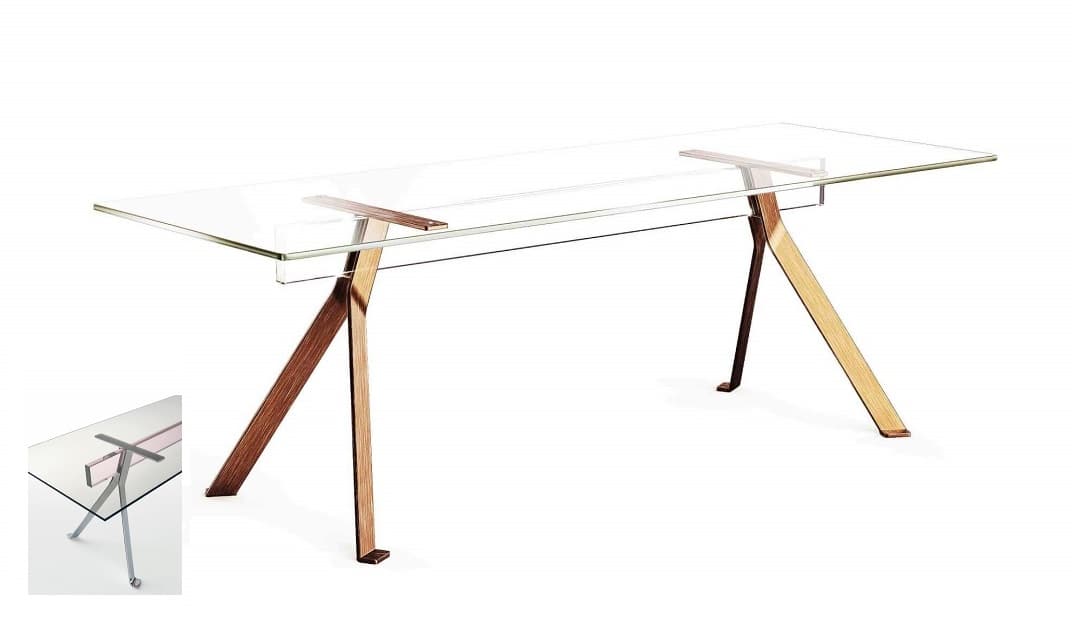
Table Mari Cristal (Glas Italia)
A sample of how Philippe Starck works with all materials, in this case glass. This table, always rectangular, features a 12.0 mm transparent tempered glass top. thickness, although it is also available in laminated glass 6+6 mm . colored with light yellow, light gray or light pink sheet. Its edges are perfectly beveled and the edges frosted, being very pleasant to the touch.
This impressive glass board rests on 2 easels of stainless steel, either polished or lacquered satin bronze. These easels are joined by a stringer also made of laminated glass 19 + 19 mm . with transparent intermediate sheet or with the optional colors of the yellow, gray or pink board. The easels have an accommodation that will cross the glass stringer. On the lower face of this accommodation accommodation there is a prisoner screw with allen head that, together with a silicone pad, will firmly hold the easels to the spar. On the arms of the easels, two small transparent silicone metopes will allow the glass board to rest on the whole and give it the solidity of its weight.
The lightness of this design, provided by the glass stringer and the stylized easels, does not miss the ” architecture” of this table. We are facing the architectural facet of Starck, inclined pillars, main beam, corbels and board. Dimensions : 200/220/250 x 80/90 x 72 cms. Price: around 4.400,00 €.
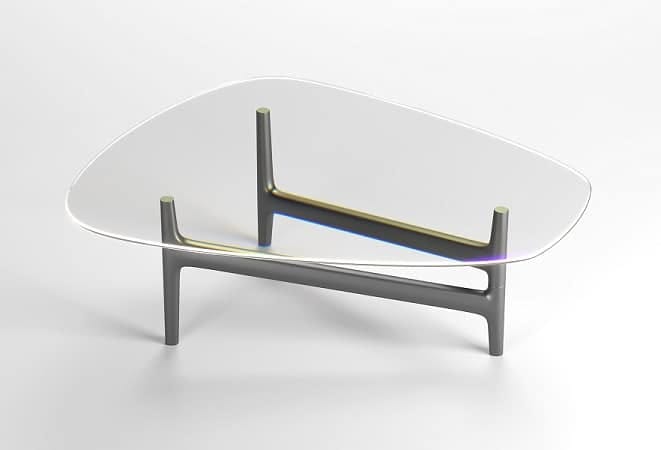
Table Rae Orrgray (Kartell)
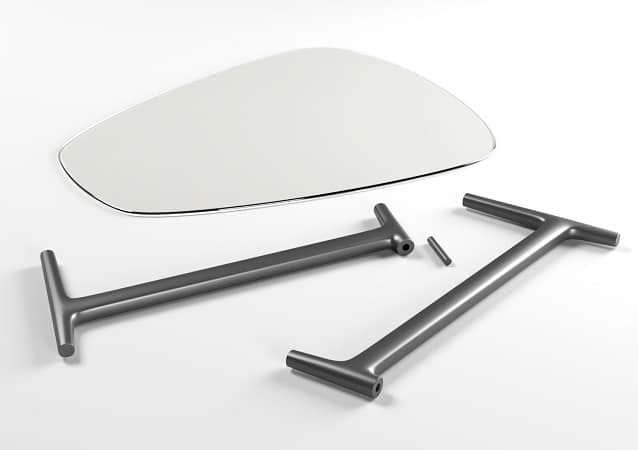
Too bad that Kartell (editor of this beautiful coffee table) no longer produces it, because it is one of those design games that Philippe Starck likes very much. Starck, on his website says: “Rae Orrgray isn’t a table, it’s a mind-building game. As we approach function, practicality and the minimum, we always find elegance.”
Rae Orrgray is composed of 4 pieces: A glass lid with a regular curved shape, two equal pieces of injected polycarbonate and a small metal cylinder. It is ideal to live next to the sofa, it is elegant, timeless and its structure takes us to the world of geometry. Why? Two identical pieces form, united, 6 points of support equidistant 2 to 2, or what is the same, 2 parallel planes. The glass lid (transparent or gray) is a regular trapezoid with its rounded sides, bringing its figure closer to the triangle that forms the structure. More for less? Impossible.
Mac Gee Shelving (Baleri Italia)
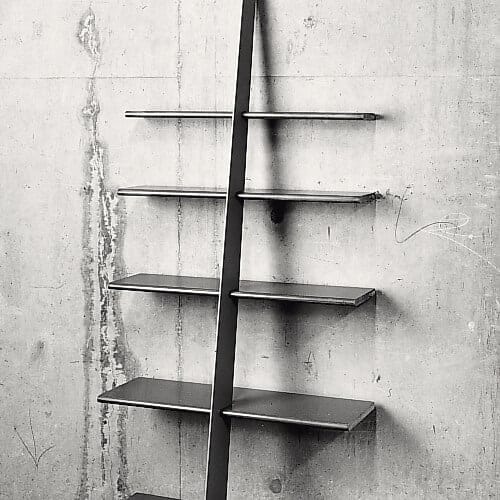
The particularity of this shelf is the vertical post that supports it, which, like a keel, collects the shelves in a decreasing way.
Made entirely of lacquered steel, white, metallic gray or black , it consists of a central pillar of triangular section, with horizontal notches to locate the shelves. The shelves flush with the wall and are located inside each internal notch of the pillar. The central pillar is fixed to the wall and floor with two metal discs. The measures of a module with a pillar and five shelves is 99 x 235 x 51 cms. (width x height x depth).
Armchair Louis Ghost (Kartell)
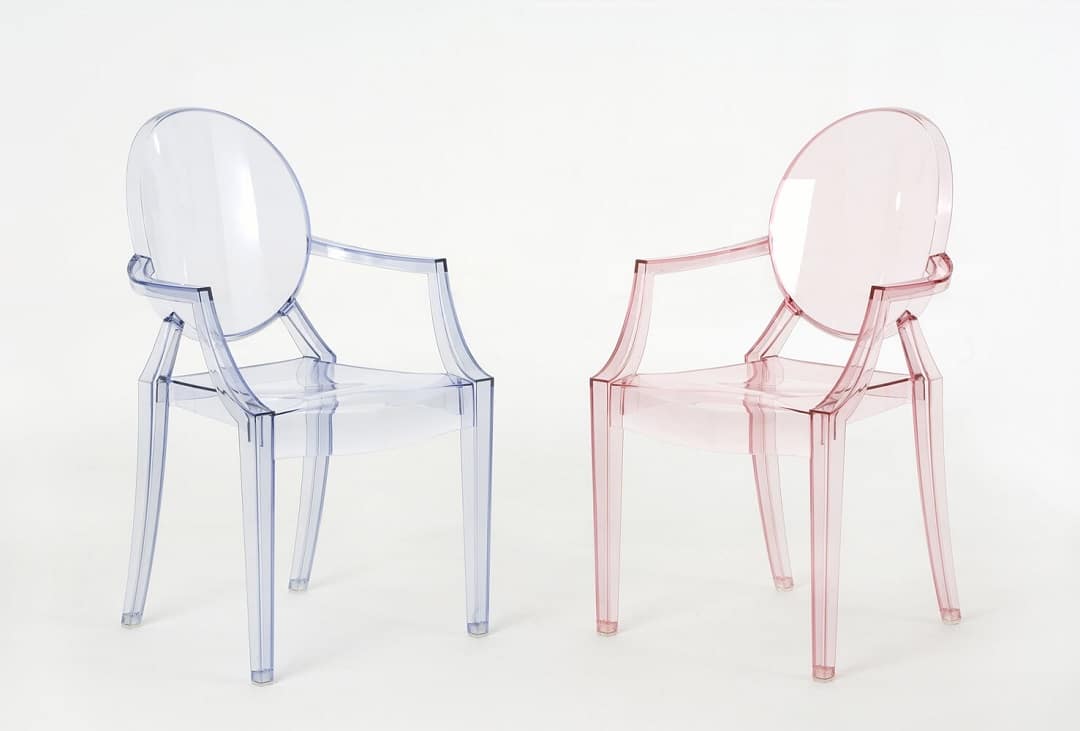
Philippe Starck’s constant concern in relation to sustainability, the economy of materials, space and his desire to “democratize” design, were surely concepts that he put on the table when designing Louis Ghost. A single material (Polycarbonate 2.0), a stackable armchair, a democratized reminiscence of luxury in the French Baroque monarchy (Louis XV) and a contained cost , are the concepts and elements that, 20 years ago, created this iconic transparent or translucent design.
The result has been a break (one more!) in the concept of strength/weight. The chair is made, in a single mold, with transparent injected polycarbonate, or dyed in mass (translucent), it is very resistant, as well as stable. It also supports atmospheric agents. It is stackable up to 6 units. As an additional contribution, it has an ISCC Certificate. Under minimum order of 10 units can be customized. Available in 8 colors, it is accompanied by other formats such as stools and chair without arms. Dimensions: 54 x 93 x 55 cms. (width x height x depth). Weight: 4.8 kgr. Price (2 pcs.): 720,00 €.
Adela Rex Chair (Andreu World)
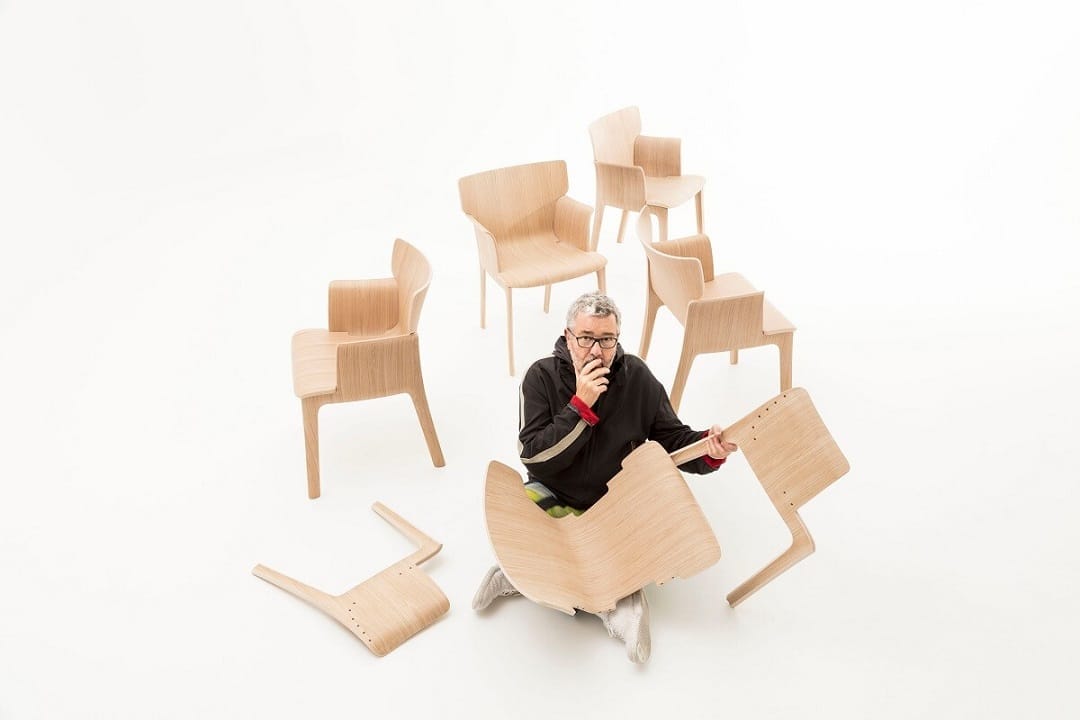
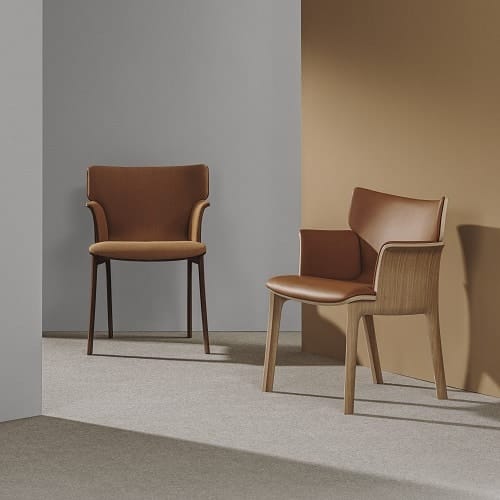
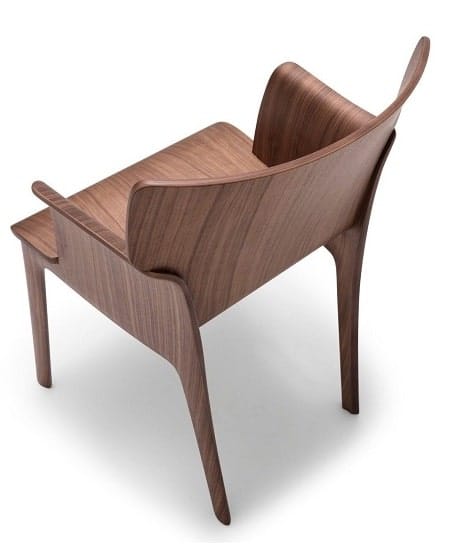
In his first collaboration with Andreu World, Philippe Starck made a design with a single material. Only wood, 100% plywood, FSC certified and treated with the care of the best master cabinetmakers. Deploying all its conceptual arsenal: sustainability, technology, economy of materials, simplicity and functionality, solves this chair worthy of the RedDot Award 2022.
Adela Rex is sustainable because its origin, plywood, is obtained from slow-growing reforested forests. Finished in tinted oak veneers (3 colors) or walnut, the plywood is carefully molded (in a display of precision) to achieve perfect curvatures. Seat and backrest share piece and two others, with legs and armrests, make up the chair (3 pieces in total). Nothing else. There are no hardware or additional elements. Only the essence: matter. In this same way, without hardware or additional elements, a whole series of seats and tables has been developed that surprise with their elegance, purity and sustainability.
Adela Rex is also available with textile or real leather covering. In its basic variant it has the following dimensions: 560x800x570 mm. (Width x Height x depth). Weight : 8,5 Kgr. Price: from 629,00 €.
Armchair Lou Speak (Driade)
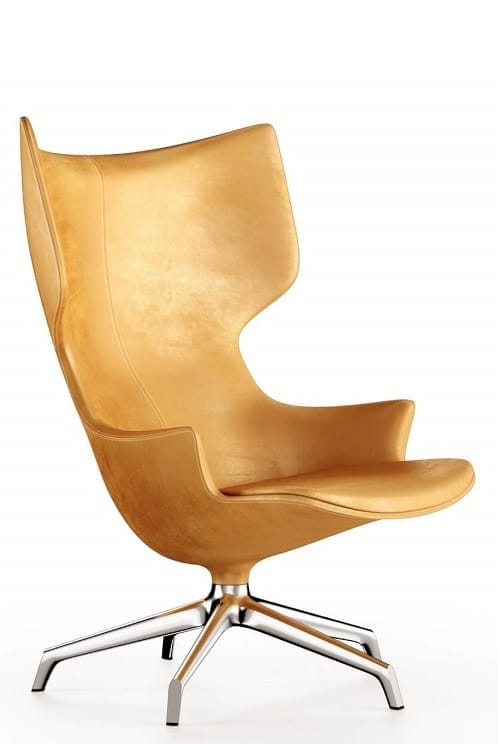
This comfortable, enveloping and slender armchair is a creation by Philippe Starck complementing the Lou series by Driade. It stands out for its elegant curvilinear silhouette and its wide headrest. Sitting in Lou Speak everything is better and you sure will strive, in Starck’s words, to “raise the level of your conversation“. You can go to any contertulio looking into their eyes since Lou Speak is rotating.
A lightweight polyurethane foam shell, reinforced with a steel rod structure, will be clad with a delicate upholstery or elegant footl. For the seat is used a cushion properly padded and covered with the same material. All this set rests on a cast aluminum foot polished mirror finish 5-arm. Dimensions: 83 x 109 x 79 cms. (Width x Height x Depth). Price: From 3.000 €.
Starck Biotech glasses (Luxottica)
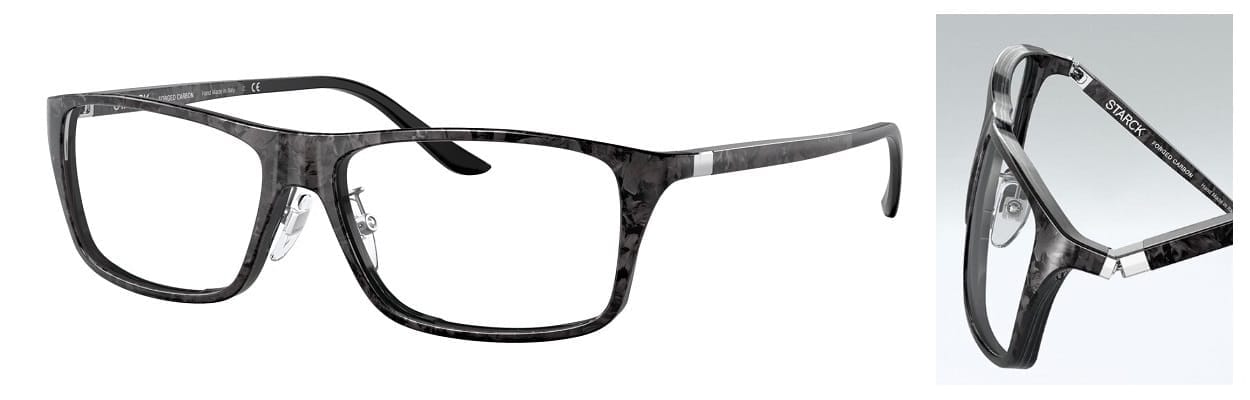
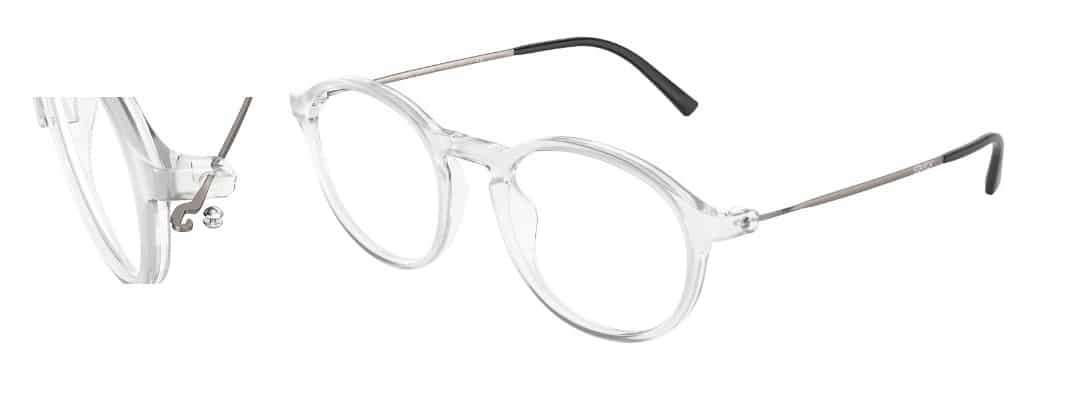
Fully in industrial design, on this occasion, Philippe Starck surprises us in the world of optics. Its technological contribution in this regard is impressive, a revolution in the world of frames for glasses, a display of innovation. In 1996 Starck engaged with the firm Alain Mikli to design the forward-thinking tool.
From this union of criteria a new optical concept was born: Biovision. Conceived on the human well-being, the Biovision provides better solutions to eyeglass frames, reduces its weight, uses new materials (carbon fiber, titanium, polymers) and in smaller quantities, it adopts new forms and the new biomechanical hinge BIOLINK®(inspired by the human shoulder joint), which also provides a 360º free movement to the temples (greater comfort and flexibility).
In November 2019, the new articulation: SPHERE® (a 0.07 gr. stainless steel sphere, lowered between tropics), connects an ultra-thin titanium rod with a part injected with the new Gravity Evo® polymer. Everything done by hand in Italy, dispensing with screws and welds, get frames of only 15 grams!
There is a wide range of frames (metal and resin), with BIOLINK® or SPHERE® articulation (Red Dot Award 2022), available from optical distributors of Starck Biotech Paris, belonging to the Luxottica group, consult. Prices: from 230 €.
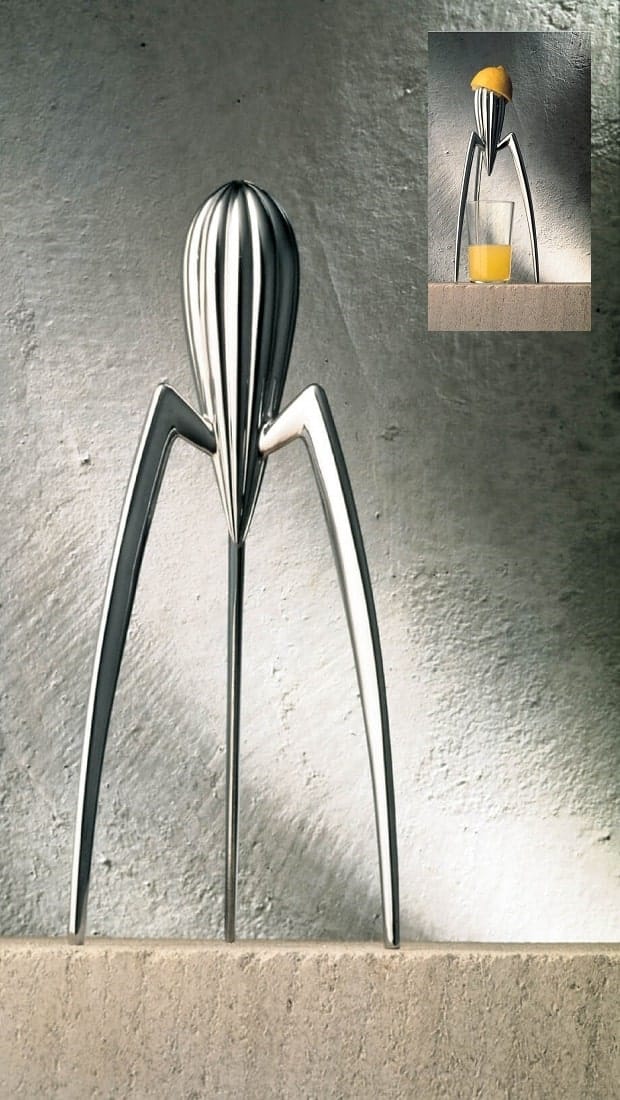
Citrus juicer Juicy Salif (Alessi)
Surely Philippe Starck’s best-known industrial design and the one that has most elevated his reputation in this discipline. Sketched on the individual tablecloth of a pizzeria, it responds to a request from Alfredo Alessi to create a butter shop… (Starck in its purest form!). Since 1988 he has been the protagonist of many conversations, a huge bestseller and an icon of contemporary design.
Today, it is studied as an example of universal design. It corroborates Starck’s style: simple, surprising and eminently functional for what is required: obtaining juice. Versatility is never going unnoticed.
Made of cast and polished aluminum , it professionally fulfills its mission, allowing the glass to be deposited between its legs and removed comfortably. The juice slides through his body and, for the most demanding, nothing spills. Dimensions: Ø 14 cms. Height: 29 cms. Price: 79,00 € (VAT included).
Gun Floor Lamp (Flos)
The Gun (pistol, weapon) design begins in 2005 in collaboration with Flos. The most combative and committed Starck made this series of provocative lamps as a pacifist protest in favor of the underdeveloped world ravaged by wars. It should be noted that 20% of the profits of this lamp have been donated to the NGO Fréres des Hommes.
The base is circular, lacquered black or matt white, or plated in 18K gold. It distinguishes a cast aluminum body replica of an M16 assault rifle (Other models of the series replica the legendary Beretta pistol or the Kalashnikov AK47 rifle), finished as the base. The screen is made of matte black laminated paper with its interior screen-printed in gold or gray. The lighting is direct and ideal for reading on the sofa. The lamp is halogen of 250 W (not included), the cable is 1.5 meters and contains a current regulator. Dimensions: Base Ø 386 mm., Screen Ø 560 mm. Height 1694 mm. Weight : 19,2 Kgrs. Price: Consult.
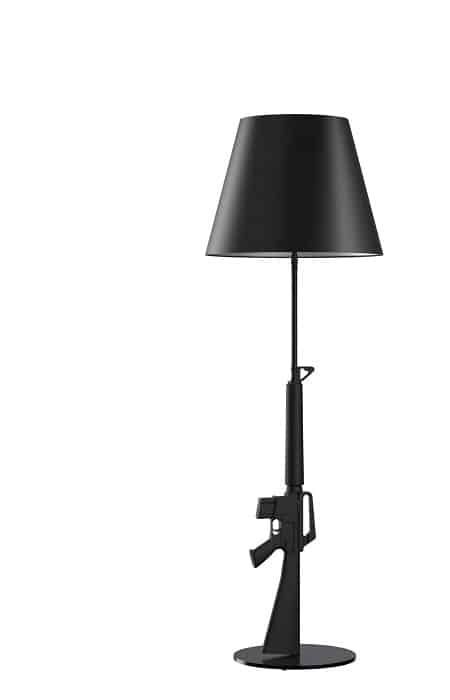
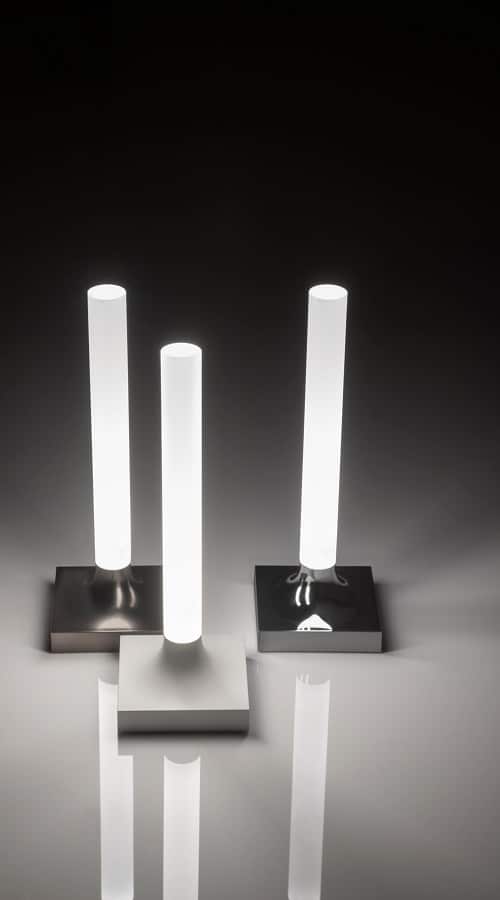
Table lamp Goodnight (Kartell)
The Goodnignt lamp is inspired by the straight candle, the wax or paraffin candle that we use in a chandelier. The same candle that we put on the table of a romantic dinner, looking for an intimate atmosphere with warm and soft reflections. Starck brings out his most nostalgic version and recreates the bar candle in an exercise of soft, eloquent and technological design.
From PMMA (Polymethylmethacrylate), PP (Polypropylene) and recycled metallized or painted ABS Starck reproduces an elegant candle. Its square lacquered or metallic base (matt white, champagne, copper, matt titanium or chrome) rises to become a cylinder that begins the “candle”. The candle is completely cylindrical and houses a 1.6 W Led lamp inside. It is a lamp with a USB rechargeable battery, so it will remain cordless on the table. It has 3 intensities that are regulated with the finger on the base, as well as its on and off. There is outdoor version and wall lamp . Dimensions: Base 97 mm. Height: 290 mm. Weight : 0,35 Kgr. Price: 247,00 €
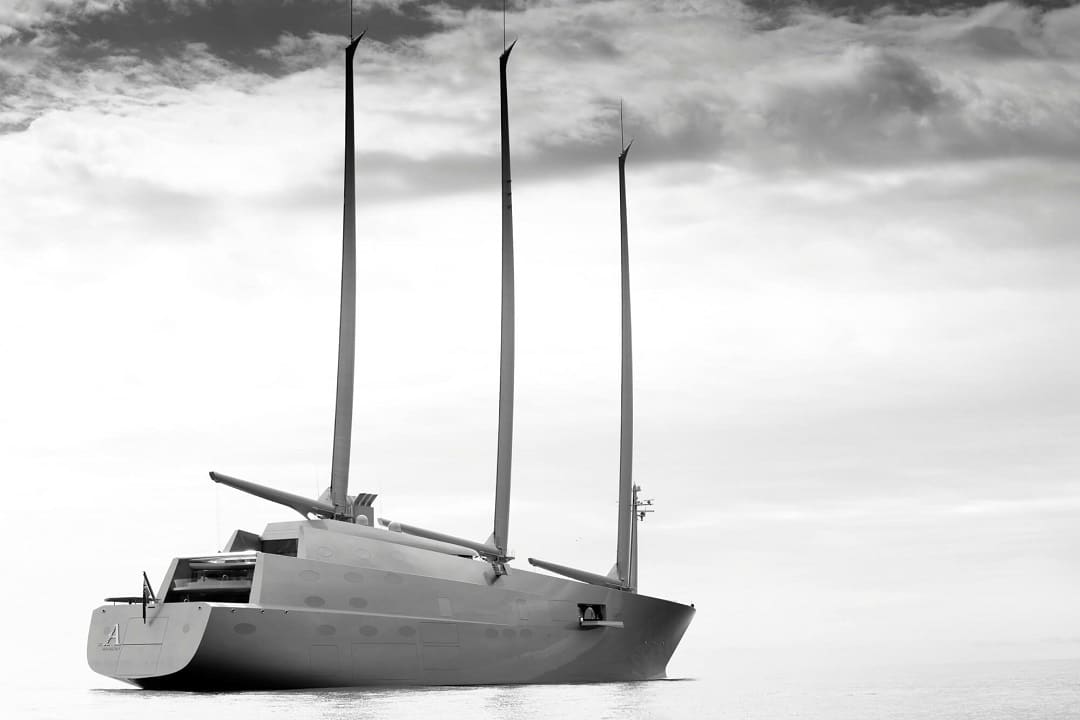
Sailboat A
I understand that, for ordinary mortals, designing a yacht is impossible. For Philippe Starck, no. At this point in the article it is natural for the reader to ask: But what capacity does this man have? Yes, I have also asked myself, and I have the answer: his capacity is extraordinary and his ingenuity inexhaustible. I’ve written it before: more than 10,000 designs!
Initially known as Project 787, it is propelled by the wind thanks to the 3,700 m2 of surface of its sails, distributed in 3 masts of 90 m. of height. The masts have been built by the English company Magma Structures; the booms, the Valencian company Future fibres and the sails, were built by the American firm Doyle Sails. In addition, it has a diesel/electric hydride engine (3,600 kW and 4,300 kW respectively) to reach a maximum speed of 22 knots, with a maximum range of 5,300 miles. Launched in 2016, it completed its last tests from the Navantia shipyard in Cartagena, finishing its check-up in Gibraltar. Built in the shipyards of Noviskrug (German builder of luxury yachts), it was delivered to its owner (Andrey Melnichenco) in Monaco in early 2017.
In this project, Starck has designed the largest sailboat ever designed and built, with 147 m. of length, 25 m. beam and displacing 12,558 Tm. It is equipped with the most modern technology and its interior design is of authentic luxury. It has 8 decks, with 10 cabins for 20 guests, as well as space for a crew of 20 men. In the quila it has a transparent surface to visualize the bottom of the sea. You can order one starting at €450 million!
Exterior architecture
It is the discipline in which Philippe Starck has lavished himself less, but not with less intensity or with less success. His projects and buildings have the nonconformist stamp of Starck and, each and every one of them, incorporate that provocative wink that the designer prints to his work.
Highlights: Le Nuage, Activity Center in Montpelier, the Control Tower of Bordeaux Airport, The Fasano Hotel in Rio de Janeiro, the Asahi Beer Hall building in Japan and The Oil Mill, Mill and Museum on the outskirts of Ronda (Spain).
Edificio Nani Nani (Tokio)
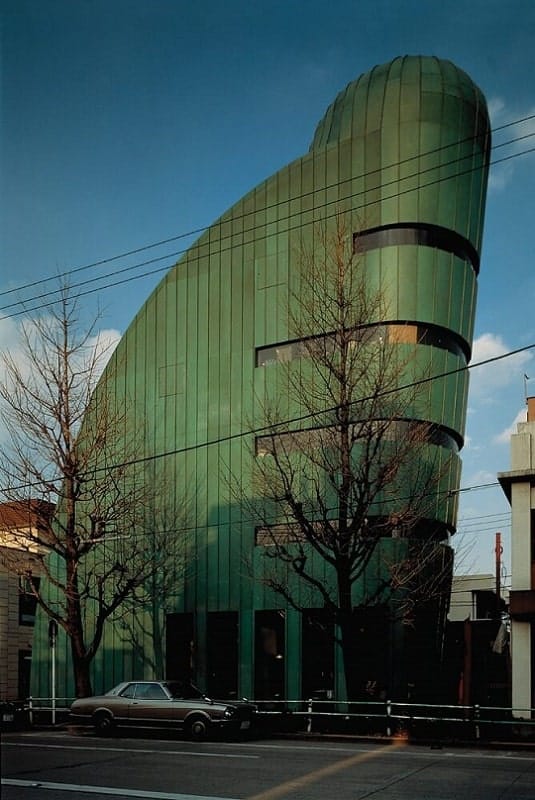
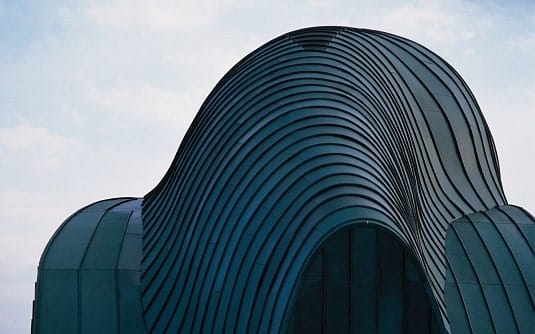
La constructora Unhex solicitó a Starck el diseño de un nuevo edificio para un cambio de imagen. Inaugurado en 1989, se dice que se concibió como un monstruo verde saliendo de un pantano. No diría que no, ya que Starck es imprevisible, y ciertamente, observando la cubierta del edificio desde la parte de atrás, sugiere algo enorme en movimiento. El caso es que lo bautizó como Nani Nani (¿qué es? ¿qué es?) y acertó de pleno.
La empresa Kikukawa realizó el recubrimiento (lamas de cobre patinado de 1,5 mm.), previa construcción de una maqueta escala 1/130 para comprender bien el proyecto y la fabricación. Los 1360 m2 de lamas se perfilaron con láser y se curvaron mediante estiramiento, flexión o golpeo, recubriendo la totalidad del edificio. La cima del edificio, en forma de sombrero esférico, fue la más complicada de realizar, teniendo que preparar en taller una réplica a escala 1:1.
En su planta baja se ubica la cafetería. El sótano se convirtió en restaurante y las cuatro plantas bajo cubierta albergan las oficinas. No ofrece más, aunque ya es mucho, puesto que logra el objetivo propuesto a la hora de proyectarlo mediante un volumen único, un color sutil y una textura muy pronunciada. La forma, en este caso, toma el protagonismo con una sucesión de curvas cambiantes pero a su vez continuas. Starck 100%.
Interior architecture
Interior design is the quintessence of Philippe Starck. The space where he can unfold his creativity and turn the material into spiritual and provoke what we call emotion. Philippe Starck has done interior design in Hotels, Restaurants, Bars and Clubs, Cultural Centers, Museums, Shops and a long etcetera. Undoubtedly, in this discipline he is like a fish in water, because once he has found the versatility and versatility of the project, he is able to mix styles with an exclusive naturalness, being able to be Versailles and modernist at the same time. The exquisite treatment of lighting in its interior design is a trademark of the house.
We will highlight in this area the following projects: Hotel Mob House (Saint-Ouen, France), Mondrian Hotel (Hollywood), Teatro Eslava (Madrid), Quadri Restaurant (Venice), Café Costes (Paris), Maison Baccarat (Paris), Taschen Shop (Los Angeles). Just to highlight a few, since he has carried out many international projects.
Restaurant Teatriz (Madrid)
Forgive my boldness in selecting this project. After living 54 years in Madrid, the city that welcomed a child and transformed him into a man (with white hair, yes!). You have your little heart and this work by Starck in Madrid, for me, is one of the most beautiful projects I have ever contemplated.
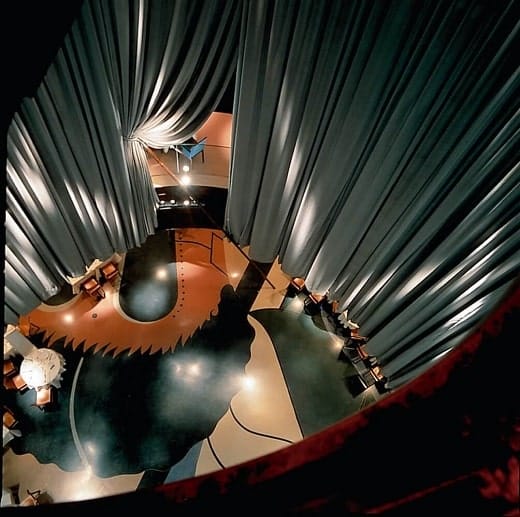
In 1990 Madrid society woke up from the hangover of the Movida of the 80s, that space of freedom that invaded the young and not so young. In January of that year the reform of the old Beatriz Theater was inaugurated, at the confluence of Hermosilla and Claudio Coello streets, Barrio de Salamanca of “Madrid me mata”. This inauguration came to put Madrid in the spotlight. The restaurant designed by Philippe Starck monopolized the world of design and a large part of Madrid and non-Madrid society, eager to visit the place.
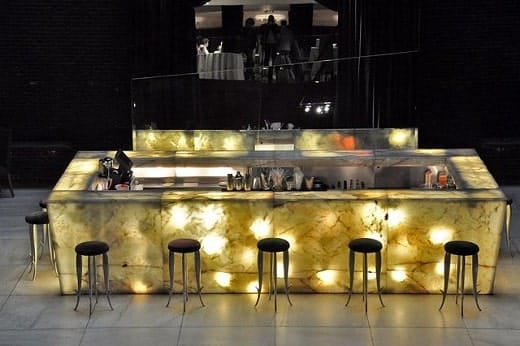
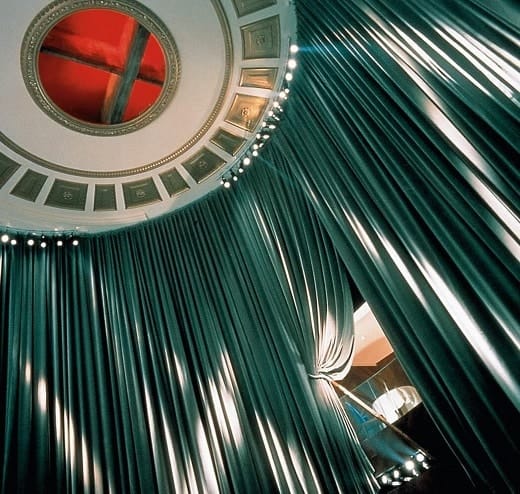
I visited it on a few occasions and it always impressed me, it was a provocative, transgressive, revolutionary and reflective exercise in architecture and interior design. Turning a theater into a multipurpose space with the softness and at the same time rotundity of the performance is what made this place unique. The huge columns of the entrance; the pink capital ; the huge curtain ; the furniture; the floors, etc … Everything invited to be contemplated, to pass the hand everywhere, everything was beautiful. On stage, that backlit onyx bar invited you to have the best drink, while the huge inclined mirror witnessed prying eyes. The sinks?, going to the bathroom was to enjoy an extrasensory experience. The very careful lighting created the different atmospheres.
One of the most exciting projects my eyes have ever seen and my senses perceived . Unforgettable.
Legacy and Recognition
Philippe Starck’s work will be studied and valued by future generations of designers, architects and interior designers, and I trust that many of them are inspired by its creation. Starck It leaves us many concepts to work on. For him, we are all necessary, we can all contribute ideas and solutions to improve our society. The ideas of this brilliant designer have already transformed our world. His idea of democratizing design has penetrated deeply and is practiced profusely, as well as his values on the environment. Their minimalism (the idea of using only one material) is the best example of sustainability for a global economy. It leaves us the versatility; versatility; deep reflection; provocation; surprise; The game and above all, the emotion, that feeling that makes us, sometimes, shed a tear.
The recognition of Starck’s work has been and is continuous throughout his career. It would be very extensive to list all his awards, awards and recognitions, so I will briefly state the following:
- Teaching at the Domus Academy (1986) in Milan and at the École des Arts Décoratifs (1987) in Paris.
- Knighted at the ‘Ordre des Arts et des Lettres’ (1985)
- Received the Legion of Honor (2000)
- Design Award (Tokyo, 1987)
- Grand Prix National de la Création Industrielle
- Oscar du Design (Paris, 1988)
- Excellence in Design Award from the Harvard Graduate School of Design (1997)
- Compass of Gold (2001)
- Lifetime Achievement Award di Designboom (2019).
If I were with him, I would ask him hundreds of questions. I don’t know if that will happen. I am satisfied with having studied the designer, the architect and the interior designer and also, for having known, a little, the man.
Information, bibliography and media:
We use our own means and other means with the availability allowed by current legislation and free access to the World Wide Web. (See Terms and conditions)
Texts: Own, based on starck.com information; Wikipedia; Baccarat; Glas Italy; Flos; Vitra; Magis; Kartell; Baleri Italy; Andreu World; Driade; Essilor Luxottica; Alessi;
Images: starck.com, Wikimedia Commons.
Vídeos: s. n.