

Charles and Ray Eames, functional and avant-garde design
Earn 10.00 Reward Points by commenting the blog post
Introduction
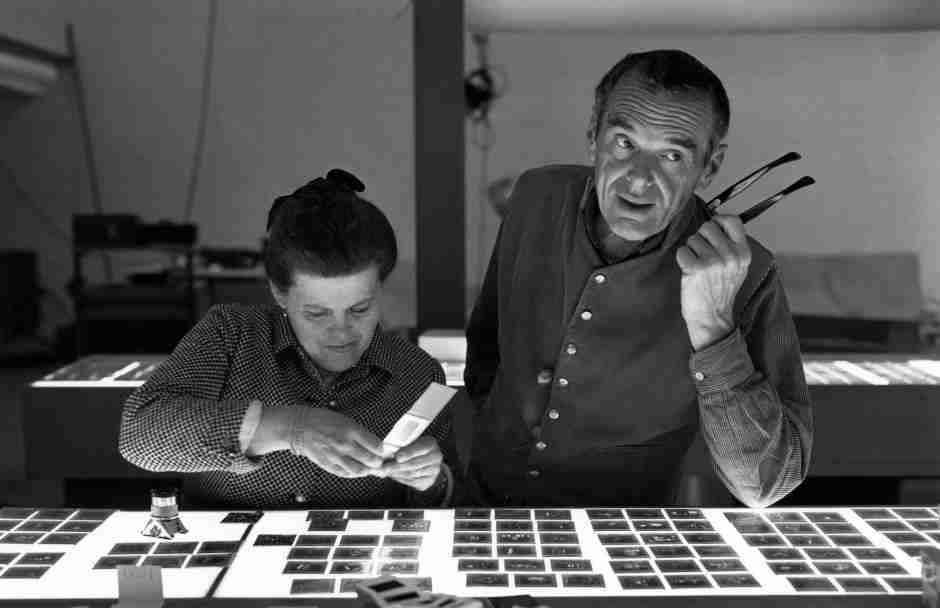
Charles and Ray Eames were two of the most influential and visionary designers of the 20th century. Their collaboration revolutionized the world of design and left an indelible mark on the way we conceive of furniture, architecture , and aesthetics in the last century.
In this article, we’re going to take a look at the history, ideas, and projects of an extraordinary couple. Charles and Ray Eames were a real team and dedicated their lives to what they loved most: “learning by doing”. This intense vision of life led them to experiment with new materials and applications, causing some stops and lessons along the way.
The sum of the disciplines that each one mastered allowed them to travel the world of design along unexplored paths, with surprising results. All his works are admired by professionals and have become icons in the world of design.
Charles and Ray Eames, biography
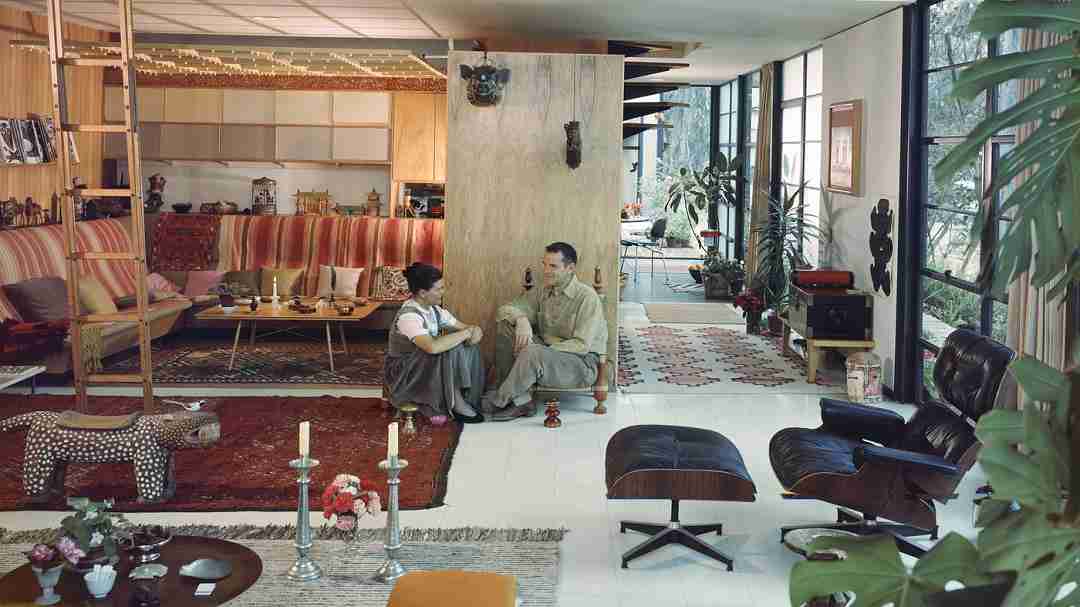
Charles Eames Ormand Jr, was born on June 17, 1907 in St. Louis, Missouri. At the age of 10, after his father retired, he began working at Upton Cody’s printing company.After his father’s death in 1930, the family’s financial situation was precarious ($30 a month) and they moved in with relatives. He began working at Laclede Steel Company to support his family. He worked from dawn to dusk during the weekends and summers of the school year. Despite the effort, he excelled in the studies.
At the age of 14 he began studying at Yeatman High School where he excelled as a student and learned some drawing, engineering and architecture. There he conceived of becoming an architect. He graduated and enrolled, thanks to a scholarship, in the architecture program at the University of Washington in St. Louis.
Charles Eames had a deep admiration for
Frank Lloyd Wright
, and believed that his work should be a teaching pillar in modern architecture studies. His fierce defense of Wright led to several clashes with his professors, and he was eventually expelled from the University on the grounds that he had “too modern” views. He never got a college degree.
He met Catherine Dewey Woermann, his first wife, at Washington University. She was the first woman accepted into the University’s graduate program in Architecture. Their honeymoon in Europe in 1929 brought them into contact with the Modern Movement (Le Corbusier, Gropius and Mies Van der Rohe), considered the fathers of Modern Architecture.
After 1929, the Great Depression made it impossible to get a job, so Eames decided to set up his own studio with Charles Gray and Walter Pauley. They took all kinds of jobs, but they weren’t enough and he had to leave his wife and daughter at Catherine’s mother’s house. He emigrated to Mexico with 75 cents in his pocket.
Years later, on his return, he set up an architecture studio with his friend Robert Walsh. They built several houses and two churches. The Catholic Church of St. Mary, published in Architectural Forum came to the attention of Eero Saarinen, director of the Cranbrook Academy of Art in Michigan , and in 1938 he was offered a fellowship in the Architecture and Urbanism program. There she would meet Ray , with whom she would share the rest of her life.

Bernice Alexandra Kaiser (Ray) was born on December 15, 1912 in Sacramento, California. Due to the early death of her older sister, she was raised in a protective environment and affectionately nicknamed Ray-Ray or Ray by her relatives. Because of his early exposure to art (his father ran a vaudeville theater and opened Sacramento’s Loews Theatre), he began drawing at just 3 years old. Years later she would study ballet and make her debut, at the age of 9, in 1922.
He graduated in 1931 from Sacramento High School, where he developed an aptitude for drawing and color. That same year she moved with her mother to New York and was accepted into the May Friend Nennett School in Millbrook. After graduating, she moved to Manhattan and at the Art Student League she met the German expressionist painter Hans Hofmann, who would exert a great influence on her, joining his school. He worked hard for 6 years with Hofmann on the relationships of structure and color.
In 1936, Ray founded the American Abstract Artist. In 1940 his mother died in Florida, Ray closed the house and joined, along with other friends, the Cranbrook Academy of Art.

Charles was already Director of the Department of Industrial Design when Ray joined Cranbrook, and they would surely meet in collaboration with the “Organic Design Competition in Home Furnishings”, in which Eames and Saarinen participated in 1940.
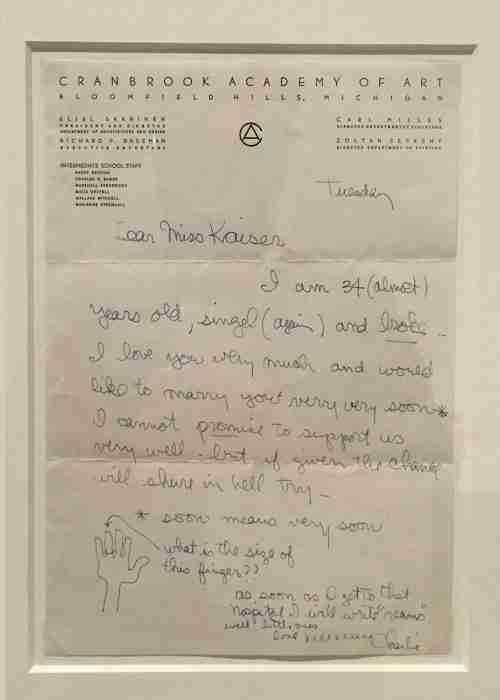
After the end of his relationship with Catherina in 1940, Charles, although still married, discreetly began a relationship with Ray. Uncomfortable in hiding, Ray left Cranbrook and settled in New York. In May In 1941, once he had obtained a divorce from Catherina, he wrote a letter to Ray asking him to marry him; This happened on June 20th, beginning a life forever linked to architecture and design.
John Entenza (Editor of Arts and Architecture), who would be a great friend of the couple, supported them in the beginning. Charles began designing sets at MGM (Metro Goldwyn Mayer) while Ray designed the covers for Arts and Architecture. In their spare time, they both experimented with molded plywood to create furniture.
Thanks to these experiments, a doctor friend, seeing the possibilities of this type of wood in the recovery of fractures, encouraged him to develop this application. The U.S. Navy hired him for 5,000 immobilizer slats, and, thanks to this financial push, he set up the Plyformed Wood Company, continuing the development of molded plywood.
In 1946 they exhibited their first experimental designs at
MoMA
, and soon after, the Herman Miller Company of Zeeland, Michigan, began making furniture designed by the Charles and Ray Eames. In 1949 they completed the Eames House and continued to design furniture, especially chairs, graphic design, film and exhibition design.
Design Concept
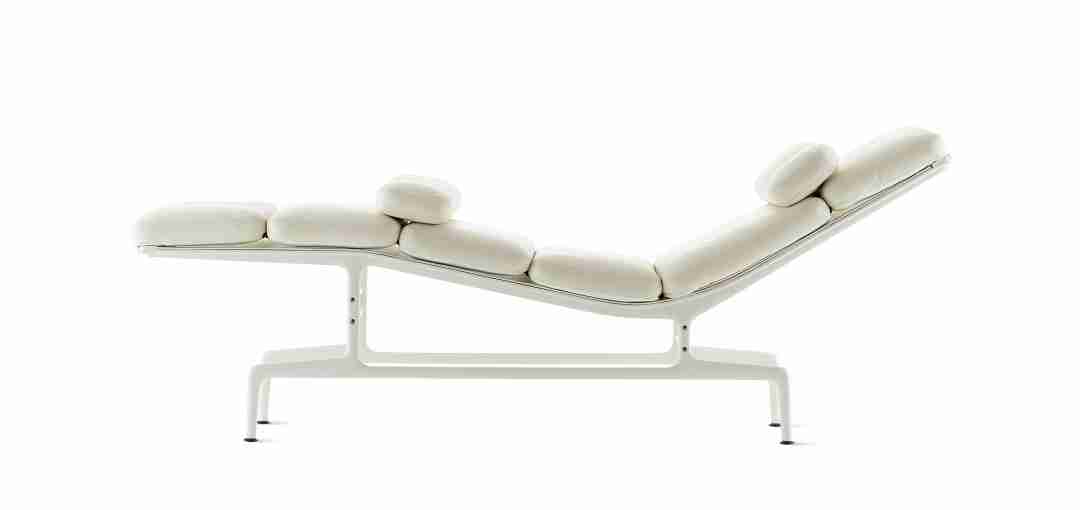
Charles and Ray Eames ‘ design was eminently conceptual. Probably due to the different approaches of their academic training, both had to combine their basic design principles in a common space. Thus, also influenced by their daily practices in the experimentation of materials, and committed to the viability of their creations for the public , they established conceptual design lines based on:
Functionality
The essential element for your designs. Objects should be useful and meet people’s everyday needs . This approach is reflected in the ergonomics and practicality of many of his creations. A clear example of this principle is the following response:
– Who is the design aimed at: the vast majority, specialists, amateurs or a privileged social class?
– “Design is directed to need.”
Charles Eames.
Part of the interview: What is design? Interview with Charles Eames. (The question was asked by Madame Amic)
Experimentation with materials
Pioneers in exploring and experimenting with new materials, Charles and Ray Eames spent many hours studying their possibilities. Somewhat fearless, they deployed a huge battery of ideas that has served as the basis for the future use of materials such as plywood, plastic and fiberglass. The artistic vision of plywood molding stands out, achieving unthinkable curvatures and opening up ergonomic possibilities unknown until then.
Experiments with fiberglass-reinforced plastic culminated in the “Plastic chair”. Surely, when they got it, they fulfilled their desire to create an inexpensive chair for the general public. Experimentation was once again the key and functionality was the goal achieved: comfortable and resistant!
Their “experiments” did not end there, because in 1958 they developed, for a project by Eero Saarinen , a set of outdoor chairs with a die-cast aluminum structure that were truly impressive. The idea was to achievequality in outdoor furniture and they succeeded. So much so that today, the Aluminium Chairs line is present outdoors, at home, at work (a benchmark in high-end offices) and in living rooms .
Elegant and timeless aesthetics
Despite the fact that, in its design, Function took precedence over form, Charles and Ray Eames did not disdain the aesthetics. A traditionally accepted definition of design: “the balance between form and function” is rigorously employed by the Eameses, also endowing their designs with an elegant, simple and timeless aesthetic. One of the main characteristics of the “Eames” aesthetic is the use of delicate and soft curves, which invite both contemplation and ergonomics.
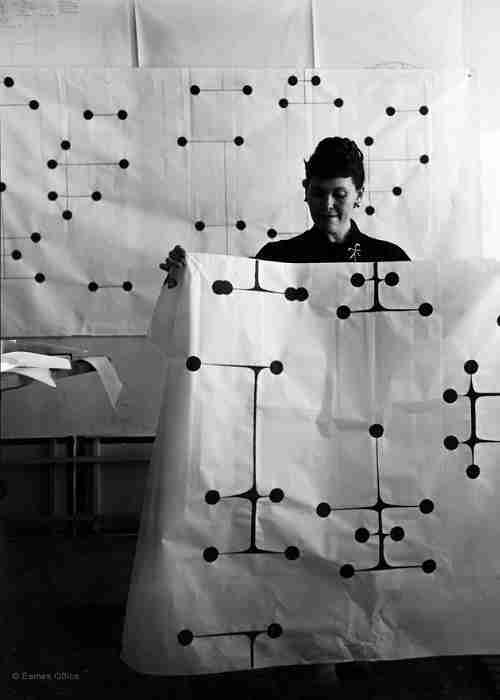
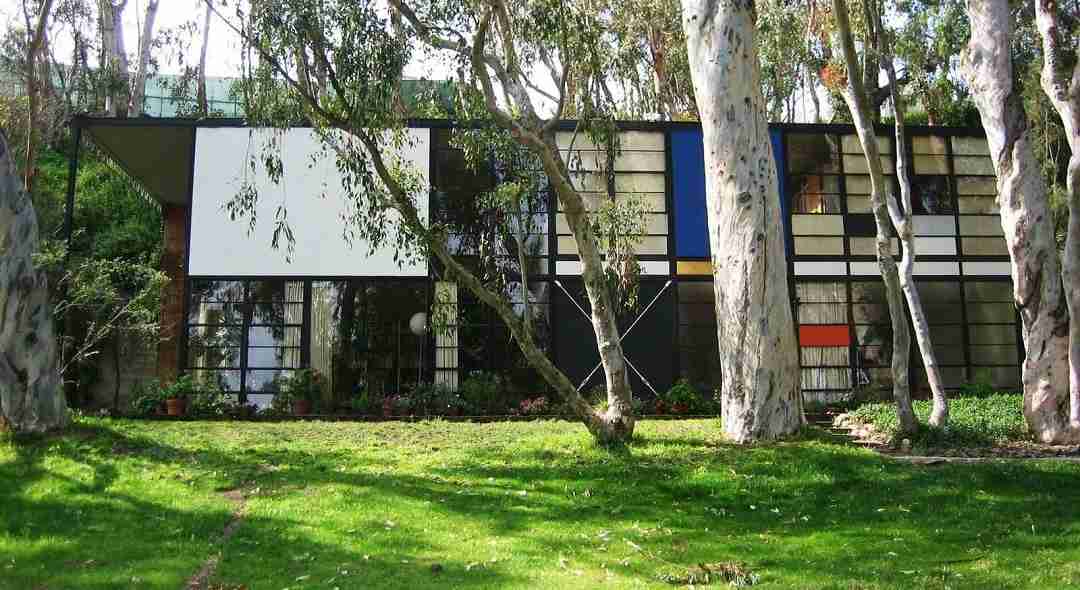
The use of straight lines, unceremoniously, is another characteristic, this one more architectural, of the design of the Eames (Eames House). The use of the colors blue, white, black , and red is a prominent predilection in the aesthetics of Charles and Ray Eames. On other occasions, as if to mark strategic milestones, they used circular dots to decorate upholstery, graphics and scenery.
Emblematic furniture
Within his designs, the furniture stands out from the rest of the disciplines. Charles and Ray Eames dedicated themselves very intensively to this task, creating truly amazing pieces that, to this day, maintain not only the design, but also its functionality and ergonomics. The use of new materials, especially moulded plywood, plastic and fibreglass, in combination with metal structures (steel and aluminium), gave rise to elegant, functional and surprising pieces .
Plywood
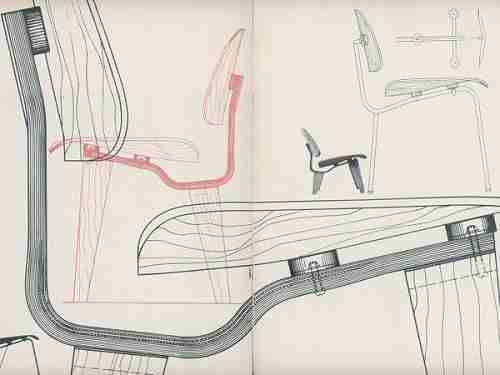
Charles and Ray Eames invented a machine (they called it Kazam!) with which they carried out a process to Mold plywood. They introduced a wood veneer and added a Coat glue, well 5 to 11 times, alternating the grain of the wood. Then, using a bicycle pump, they inflated an inner balloon that pushed all the wood veneers into the (plaster) mold. When the adhesive hardened (using heat-producing electrical resistors), they deflated the balloon and removed the plywood from the mold. And, as if by magic , the piece appeared: Kazam! They then profiled the piece with a hand saw and sanded the edges.
With this “method”, Charles and Ray Eames carried out many experiments and developed their line of molded plywood chairs, achieving very ergonomic and slender pieces.

Plywood Chair LCW/DCW (1945 – 1946)
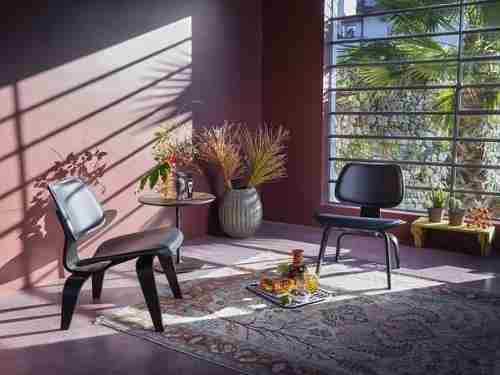
The Eames Lounge Chair, entirely made of molded plywood, known as LCW (Lounge Chair Wood) or DCW (Dinner Chair Wood), was defined by Time as “the chair of the century”. Designed more for rest than for activity, it is an example of the use of honest materials. It adopts the construction in pieces (5, seat, backrest, backbone and 2 sets of legs) in the idea of economizing the replacement in case of deterioration.
The seat and backrest stand out, which, with their gentle curves, delicately gather the body. A subtlety (from 1945!) is the use of small rubber blocks (black rubber) in the screw connection of the spine with seat and backrest.
The finishes of these natural wood chairs can be: Natural Ash, Black Ash and Black Stained Walnut. Optionally, they can be upholstered with smooth leather or calfskin. Dimensions: LCW, 560 x 530 x 680 mm. DCW, 495 x 530 x 725 mm. (W x D x H). Prices (excluding shipping): From €1,730.00 (VAT included).
Plywood Chair LCM/DCM (1945 – 1946)
These two chairs share with the previous ones the backrest and seat made of molded plywood. The difference is the base, this time made of metal (steel tube). The concept is the same as this Metal structure is a skeleton of the one made of moulded plywood, i.e. a central spine and 2 Paw plays. All the metal is curved following the lines of the LCW model and the connection of the structure with the backrest and seat is made with screws and a black rubber plug. The legs come with a small metal skid that ends to the ground.
The seat and backrest finishes are the same as on the LCW and DCW models. The finishes of the metal structure can be: glossy chrome or powder-coated black. Dimensions: LCW, 560 x 530 x 650 mm. DCW, 490 x 505 x 755 mm. (W x D x H). Prices (excluding shipping): From €1,050.00 (VAT included).
Lounge Chair & Ottoman (1956)
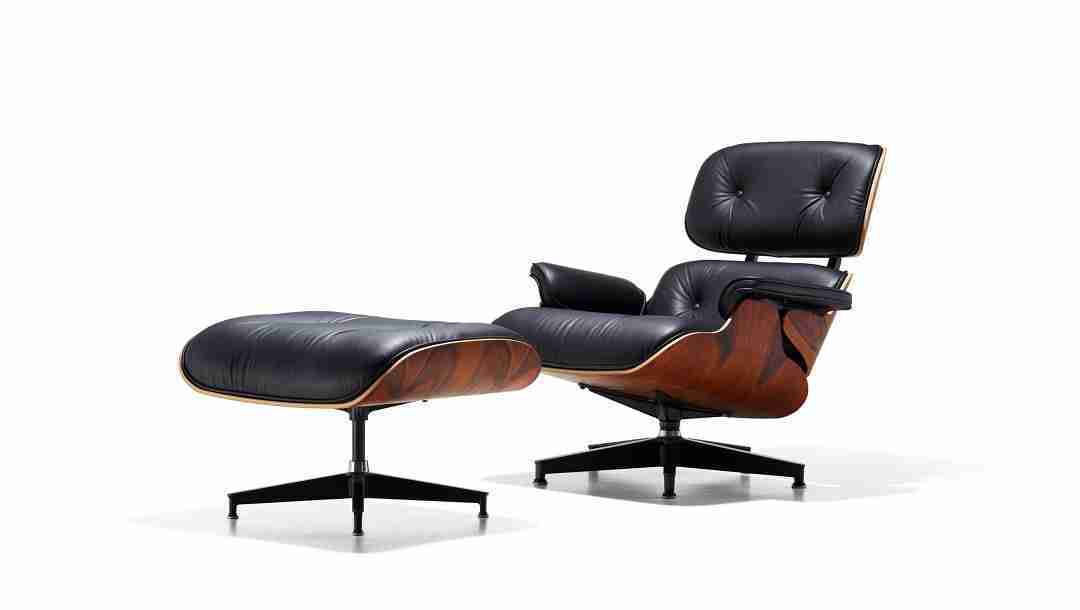
This armchair and footstool, a masterpiece by Charles and Ray Eames, was designed with the aim of combining elegance and supreme comfort. Charles Eames‘ desire to make a version and update the old English club armchair led him, after several years, to build a lighter, more elegant and more modern armchair than the heavy English club armchairs, and also much more comfortable. It became the most famous design of Charles and Ray Eames, and today, it is already a classic in the history of modern furniture.
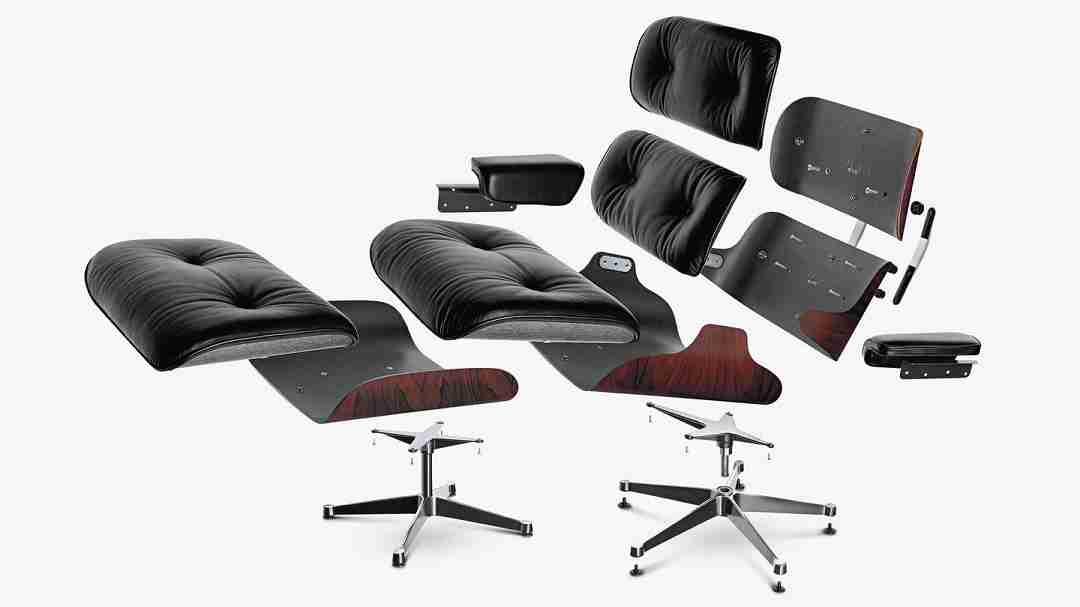
This piece has very original and surprising elements. First of all, its innovative concept, since it converts moulded plywood modules into the structure of a large armchair, forming a “large shell”. Like an articulated ( although rigid) body, the plywood modules form: seat, backrest and headrest.
Secondly, it is worth noting the simple technique of fastening the plywood modules using concealed metric thread screws . The headrest is solidly attached to the backrest by means of 2 outer arms also secured with concealed metric screws.
Thirdly, the exquisite craftsmanship of the leather cushions (with zipper), with exceptional padding and fastened by 2 sewn buttons. The cushions feature innovative concealed clips to attach to the plywood modules.
Finally, a 5-foot cast aluminum swivel base centrally supports a piece of cast aluminum (to give the chair the proper tilt), bolted to the seating module. The bases have hard carpet sliders, optionally made of felt for hard floors. The footrest features a 4-foot base.
With the passing of the years and the increase in size and weight of the population, the Eames Lounge Chair and Ottoman is presented in 2 sizes, the original and a new larger version .
The finishes of this extraordinary armchair can be: Body: American Cherry, Black Stained, White Stained Walnut, Black Stained Walnut, Palo Santo. Upholstery: Natural Leather F, Premium Leather F, Nubia (Various colors to choose according to upholstery). Base: Polished, Polished with black sides. Glides: metal or felt.
Dimensions: Classic, 840 x 565 x 840 mm., New, 840 x 605 x 890 mm. (W x D x H) Ottoman: 560 x 630×560 mm. (W x D x H). Prices (excluding shipping): From €7,400.00 (VAT included).
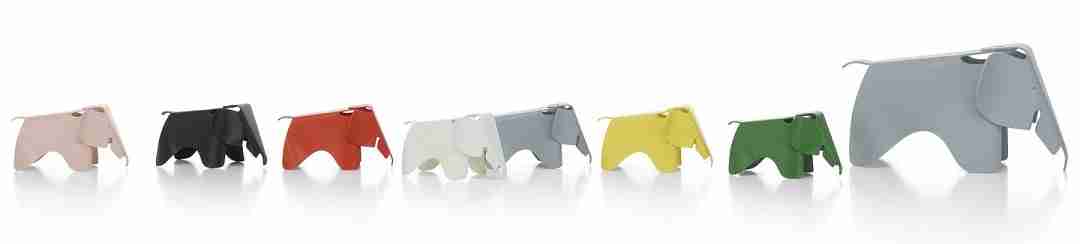
Elephant (1945)
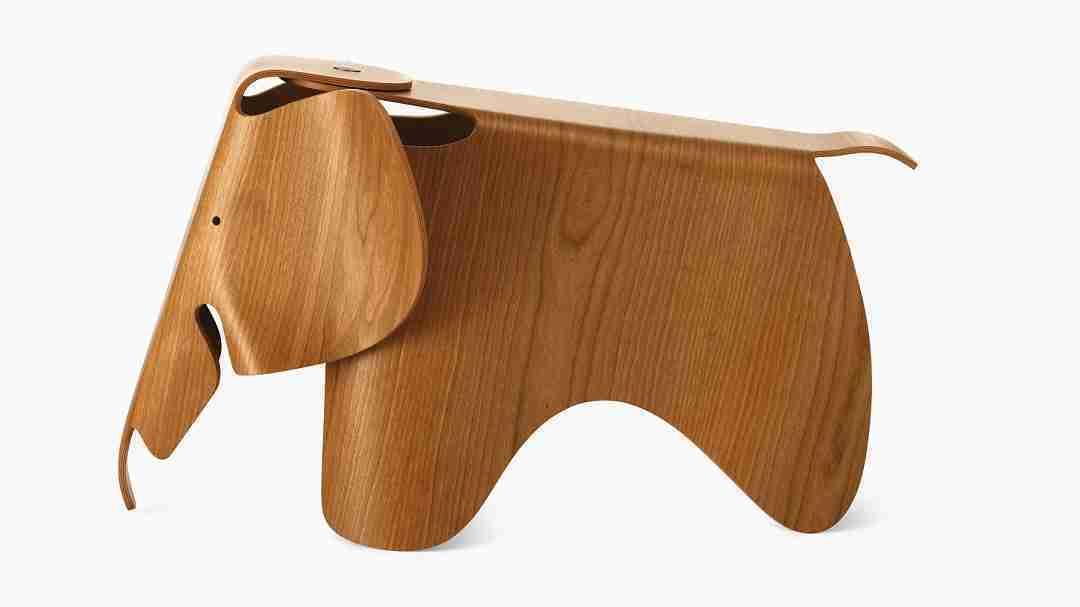
A toy, a seat, an exercise in virtuosity made of molded plywood. Extremely simple (2 pieces), but complex in its design and manufacture due to the nature of its curves, it never made it to the production phase. In 1946 it was exhibited at MoMA.
After the 2007 limited edition, Vitra added it to its catalogue (2017) as a sculptural figure made of plywood finished in American cherry veneer. For some years now, a plastic version (Polypropylene) has also been marketed, with the aim of making it available to its real recipients: children. In turn, a smaller, more evocative scale version is available in its 7 colors: White, Glacial Gray, Palm Green, Dark Black, Poppy Red, Pale Pink and Buttercup.
Dimensions: Plywood, Plastic, 410 x 785 x 415 mm. (W x L x H), Scale, 205 x 390 x 210 mm. (W x L x H). Prices (shipping not included): Plywood, €1,495.00, Plastic, €279.00, Scale, €99.00. All prices include VAT.
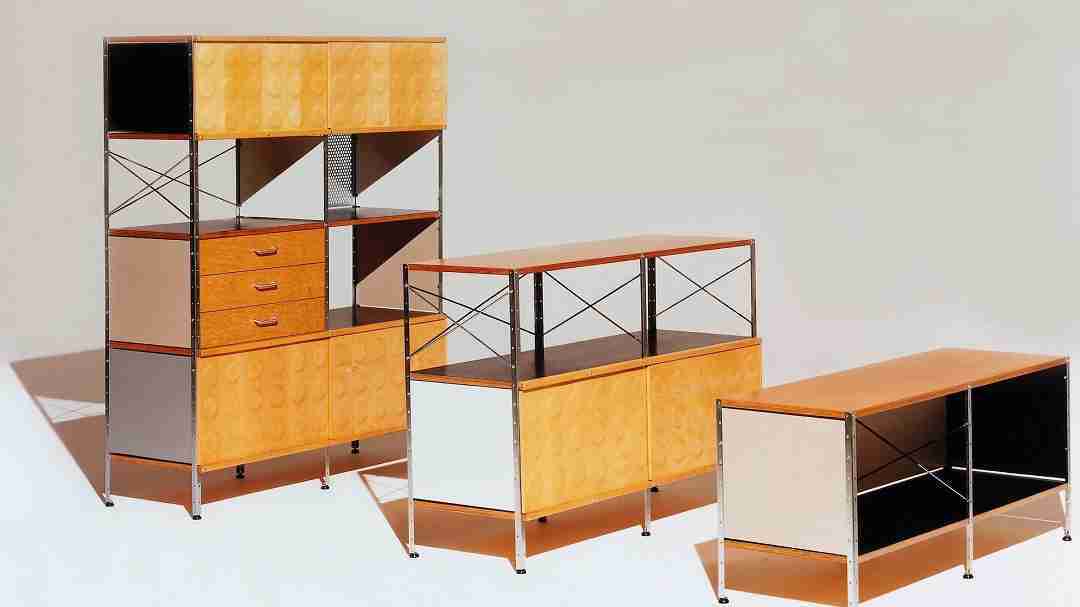
ESU Storage Unit (1949)
Eames Storage Units (ESUs) were designed to achieve economy in the production process. Using standard elements , the aim is to achieve several uses: living room, dining room, bedroom or simply as a room divider. Extruded perforated steel profiles, with diagonal rebar, are the structural elements that will house the shelves, drawers or sliding doors for closed or open storage. Customization was possible with perforated metal panels, colored panels (yellow, blue, and red/beige and gray), drawers , or plywood doors. The look of this furniture was “high-tech” and “industrial”, and its modular nature allowed for many different combinations. It is still produced today by Herman Miller and Vitra.
Dimensions: see technical sheet. Prices (Shipping not included): from €2099.00 (VAT included).
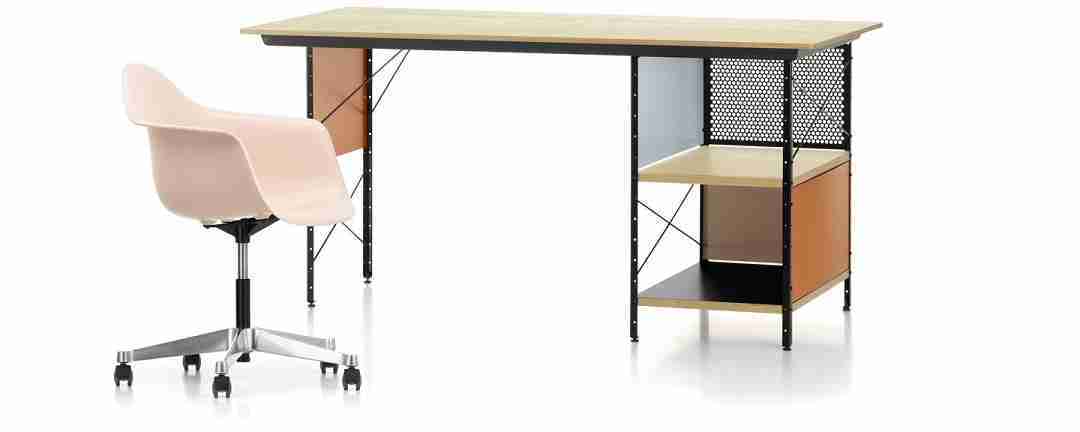
EDU Desktop Unit (1949)
Eames Desk Units (ESUs), like storage units, are born out of the principles of industrial production by procuring economy in the production process. Extruded perforated steel profiles, with diagonal rebar, are the structural elements on which a birch plywood board will rest and which will house the shelves or drawers for closed or open storage. Customization was possible with Perforated metal panels and colored panels (yellow, blue and red/beige and gray). The appearance of this furniture was “high-tech” and “industrial”, and its modular nature allowed for many different combinations.
Dimensions: 1,525 x 710 x 740 mm. (width x depth x length). Prices (Shipping not included): from €1,929.00 (VAT included).
Molded Shell Chairs
There is no defined “Charles and Ray Eames style.” His furniture, made with curved shapes and straight lines, uses wood, plastic, steel wire and aluminum. In the words of Charles Eames:-“A chair essentially has two parts: 1) a surface to collect the body and 2) a structure to keep that surface in proper relationship with the ground.” This assessment of molded shell chairs is obvious, however, their concept also considers the customer’s “pocket”. With fewer parts, better quality chairs can be sold at a lower price.
A $5,000 prize, received from the Museum of Modern Art (MoMA) in 1949, allowed them to lead a research group on new low-cost furniture. They devised several one-piece shells made of neoprene-coated steel rod (wire) (to prevent the cold of the metal in contact with the body). In this second contest, they won the 2nd prize , with the judges valuing very positively the system of bases (4 legs, base for rocking chair, base made of steel wire and base made of cast aluminium).
To carry out this project, they needed a high-cost steel stamping press , which Herman Miller discarded due to product uncertainty. This setback made them sharpen their ingenuity and turned to another wartime technology: fiberglass molding. They hired John Wills (fiberglass manufacturer) for two fiberglass frames (one still stands in the Henry Ford Museum), and found that they were resistant to extreme heat and cold, which would prevent them from covering them. They could also use the rubber shock absorbers to provide added comfort.


Together with Irv Green and Sol Fingerhut, from Zenith Plastics, they would partner with Herman Miller and begin the production of fiberglass-reinforced polyester chairs. Production began in November 1949 and the first chairs were exhibited at the Chicago Merchandise Mart in 1950. The chairs won the Low Cost Furniture Competition.
Charles stated:- “When we first introduced this revolutionary new plastic and fiberglass chair in New York, we thought it would take a long time to get it to catch on. We thought that only ultra-modern housewives would opt for such advanced designs. How wrong we were! Hundreds of housewives came to see this wonderful chair.”
Initially only with 3 colors, later they were offered with up to 30 colors. The great success of this type of chair was due to the comfort in the recollection of the body, the simplicity of the production process and the homogeneity of the shell, not requiring painting or subsequent actions for its completion.
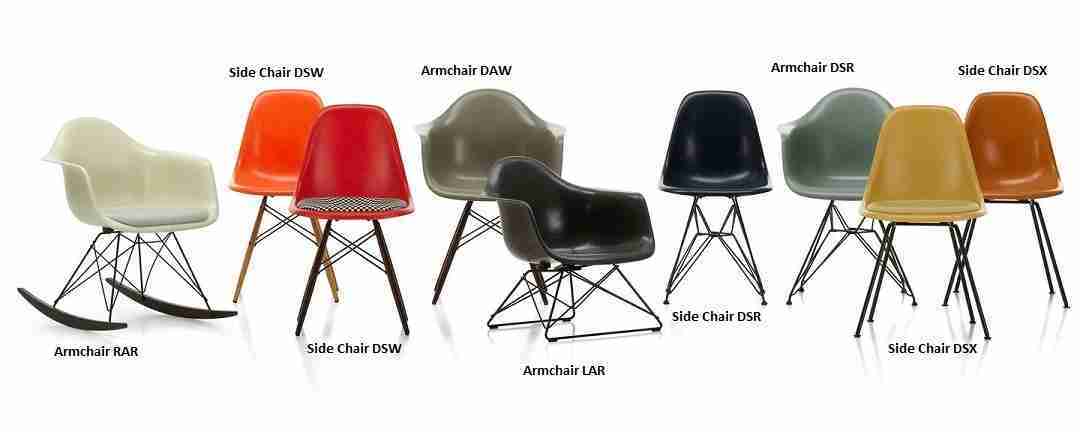
Fiberglass Side Chair (1950)
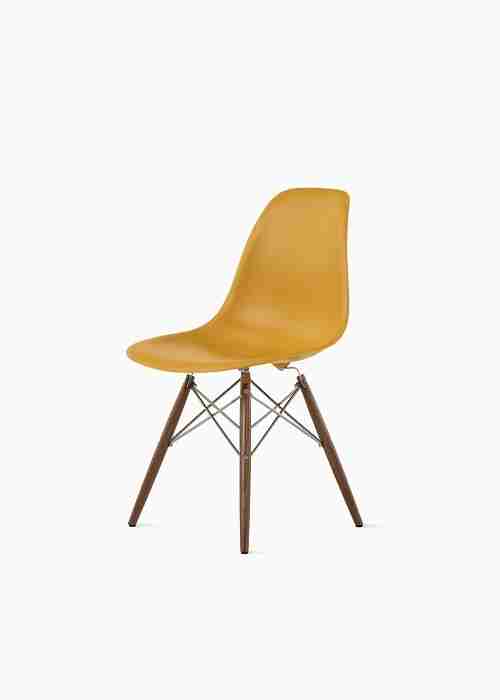
Charles and Ray Eames, in the search for alternative materials for their “low cost” chair, discovered fiberglass-reinforced polyester resin. With this material they could make their shells in an industrial process, maintaining, in a single piece, the organic lines of their creation. Quite an innovation, because the material was also very pleasant to the touch and molded perfectly, achieving extraordinary comfort. Charles and Ray Eames completed the design with a pair of Amazing Design Bases: “Eiffel Tower”, with welded steel rods and a Base with wooden legs and metal reinforcements.
After obtaining several colors for the Fiberglass housings, the commercialization began in 1950, expanding very soon the options of bases and colors and becoming one of the emblematic designs of the twentieth century.
Dimensions, finishes, options and configuration: Available on this vitra page. Prices (Shipping excluded): LSR, from €770.00, DSR, €680.00, DSW, from €850.00, DSX, €640.00 (All prices including VAT).
Fiberglass Armchair (1950)
Charles and Ray Eames made 2 fiberglass molds: the first, without armrests, was used in the Fiberglass Side Chair; The second mould was made with armrests and with the larger shell, in the form of an armchair. This second mold is used in the Fiberglass Armchair. A tilting model with wooden skids (RAR) is introduced.
Dimensions, finishes, options and configuration: Available on this vitra page. Prices (Shipping excluded): LAR, from €975.00, DAR, from €885.00, DAW, from €1,055.00, DAX, from €845.00, RAR, from €1,100.00. (All prices include VAT).
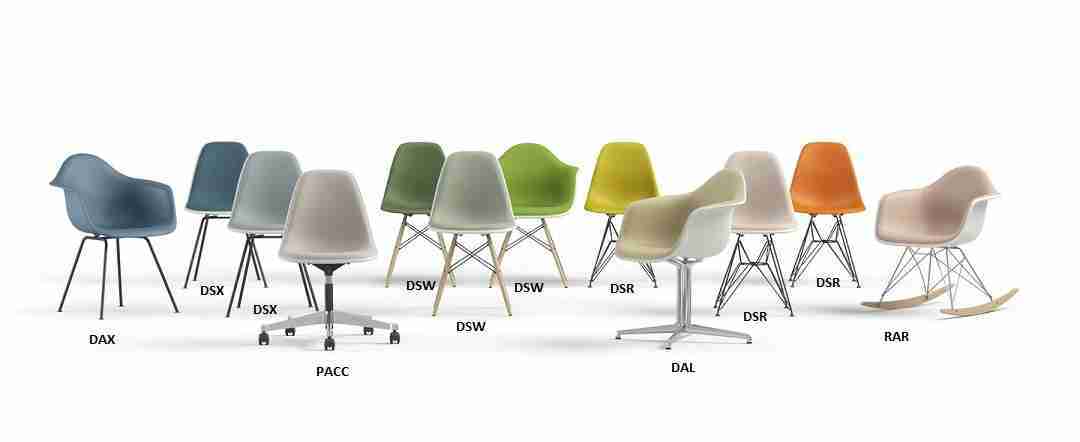
Plastic Side Chair RE (2006)
The Eames LLC office continues to work intensively under the conceptual inspiration of Charles and Ray Eames. Together with Herman Miller, in 2006, using Polypropylene (a lighter and more environmentally friendly material than fiberglass) the Fiberglass models were published, creating the series Plastic Chair. Greener, lighter and cheaper.
A wide selection of colours, new models and new bases, have further developed the genuine “low cost” chair of the Eames. In addition, since 2024 all polypropene used is recycled, hence the acronym RE. A wheelchair model and a collective seat on a crossbar are added.
Dimensions, finishes, options and configuration: Available on this vitra page. Prices (Shipping excluded): DSR, from €330.00, DSS, from €290.00, DSW, from €500.00, DSX, from €290.00, LSR, from €420.00, PSCC, from €670.00. (All prices include VAT).
Plastic Armchair RE (2006)
Derived from mold A, the Armchair is the version of the “low cost” Eames chair with armrests. Also made of recycled polypropylene, it is more ecological, lighter and more economical. It features a new cast aluminium base and a collective seat on a crossbar.
Dimensions, finishes, options and configuration: Available on this vitra page. Prices (Shipping excluded): DAL, from €830.00, DAR, €465.00, DAW, from €635.00, DAX, €425.00, LAR, from €555.00, PACC, from €805.00, RAR, from €680.00. (All prices include VAT).

La Chaise (1948)
Designed in 1948, this sun lounger is inspired by Gastón Lachaise’s work “Floating figure”. Composed of two fiberglass shells joined together, a chrome-plated metal base and natural oak feet, very thin metal rods support this slender lounger, providing a “levitation” to the figure. It exhibits captivating elegance and allows for a wide range of sitting and reclining positions.
Due to its high cost , it was never sold during the lifetime of Charles and Ray Eames. In 1996, in response to public interest, Vitra International, a long-time partner of Eames , began manufacturing and distributing it. Today, it’s an icon of organic design. Available exclusively at Vitra.
Dimensions: 1470 x 870 x 880 mm. (W x D x H). Prices (Shipping excluded): €10,120.00 (VAT included).
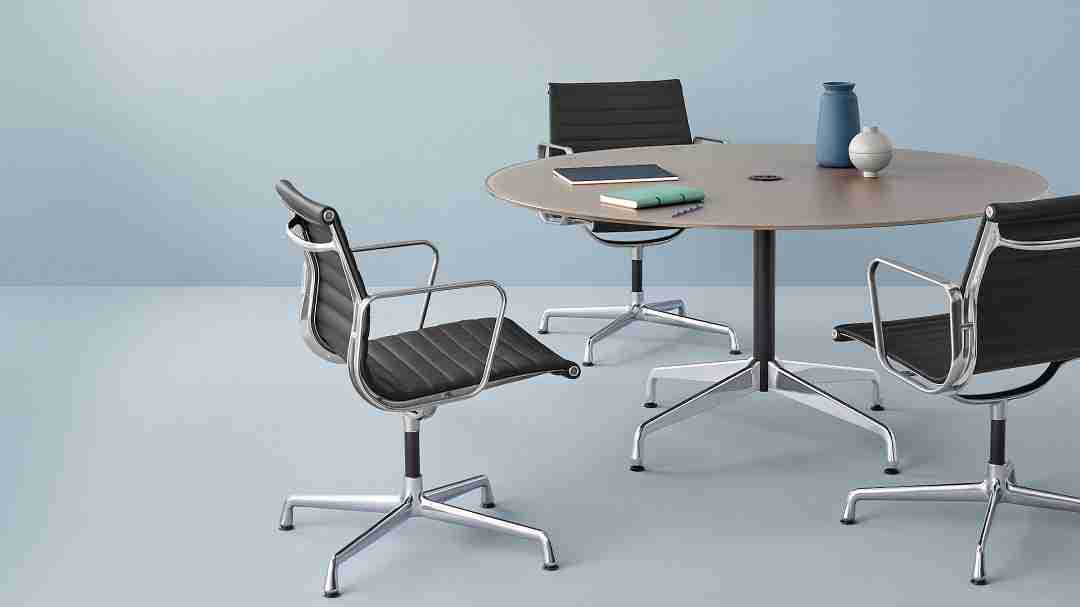
Aluminium
Their intensive collaboration with Eero Saarinen resulted in the commission to design high-quality outdoor chairs for homes Irwin Miller House and Alexander Girard’s House in Columbus, Indiana. The durability of the cast aluminum and its Charles and Ray Eames‘ great outdoor performance led them to develop chairs in this material for both outdoor and indoor use. In 2015 when the Millers donated the house to the Indiana Museum, the same chairs from 1958 were still serving in the home’s garden.
The design of the Eames Aluminium Group is very simple as there are only two main elements, the one-piece seat pad and the aluminum frame. Simplicity has always characterized the Eames‘ construction methods. In this case, both the seat padding and the chair upholstery form a supporting element.
A 6.35 mm. vinyl foam core covered with 2 layers of Fiberthin is coated with two layers of coating and heat-sealed by reinforced stitched edges. This procedure forms a firm and durable unit but with a certain flexibility. In addition , the heat sealing keeps the padding in place.
The aluminum frame consists of base, side supports , and arms. The base consists of a central column with 4 or 5 arms that are oriented downwards at their ends, where a nylon slider is inserted. The central column contains a rotating mechanism, the shaft, 25.4 mm in diameter, flows into a pole-shaped piece that leads to the aluminium side supports. At the same time, in the backrest area there is another pole that maintains the equidistance of the lateral supports.
The idea is to introduce the cladding through the interior longitudinal grooves of the side supports, maintaining a tension that will act as a seat and backrest shell. Everything will be kept snug with the placement of T-shaped screws at the ends of the 2 brackets.
Charles and Ray Eames had done it again, an exercise in slender, simple, comfortable and also unprecedentedly lightweight design. The versatility of the Aluminium Group concept has made it possible to use this chair as a table chair, a conference chair, a work chair and even as an armchair with Ottoman (footstool).
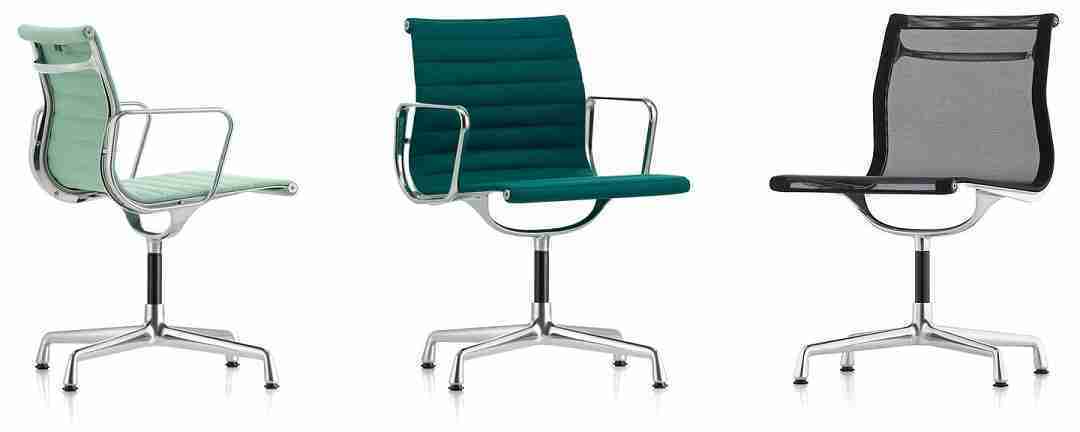
Aluminium Chairs EA Dine (1958)
This version is intended for use in the dining room. Its backrest is medium high and it is a little higher and lighter than conference chairs, to sit at the table. Seat and backrest: in mesh fabric or upholstered with horizontal ribbing welded at high frequency in fabric or leather. Side profiles and crossbars in die-cast aluminium, polished, chrome-plated or powder-coated finish in Deep Black. Armrests: die-cast aluminium, polished, chrome or powder-coated finish in Deep Black. Base: 4 spokes die-cast aluminum, finished polished, chrome plating or powder coating in Deep Black color
Available in 3 versions: EA 101, non-swivel, without armrests, EA 103, non-swivel, with armrests and EA 104, swivel, with armrests. Dimensions: EA 101, 500 x 440 x 845 mm. (W x D x H) EA 103 and EA 104, 560 x 440 x 845 mm. (W x D x H) Price (Shipping excluded): from €1,840.00 (VAT included).
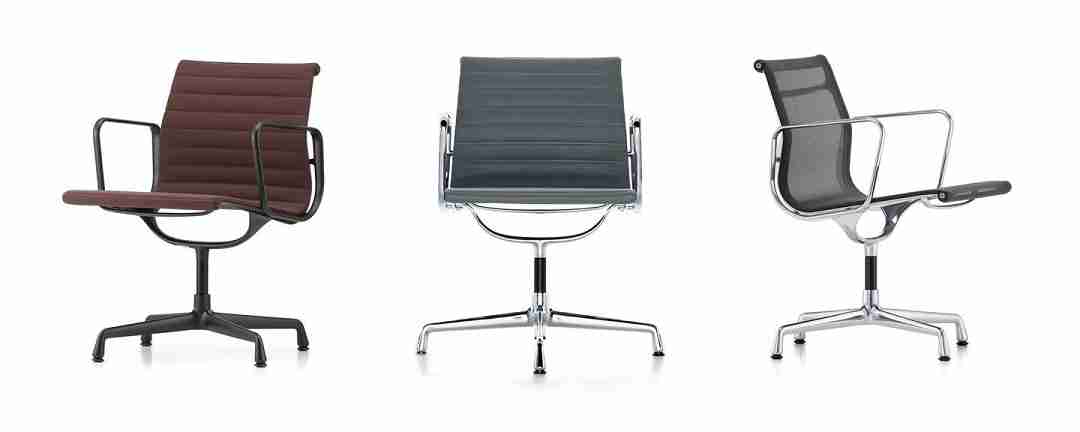
Aluminium Chairs EA Conference (1958)
This version is intended for use in meetings, conferences, etc. Its backrest can be tall or medium height. Seat and backrest: in mesh fabric or upholstered with horizontal ribbing welded at high frequency in fabric or leather. Side profiles and crossbars in die-cast aluminium, polished, chrome-plated or powder-coated finish in Deep Black. Armrests: die-cast aluminium, polished, chrome or powder-coated finish in Deep Black. Base: 4 spokes die-cast aluminum, finished polished, chrome plating or powder coating in Deep Black color
Available in 2 versions: EA 105, non-swivel, without armrests, EA 107, non-swivel, with armrests and EA 108, swivel, with armrests. Dimensions: EA 105, 525 x 482 x 830 mm. (W x D x H) EA 107 and EA 108, 580 x 482 x 830 mm. (W x D x H) Price (Shipping excluded): from €2,100.00 (VAT included).
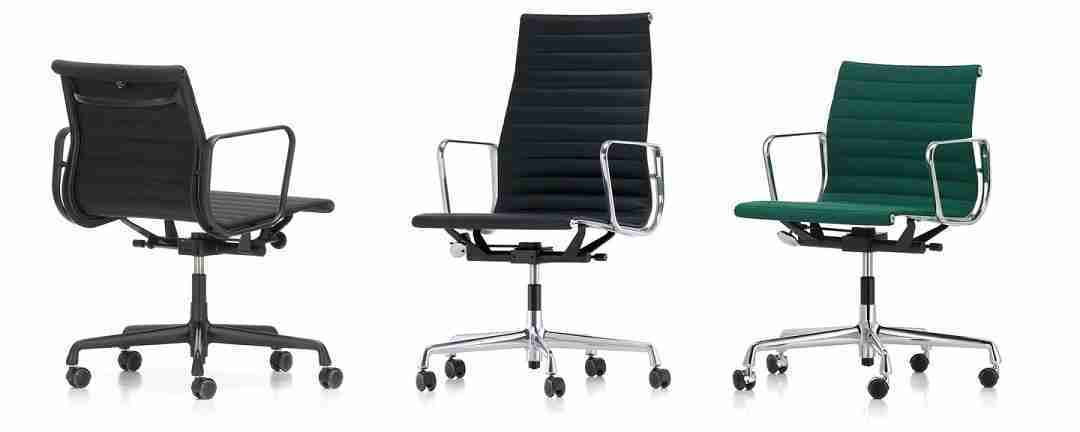
Aluminium Chairs EA Work (1958)
This version is intended for use at work and adds an iconic presence in high-end offices. Seat and backrest: EA 117, half-height backrest, EA 118 with half-height backrest and table-facing sitting position and EA 119 with high backrest.
Seat and backrest: high-frequency welded horizontal ribbing in fabric or leather. Side profiles and crossbars in die-cast aluminium, polished, chrome-plated or powder-coated finish in Deep Black. Seat mechanism: Adjustable backward tilt , lockable in forward position. Infinitely variable seat height adjustment by means of a pneumatic spring. Armrests: die-cast aluminium, polished, chrome or powder-coated finish in Deep Black. Base: 5 spokes of die-cast aluminium, polished, chrome-plated or powder-coated finish in Deep Black. Hard wheels for carpet and Soft for hard floors
Dimensions: EA 117, 580 x 465 x 830/950 mm. (W x D x H). EA 118, 560 x 442 x 830/945 mm. (WxDxH). EA 119, 525 x 465 x 1015/1135 mm. (WxDxH) Price (Shipping excluded): from €2,540.00 (VAT included).
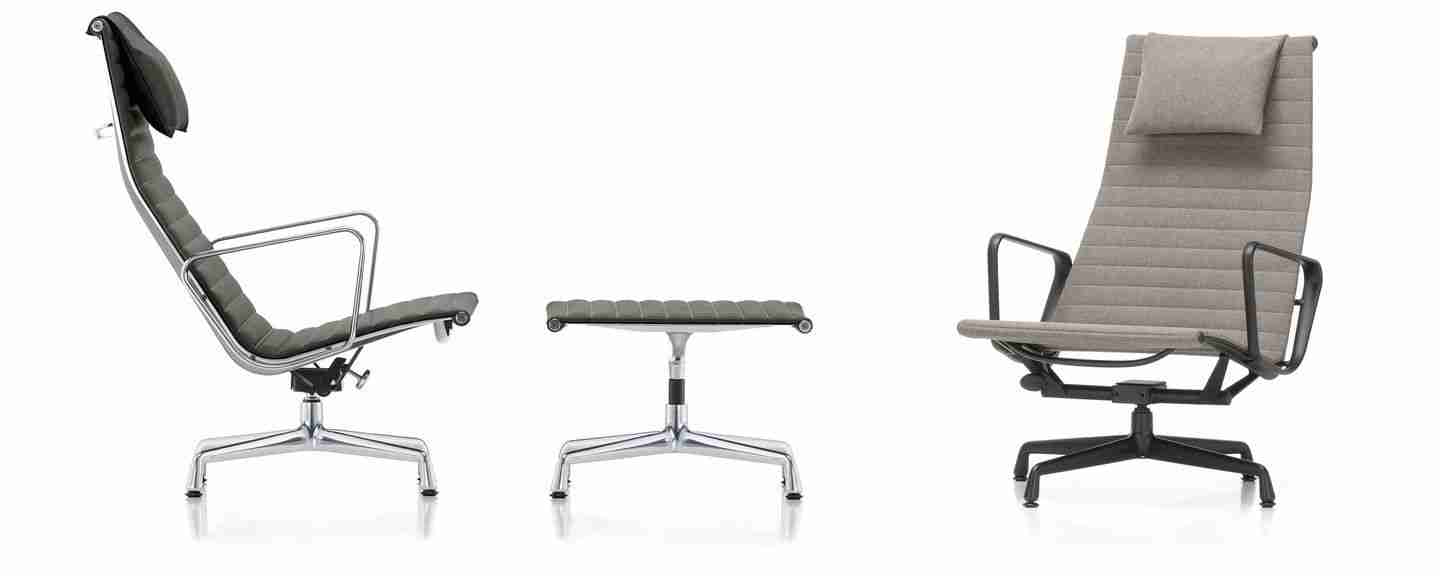
Aluminium Chairs EA Lounge (1958)
This version is designed for outdoor use or in the living room. Its excellent comfort is provided by its extraordinarily high backrest, its head cushion and its tilting mechanism that can be adjusted to the user’s weight.
Seat and backrest: high-frequency welded horizontal ribbing in fabric or leather. Side profiles and crossbars in die-cast aluminium, polished, chrome-plated or powder-coated finish in Deep Black. Seat mechanism: Adjustable backward tilt . Armrests: die-cast aluminium, polished, chrome or powder-coated finish in Deep Black. Base: 4 spokes of die-cast aluminium, polished, chrome or powder-coated finish in Deep Black. It can be combined with the EA 125 footstool.
Dimensions: EA 124, 650 x 585 x 985 mm. (width x depth x height). EA 125, 546 x 435 x 354 mm. (WxDxH). Price (Shipping excluded): EA 124, from €3,610.00, EA 125, from €1,520.00 (All prices including VAT).
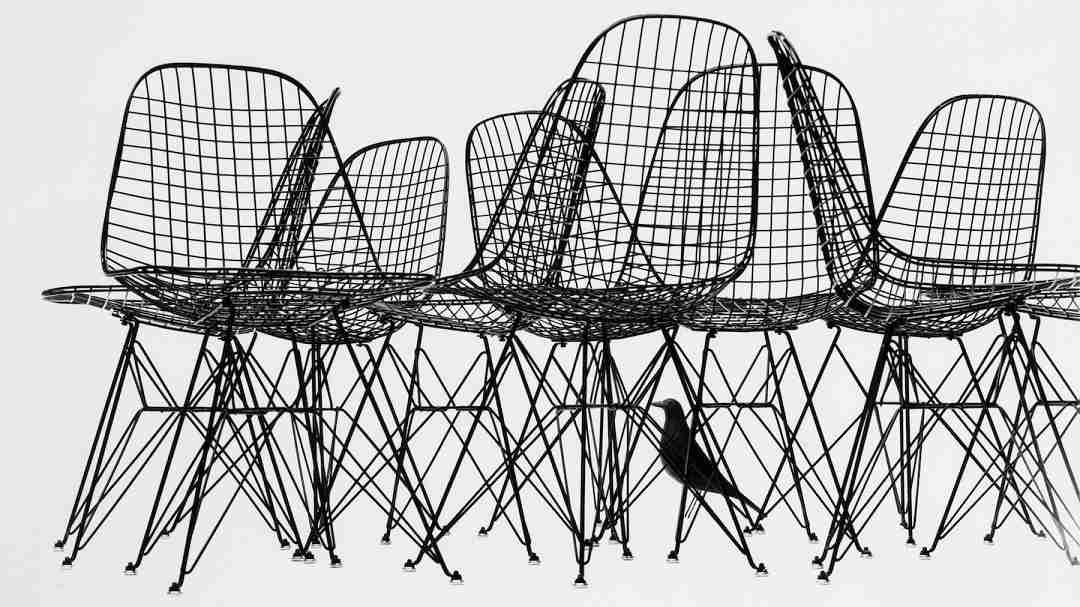
Steel Wire Chairs
For Charles, the inspiration for the Wire Chair: “If you looked around, you would find these fantastic things made of wire: trays, baskets, rat traps, using a wire making technique perfected over many years. We researched it and found that it was a good production technique and also a good use of material. Before the molded plastic chair was solved, the molded wire chair was already in place.”
The idea was modified around attaching an upholstery to the steel wire structure. They devised an upholstered pad on the steel rod shell that, like a “bikini”, would allow the placement and subsequent removal of the pads without problems. Eames Wire chairs are still made by Herman Miller and Vitra.
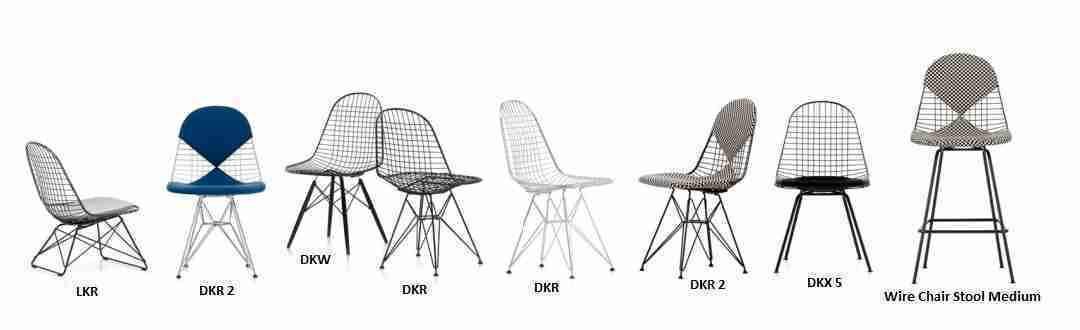
Wire Chair (1951)
Designed by Charles and Ray Eames using welded steel rod, the Wire chair follows the line of the one-piece seat shell. It combines lightness (due to its transparency) and technology. This splendidly constructed shell can be offered with different bases and is offered with or without upholstery.
Also, this “steel mesh” housing can be supplied “powder lacquered”. The DKR and DKX models, finished with powder coating, are suitable for both indoors and outdoors. In 2016, Vitra added approximately 20 mm to the base height of the Wire Chairs, in order to adapt the seat geometry to today’s average ergonomics.
The upholstery consists of a detachable mat carefully covered in Hopsak fabric or cowhide leather. It can be ordered in one or two pieces (cushion or “bikini”). It can also be supplied nude.
By models, these are the bases used:
- DKR: Four-legged metal base with crossed reinforcements, “Eiffel Tower” type. Includes plastic carpet glides (Optional: felt for hard floors). Cushion-free and powder-lacquered, it is suitable for outdoor use.
- DKW: 4 solid maple legs with stained finish, with steel braces. Includes plastic carpet glides (Optional: felt for hard floors).
- DKX: Base with 4 tubular steel legs with a finish coordinated with that of the metal housing. Cushion-free and powder-lacquered, it is suitable for outdoor use.
- LKR: Low armchair. Cushion-free and powder-lacquered, it is suitable for outdoor use.
- Wire Chair Stool: Stool with 4 tubular steel legs with a finish coordinated with that of the metal casing. Sizes: Medium and High.
- Dimensions: DKR, DKW, DKX, 490 x 430 x 850 mm. (WxDxH) LKR, 490 x 465 x 660 mm. (WxDxH) Stool Medium, 515 x 450 x 1110 mm. (WxDxH) Stool High, 555×445/1225mm. (WxDxH).
- Prices (Shipping excluded): DKR: from €495.00, DKW from €665.00, DKX from €445.00, LKR from €585.00 (All prices including VAT).
Architecture
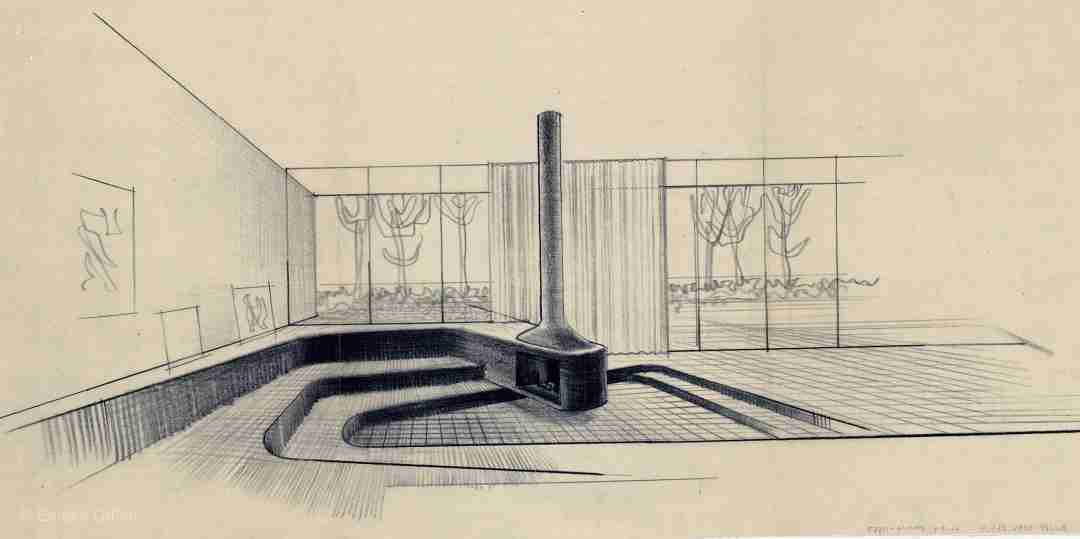
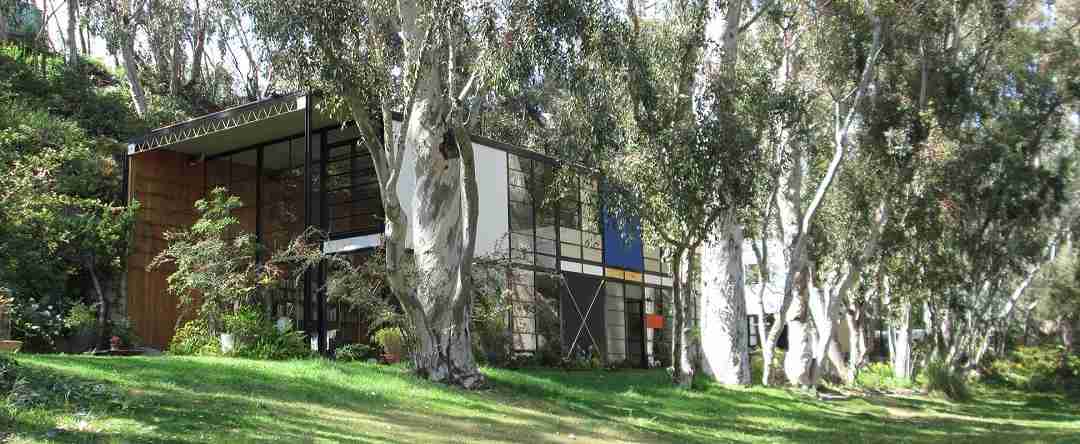
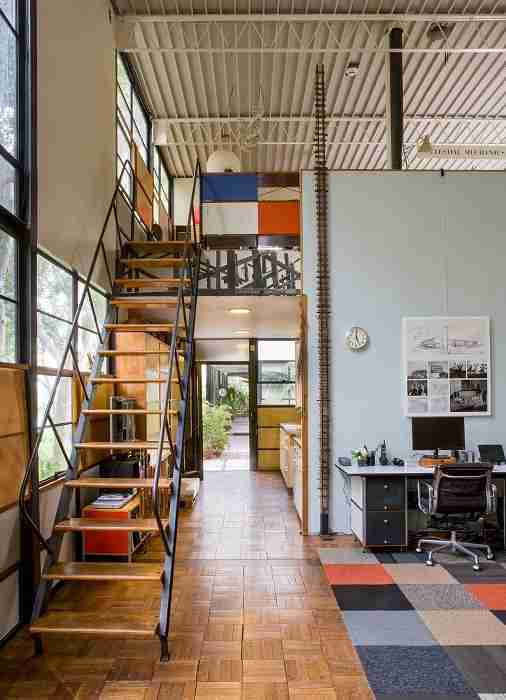
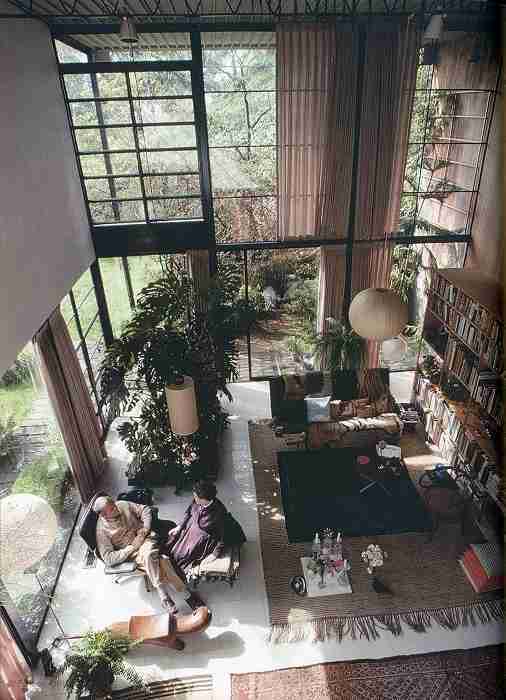
Architecture has always been a source of inspiration for Charles and Ray Eames. The structural contribution and architectural materials are protagonists in his films, toys, exhibitions and furniture. The Eames Office was involved in residential and commercial construction projects, although, for the most part, they did not go beyond a project and a model. Ideas that advanced the most, such as the Eames House, have a reserved place in architectural history.
Although their most important work, due to the architectural impact it has, is the Eames House, they carried out other very interesting works. Some of them are: Billy Wilder House, Case Study House 9: The entenza House, Herman Miller Showroom, Max and Esther De Pree House, St. Mary’s, Helena ArKansas, The Kwilkset House.
Case Study House #8 (1949)
Other Designs & Works
“There is strength in numbers.” This celebrated phrase, originally used by the Dutch Republic, can be applied to Charles and Ray Eames. Together, they carried out work, designs, and projects in various disciplines. They left their mark on Art, Communication, Filmography, the Textile World and Toys.
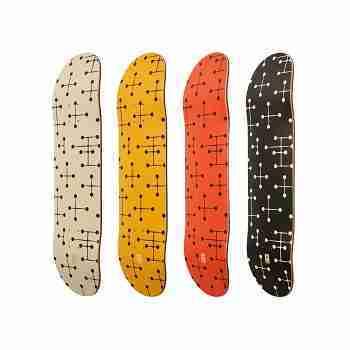
Tabla de Snowboard
Globe is a snowboard manufacturer with which Eames LLC has a trademark agreement to use Charles and Ray Eames designs in its products. The image depicts the “Dots” design.
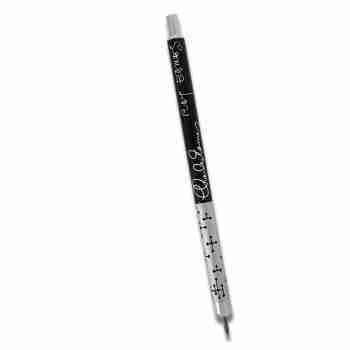
Mechanical Pencil Dots
Acme Studio, presents this mechanical pencil with the “Dots” design by Charles and Ray Eames. One of three mechanical pencils in the Architect’s Pencils series, along with Le Corbusier’s “Ronchamp” and Frank Lloyd Wright’s “FLW”.
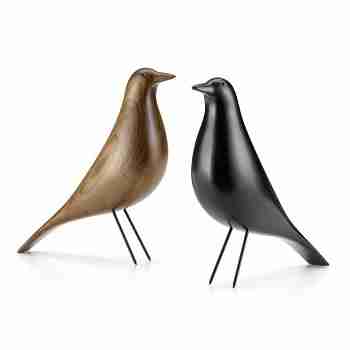
House bird
The figure of a black wooden bird has always been present in the Eames House. He appears in many photographs of the Eameses. Vitra produces it in walnut wood in collaboration with Eames LLC.
Legacy and impact
The Eames Foundation is responsible for spreading the word about the legacy of Charles and Ray Eames. It promotes design education and preserves their work. It disseminates with private media and public contributions, the focus on accessibility, innovation in the use of materials, research into production processes and the combination of form and function as a source of inspiration in design.
Charles and Ray Eame’sdesign is still relevant and admired today because of its ability to combine aesthetics with functionality. His work has left an indelible mark on the history of design and his influence is present in every place where design is appreciated.
From a global point of view, his work will continue to be the object of study and admiration of new generations of architects, designers and interior designers. It will always stand out for its functionality, subtle curves and ergonomics. The World of Furniture will always have Charles and Ray Eames on its roll of honor as the great researchers of the 20th century and as the Gods of the seat. No one interpreted better than they did the way of sitting and the short rest.
Information, bibliography and media:
We use our own and other means with the availability allowed by current legislation and free access to the World Wide Web. (See Terms & Conditions)
Texts: Owned, based on information from: DQ Arquitectura, Eames Office, Eames Foundation, Herman Miller, Street furniture, Vitra, Wikipedia.
Images: Art of Play, Doméstika, DQ Arquitectura, Eames Office, estudiosillas, Herman Miller, Katarimag, Vitra, Wikimedia Commons, Wikipedia.
Videos: s/n.