






- This event has passed.
24 Hours of Le Mans 2025
06/06/2025/10:00-06/15/2025/21:00 CEST
120.00€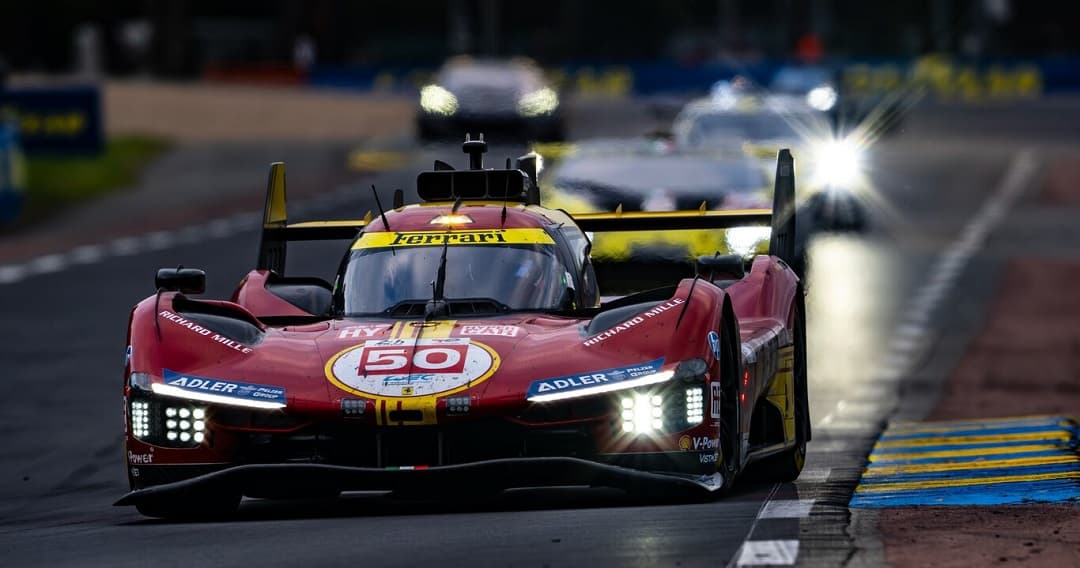
Earn 10.00 Reward Points by commenting the blog post
24 Hours of Le Mans
The 24 Hours of Le Mans is the endurance race par excellence. It is held annually in June at the Circuit de la Sarthe, near Le Mans, France. It is organized by the Automobile Club de l’Ouest (ACO). He has scored points in the World Endurance Championship between the 1950s and 1990s and again since 2010. It is one of the most important sporting events in the world of motorsport.
It is the most prestigious endurance motorsport race in the world, bringing together drivers and teams from different national and international championships. However, some get their invitation based on results in other ACO competitions, such as the American Le Mans Series, the European Le Mans Series, the Asian Le Mans Series and Petit Le Mans.
In the last edition in 2024, the Ferrari team, formed by Miguel Molina, Antonio Fuoco and Niklas Nielsen , won the second consecutive victory for the Ferrari team. Miguel Molina has become the third Spaniard to win this precious award, after Marc Gené and Fernando Alonso.
Introduction
The 24 Hours of Le Mans, since 1923, the year in which it was held on2, 6 and 27 May, has been held annually in the month of June, except for 1956 (July), 1968 (French May strikes) and 2020 (covid-19). In 1936 it was not held for economic reasons and from 1940 to 1948 it was not run because of World War II.
The competition takes place on a semi-permanent circuit that, in its current configuration, measures 13,626 meters. They are mostly sections of road that remain open to the public the rest of the year. Over the years, several sections have been built that have replaced sections of normal road, most notably the Porsche curves, which replace the dangerous Maison Blanche section. The permanent Bugatti circuit provides the facilities for the start and end of the race.
Around 50 vehicles compete simultaneously in different classes of sports prototypes and grand tourers. The winner is the vehicle that covers the longest distance in 24 hours of continuous racing. In 1966, all three Ford GT40 Mark IIs crossed the finish line at the same time, but the car that had set the worst time during practice was the winner, as it had started further back on the grid, having covered more metres.
You have to cross the finish line after the 24 hours of racing to qualify. Occasionally, damaged vehicles leave the pits for a final lap of the circuit and qualifying.
Each car, in recent years, has carried a team of three drivers. Prior to 1970 only two drivers were allowed per vehicle and even at the beginning only one driver was allowed. Until the early 1980s, most teams competed with two drivers.
In the 1990s, due to the speed of the cars and the strain on the drivers, rules were added to improve safety: Drivers may not drive more than four consecutive hours and no driver may drive more than fourteen hours in total.
The Race
The 24 Hours of Le Mans starts at 16:00 on a Saturday, and used to start with what’s known as the “Le Mans start”: the cars are lined up on one side of the circuit and the drivers on the other. When the French flag comes down at the appointed time, the drivers race across the track to their cars, mount and take off.
Harnesses and seat belts were introduced in 1967 . In those years, drivers took the first corners with their belts unsecured, they did it on a later straight.
In 1969, in his first 24 Hours of Le Mans, the young Belgian Jacky Ickx, at the start, instead of racing across the track, went slowly, got into the car and calmly secured the seat belts. Driver John Woolfe died after an accident during the first lap of the competition. Ickx, despite starting last in an outdated Ford GT40 , managed to win the race in a tight finish by just 120 metres.
From 1970 onwards, the “Le Mans start” was suspended. The cars were still on the side of the track with their engines off, but the drivers were already well secured inside before the start. From 1971 onwards the start of the race was launched.
The Circuit
The Circuit de la Sarthe is a non-permanent track that uses local roads that remain open to traffic the rest of the year. From 1965, the permanent Bugatti circuit was added, adding pit facilities and the first corner, with the famous Dunlop bridge.
It has undergone many modifications over the years. Famous for its long straight, part of the RN138, known locally as the 5 km long Ligne Droite des Hunaudières. In 1990 two chicanes were introduced on the Mulsanne Straight to reduce the high speeds. A new chicane was added in 2002, past the Dunlop Bridge. 1
It is perhaps the second longest racing circuit today, behind the Nürburgring Nordschleife. Considering that the “Green Hell” is no longer used in competition, La Sarthe is the place with the longest lap times, even being a high-speed track.
The Bugatti circuit, inaugurated in 1965, built on the Sarthe, is an important stage for car races, motorcycles and even skating, it is an FIM track (Moto 2, Moto 3, Moto GP), DTM and GP2. It has an extension of 4,430 m. with 13 curves (8 right, 5 left).
Drivers & Brands
Tom Kristensen (9 wins), Frank Biela (5 wins), Sébastien Buemi (4 wins), Woolf Barnato and Klaus Ludwig (3 wins), Fernando Alonso (2 wins) and Marc Gené (1 win), are some of the drivers who won the 24 Hours of Le Mans and left their mark on this famous event.
Porsche (19), Audi (13), Ferrari (11), Jaguar (7), Bentley (6), Toyota (5), Ford and Alfa Romeo (4), the most successful brands of the 24 Hours of Le Mans.
Cita 2025 (Edition 93)
Dates: 14 / 15 June 2025
Program: link. (06/06/2025 – 15/06/2025)
Tickets: Electronic sales.
Categories: Hypercar, LM P2 and LMGT3
General Information: Info.
Bibliography and media
We use our own and other means with the availability allowed by current legislation and free access to the World Wide Web. (See Terms Conditions)
Texts: Owned, based on information from 24 Hours of Le Mans, ACO, Wikipedia.
Images: 24 Hours of Le Mans, ACO, Wikipedia.
Videos: s/n.