





Uten.Silo, effective wall organizer
Earn 10.00 Reward Points by commenting the blog post
Introduction to Uten.Silo
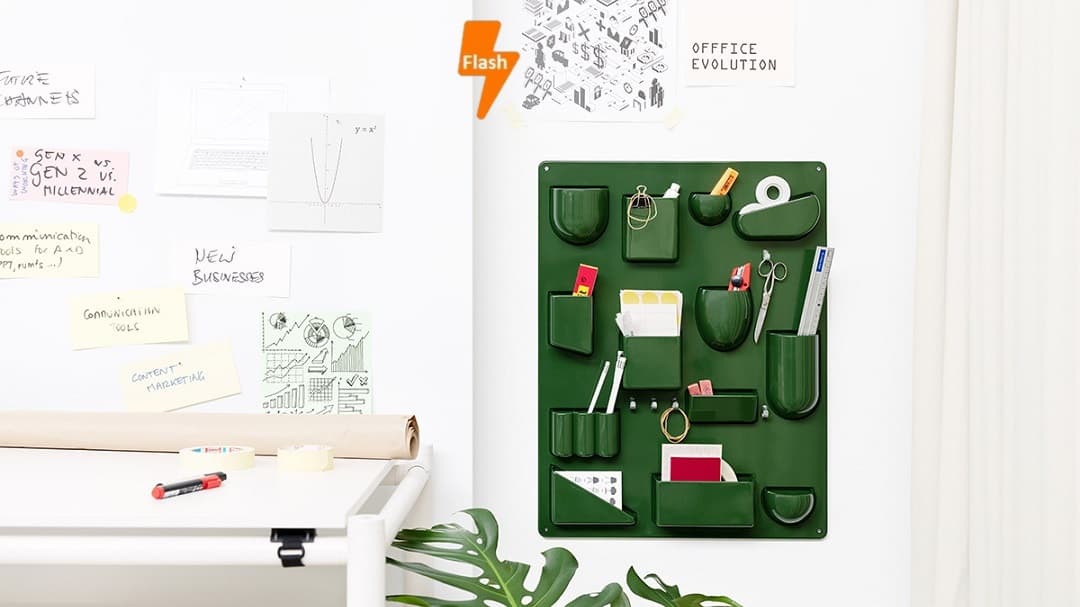
Uten.Silo is an ingenious and effective wall organizer. Designed by Dorothée Becker in 1969 , it is made of ABS plastic and contains pockets (containers), hooks and clips.
The idea is to keep objects organized but in sight, which makes it easier to locate them. Uten.Silo manages to bring order to offices, kitchens, workshops, bathrooms and other places. It can be placed screwed to the wall or leaning on a shelf, table or stand.
It is available in 3 colors (white, black and red) and in 2 sizes: Uten.Silo I (1969) 670 x 870 mm. and Uten.Silo II (1970) 520 x 680 mm. (Measurements: width x height)
Price: €399.00 (I) and €319.00 (II)

Information
Background
Dorothée Becker was a German designer, specializing in objects and furniture representative of the 60s. Self-taught in artistic matters, after designing furniture, he opened his own furniture and accessories design business in Munich.
In 1969 he designed a piece of furniture to hang on the wall. It was used to organize and place small objects organized and at hand. He gave it the name of Uten.Silo, as a “utensil” for utility and “silo” for storage. In 2020 the design was included among the best designs of everyday objects and considered one of the most relevant of the 60s.
Originally, the prototype was made of wood, although it was finally built in plastic. It was made up of small apartments, shelves and niches that protruded from a single plate of different colors.
It was first presented at the Frankfurt Fair in 1969. A year later he would make a second, smaller version, Uten.Silo II. In 1973, after the oil crisis, as it was made of plastic, it ceased to be produced. In 2001 it was successfully revived by the Vitra Design Museum , this time made in bright colours such as black, white, orange and red.
Technical data sheet
- Material: ABS plastic.
- Hooks: nickel-plated metal.
- Dimensions: 670×870 mm. (Uten.Silo I) and 520 x 680 mm. (Uten.Silo II)
- Colors: white, black and classic red.
Feedback
An exceptional organizer. It combines the ease of locating objects (pockets, hooks, clips) with the visibility to locate them. Undoubtedly, an element far ahead of its time. Proof of this is the re-edition made by Vitra with great acceptance.
To highlight: the simplicity, the ergonomics and the right decision to make it in bright colors, enhancing its character. It is lightweight, easy to place and with a very good ability to place small objects. We must not forget its extraordinary versatility, being useful in many places: an office, a painting workshop, one’s own home, etc…
Manufacturer: Vitra International AG, Klünenfeldstrasse 22 – 4127 Birsfelden, Switzerland – Tel: +41 61 377 00 00 info@vitra.com
- General Terms and Conditions of Sale: Link.
- Terms and Conditions of Use: Link.
- Privacy Policy: Privacy.
- Frequently asked questions: Yes.
- Taxes: VAT included.
- Warranty: Link.
- Repair service and spare parts: Yes.
Availability: Consult.
Shipping: Link.
Returns and exchanges: See General Conditions of Sale.
Deferred payment: s/n
Contact: Link.
Vitra is a Swiss (originally German) manufacturer of designer furniture. Its production is based on renowned designers for housing, office and public spaces.
Founded in Weil am Rhein, Germany, in 1950. Its founder, Willi Fehlbaum, owned a furniture store in the vicinity of Basel, Switzerland. In the following years, Fehlbaum acquired the rights to the designs of Charles and Ray Eames and George Nelson.
In 1981, Vitra commissioned British architect Nicholas Grimshaw to design a new factory after the fire that completely destroyed it. The new building was ready to go back into production only 6 months later. In 1986, the Portuguese architect Álvaro Siza was commissioned to build another building to expand the premises, and in 1989, Frank Gehry designed a new production hall.
At the same time, Vitra commissioned Gehry to build a building to house the private collection of furniture owned by Rolf Fehlbaum, which eventually became the Vitra Museum.
In 1993, Iraqi architect Zaha Hadid added a fire station to the ensemble of buildings. In recent years, it has housed the collection of designer chairs of the Vitra Museum. In that same building, the Japanese architect Tadao Ando designed a conference pavilion.
In 1994, the construction of the new company headquarters (also the work of Frank Gehry) was completed near Birsfelden in Switzerland.
Today, Vitra is considered the world’s leading designer furniture company. Its very wide portfolio of designs, made by the most prestigious architects, designers and artists in the world, is unrivalled, and in practically all projects of a certain level, its products are protagonists.
Additional Images


NOTE: If you liked this article, you can share it on social media. You can also rate it with stars below. If you wish to leave a comment, ask a question or make any suggestion you can do so in the comment box below. Thank you for your attention!
Bibliography and media
We use our own and other means with the availability allowed by current legislation and free access to the World Wide Web. (See Terms Conditions)
Texts: Owned, based on information from Vitra, Wikipedia.
Images: Vitra.
Videos: s/n.








Thank you very much for your support. We will of course continue to publish interesting content. If you wish, you can subscribe to our newsletter or follow us on social media. 🙂