






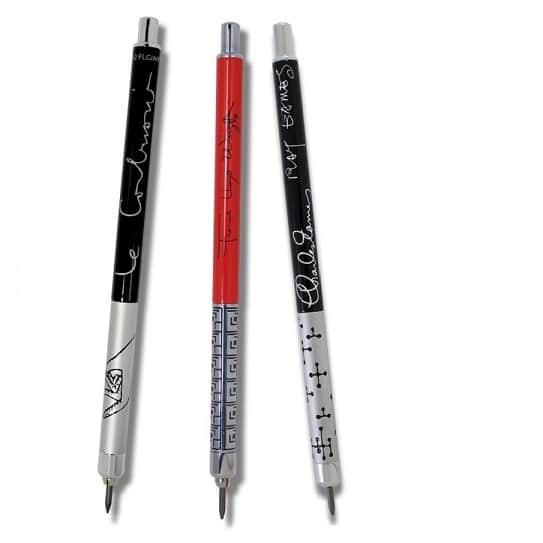
Architect’s mechanical pencil, 3 unique designs: Ronchamp, FLW and Dots
Earn 10.00 Reward Points by commenting the blog post
Introduction
Rarely have I felt so responsible when writing an article about objects. The truth is that, well thought out, it’s just 3 mechanical pencils that, despite representing three icons of architecture and design, “do not come to break neither the history of linear drawing nor the principles of modern geometry”.
However, like the journalist seasoned in years, one smells “blood” of the news and, therefore, I could not miss this opportunity to use my time in the analysis of these magnificent mechanical pencils from Acme Studio. Writing, however little, about Le Corbusier, Frank Lloyd Wright and Charles/Ray Eames is very tempting and completely satisfies my personal ego. I trust that this article deserves the approval of our readers and does not detract from the fantastic encyclobjects magazine.
To introduce ourselves to the subject of the article, I must inevitably refer to Acme Studio, the firm behind Adrian Olabuenaga and which has been the benchmark in publishing small objects linked to the world of architecture, design and the arts for many years.
Adrian, a designer himself, had the brilliant idea years ago of surrounding himself with great designers and architects and collaborating with them on this “oggetistica” plot (In Italian: Industrial or artisanal production of complementary objects to furniture or gift items; .also , the assortment of such objects.)
From his collaborations with Ettore Sottsass, Michelle di Lucchi, Aldo Cibic, Matteo Thun, Peter Shire, etc… and the entire “Memphis Designers for Acme” group, these small objects took on a leading role that they had not had until then. In this way, Acme Studio gradually became the showcase where these architects, designers and artists would exhibit their “small works” and would go down in history as true cult objects.
To finish the introduction I would like to go into the term “mechanical pencil”. A mechanical pencil, pencil, graph pencil, pen-pencil, pencil, is an instrument of writing in which the “lead” (a thin rod of graphite) is mechanically driven through the tip, rather than as in traditional pencils, where the wood that makes up the pencil is removed, usually by means of a pencil sharpener, to expose the lead and sharpen it.
Most mechanical pencils can be refilled with fresh lead, although some lower-cost models are disposable. Mechanical pencils are used for their precision and the fact that the point never thickens. (Source: Wikipedia).
Ronchamp mechanical pencil
It might seem that we are talking about just another mechanical pencil. Yes, a bit particular, with a bit of additional design and that’s it. But not. Not much less.
We are talking about the Ronchamp Mechanical Pencil, an impeccable design exercise carried out by Acme Studio to commemorate the great master innovator of modern architecture: Le Corbusier.
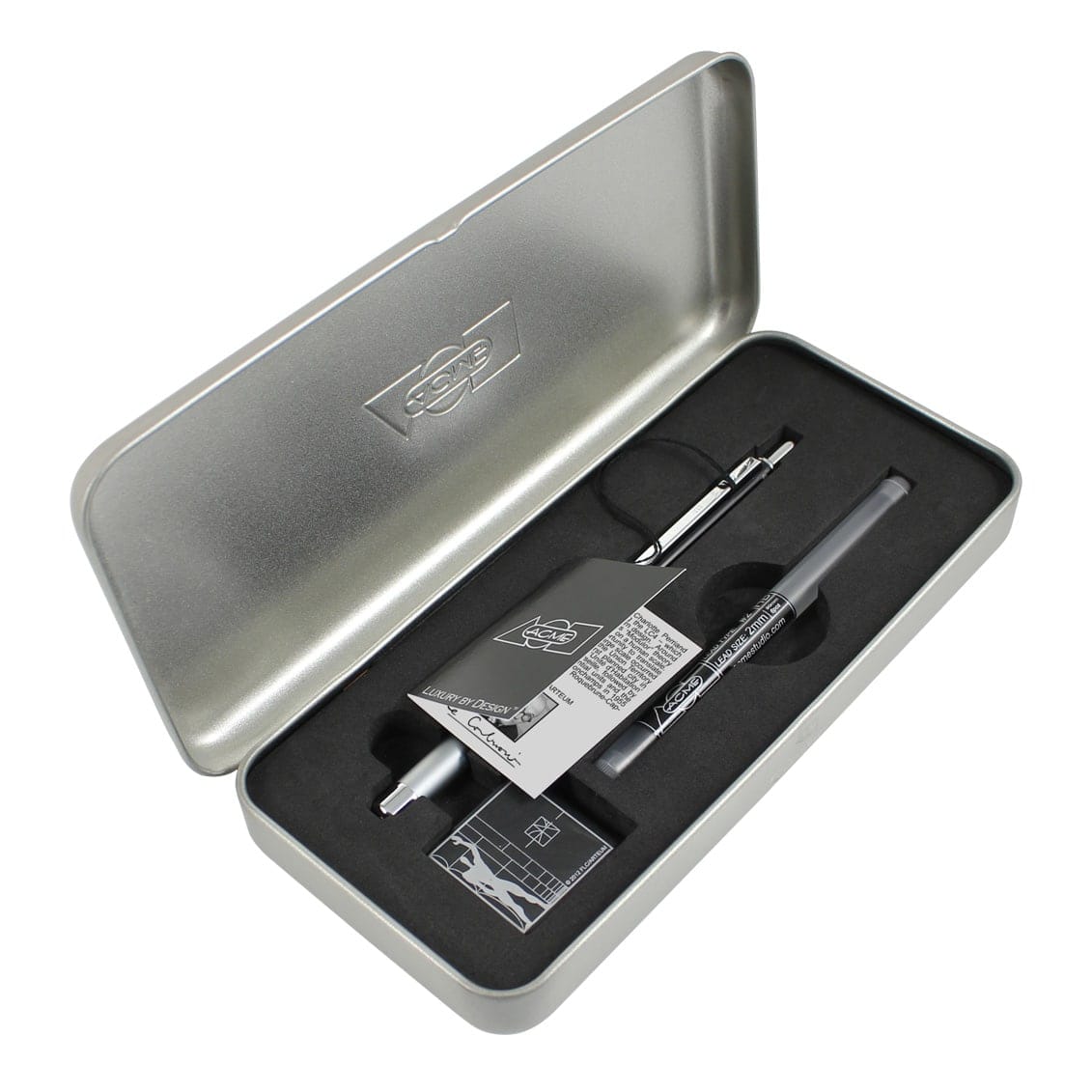
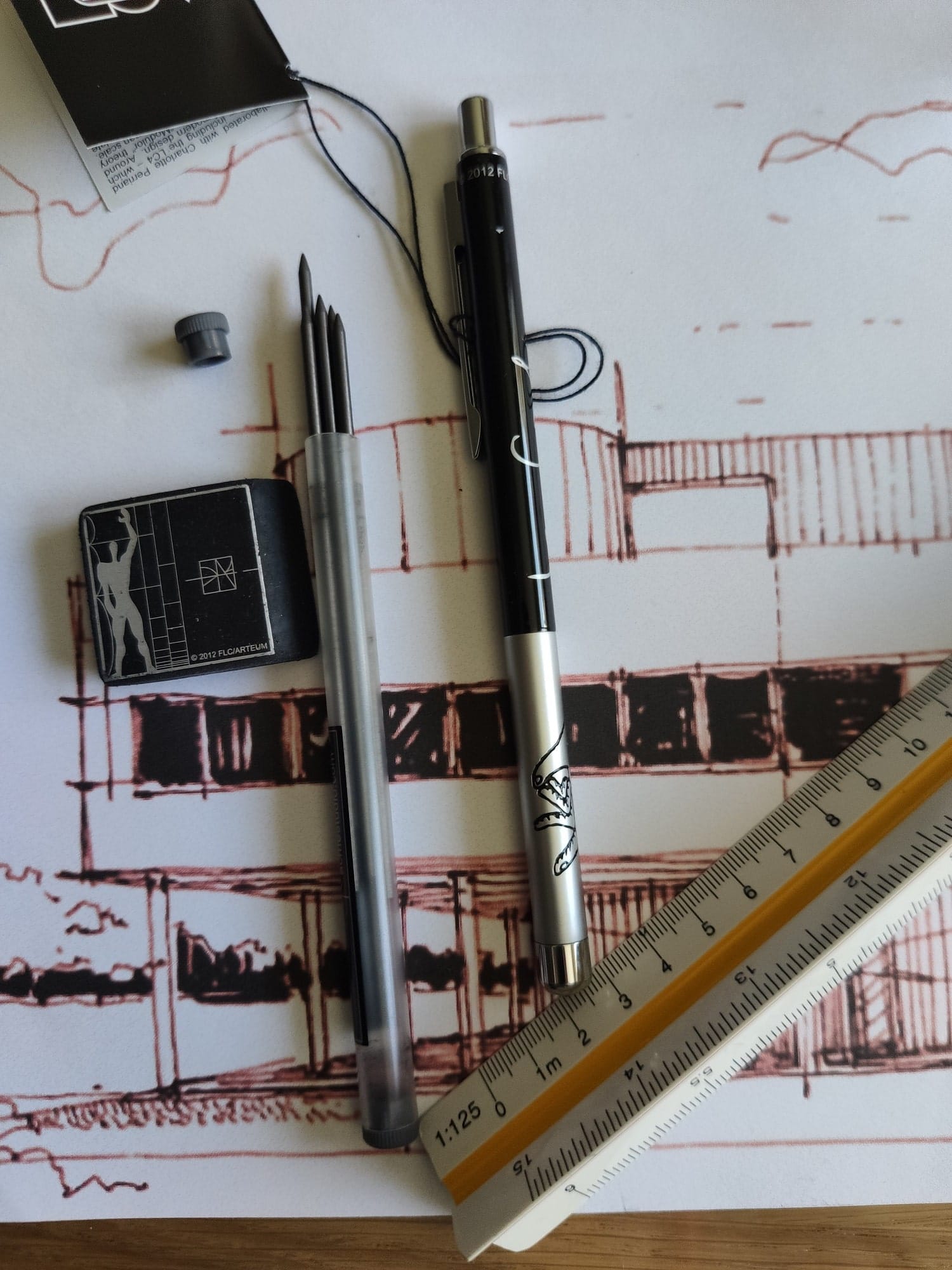
The Ronchamp mechanical pencil comes packaged in an elegant and at the same time practical metal case. Protected by a tight foam rests the mechanical pencil itself, a cylindrical plastic tube with 2.0 m graphite leads. spare and an eraser with the schematic drawing of Le Modulor.
Accompanying the product is a small booklet with some additional creations from Acme Studio. That said, very well presented, in accordance with the expectations it arouses.
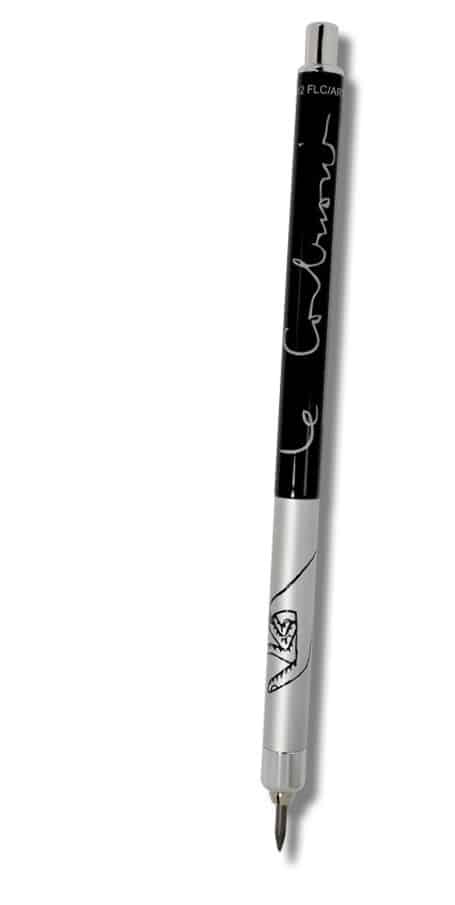
Manufactured on a cylindrical metal tube of just 7 mm. thick, presents, carefully lacquered, the signature of Le Corbusier in silver on a black background, on the upper part and, on the handle, on a chrome base, the drawing of a hand as an “aid” to the drawing of the owner of such a magnificent mechanical pencil.
The activation of the lead is carried out on the upper button, its mechanism being very precise, and always advancing the same distance, which makes the dosage of the lead predictable and comfortable.
In the hand, the mechanical pencil feels from the first moment like a powerful drawing instrument and a bit “unearthly”. Slightly heavy, it lives up to the name that, for this occasion, Acme Studio imposed on the mechanical pencil: Ronchamp (Le Corbusier’s famous chapel with that huge concrete cover).
The dimensions of the mechanical pencil, although contained (140x7mm.), allow the movement of the mechanical pencil with hardly any effort. The lead complies perfectly, leaving the precise amount of graphite on the paper so as not to stain or fade in the event of a more restrained stroke.
n short, it is clear that we are dealing with an architect’s mechanical pencil, slim, functional and with the background of a figure like Le Corbusier.
Le Corbusier becomes the engine of the new architecture, breaking molds is in the “Corbusian” DNA. Le Corbusier came to completely renew modern architecture, theorizing as never before and questioning absolutely everything.
Le Corbusier reached the sublime by exhausting reasoning. When everything has been considered, it is not possible to consider more, is it? Le Corbusier is inexhaustible, when he has reached the limit of the questions, he links them in the social and even political diatribe to give the social and human approach that architecture needs from him. An architecture for man, that simple and that relevant.
Due to the exclusivity of Acme products, and their limited distribution, sometimes certain models are sold out, becoming part of the world of collecting. At this time the availability of the product “Ronchamp Mechanical Pencil” is limited, by clicking on the Buy button you will be directed to a reliable source of sale so that you can acquire this wonderful work.


FLW mechanical pencil
If it has already been a commitment to describe and comment on the Ronchamp mechanical pencil in homage to Le Corbusier, it will no less be to explain the FLW mechanical pencil (the initials Frank Lloyd Wright).
We refer to the best American architect of all time. In 2019, 8 of his works were declared a UNESCO World Heritage Site. Therefore, there is no doubt about the relevance of Lloyd Wright in the world of architecture.
For quite some time now, Acme Studio has been devoting part of its work to extolling the legacy of Frank Loyd Wright, and not only with writing instruments, but also with card holders, cufflinks, key rings, etc… All these objects, late or sooner they will be the object of collectors’ desire.
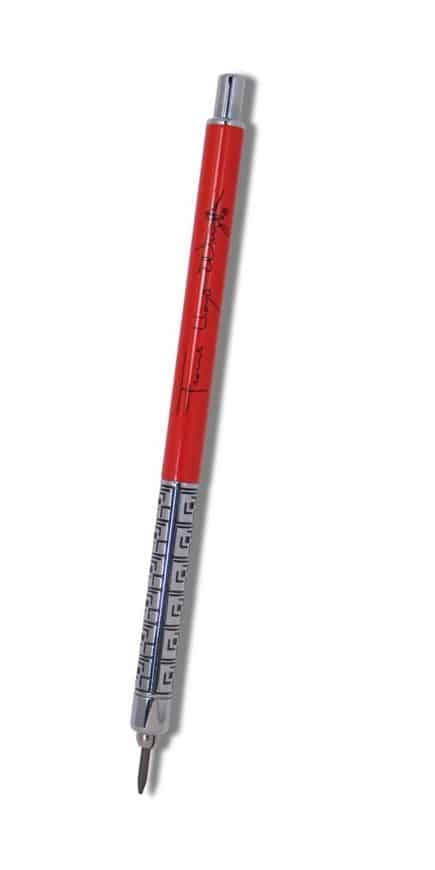
The FLW Mechanical Pencil is made from a cylindrical metal tube just 7 mm. The body, in its upper part, is carefully lacquered in the color “Cherokee Red”, Wright’s favorite, where his signature is stamped.
In its lower part, the handle has a bright chrome with lacquered bas-relief of blocks seen in the “Ennis” house. This small relief makes the grip of the mechanical pencil more comfortable.
The drive and dosage mechanism of the lead is impeccable, presenting a constant and precise dosage.
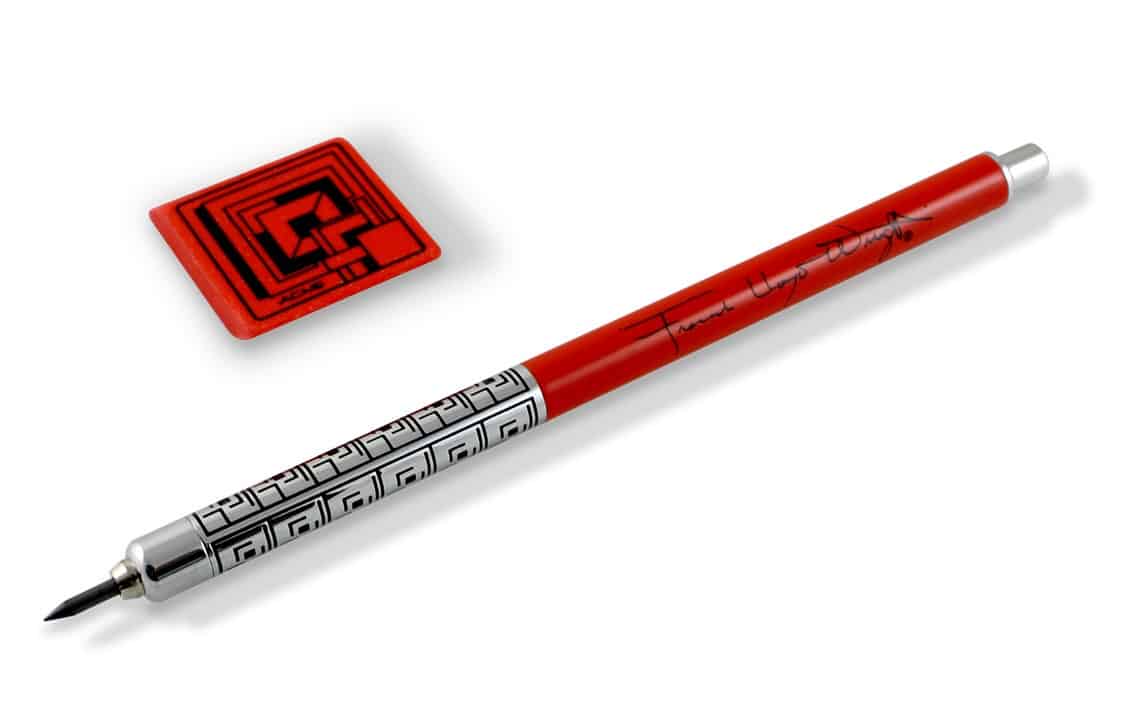
In the hand, despite its small dimensions (140x7mm.), it is comfortable and, due to its weight, it moves easily in long and short strokes. It allows the lead to leave just enough graphite on the paper so as not to stain and not go unnoticed in the softest strokes. The eraser fulfills its function, although the support for which it is prepared has to be strong. The lead collects perfectly and the clip (a bit small) fits well in a shirt pocket.
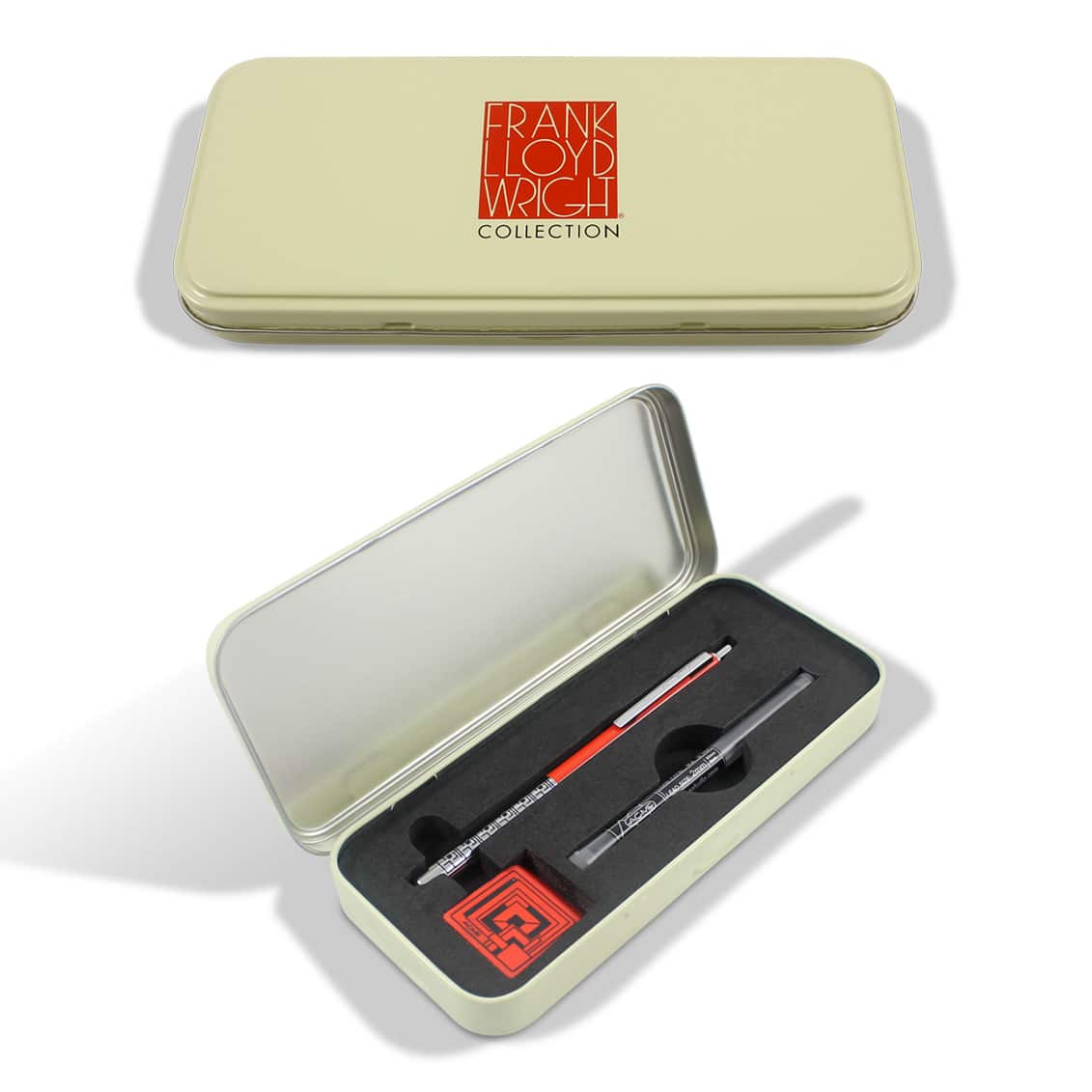
The mechanical pencil is presented in an excellent beige metal case that, in addition to being very elegant, is eminently practical. The inner foam perfectly contains the mechanical pencil, the refill tube of leads and the “Cherokee Red” colored eraser.
F rank Lloyd Wright was the initiator of the Prairie School movement, developing the Usonian concept of housing. He created a new concept of the interior state of the houses, proposing open rooms, providing great visual transparency and wide diffusion of light.
Wright studied Mayan architecture extensively, and applied a style reminiscent of Mayans to many of his dwellings, known as the Mayan Revival.
Lloyd Wright also highlights the communion between the materials used in his projects and its natural environment. One of his most outstanding and well-known projects, which perpetuates his genius, was carried out between 1935 and 1939. It is the Kaufmann house or Fallingwater house in Bear Run, built on a huge rock, directly above a waterfall on Bear Creek with a very modern style ahead of its time.
At the moment the availability of the product “FLW Mechanical Pencil” is limited, by clicking on the Buy button you will be directed to a reliable source of sale so that you can acquire this wonderful work. t is very likely that in a short space of time the stock of this item will be exhausted, which will cause the FLW mechanical pencil to enter the world of collecting and increase its value ostensibly.


Dots Mechanical Pencil
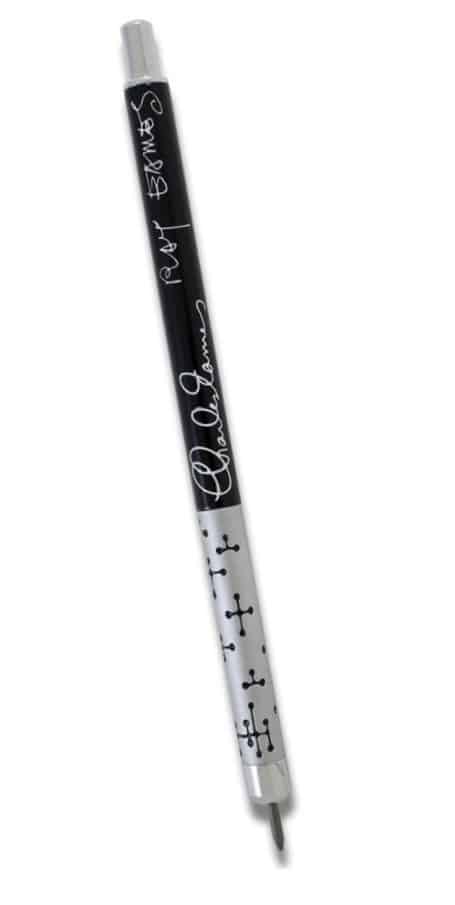
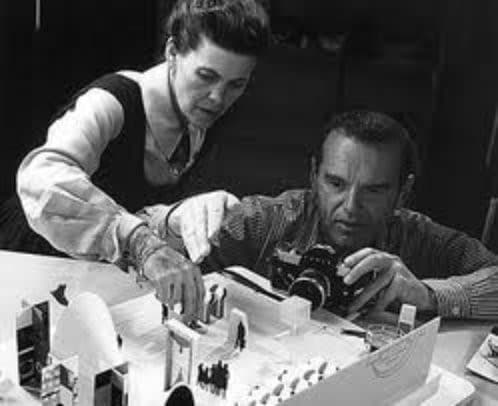
The third exponent of this article is the Dots Mechanical Pencil, also published by Acme Studio and in homage to the pair of designers Charles and Ray Eames.
As furniture designers, Charles and Ray Eames deserve a place of honor in the world of furniture. Specifically, its Dots (dots) design had a textile implementation that was later applied to the chairs and the interior space.
In the case at hand, the Dots design has been part of Acme Studio since almost the beginning of its writing instruments. Therefore, when it was decided to commemorate a mechanical pencil for Charles and Ray Eames, nothing better than the Dots design to edit it.
The Dots Mechanical Pencil is very similar to Le Corbusier’s Ronchamp Mechanical Pencil. It is still a design made from a 7mm cylindrical metal tube. splendidly black lacquered. On this lacquer appear the signatures of Charles and Ray in silver.
The lower part of the body, that is, the handle, has a satin chrome finish on which there is a bas-relief of the Dots design finished in black lacquer. This subtle embossing improves the grip feel of the mechanical pencil.
The drive mechanism uses the upper button to move the lead, always uniform and precise, always allowing the perfect dosage.
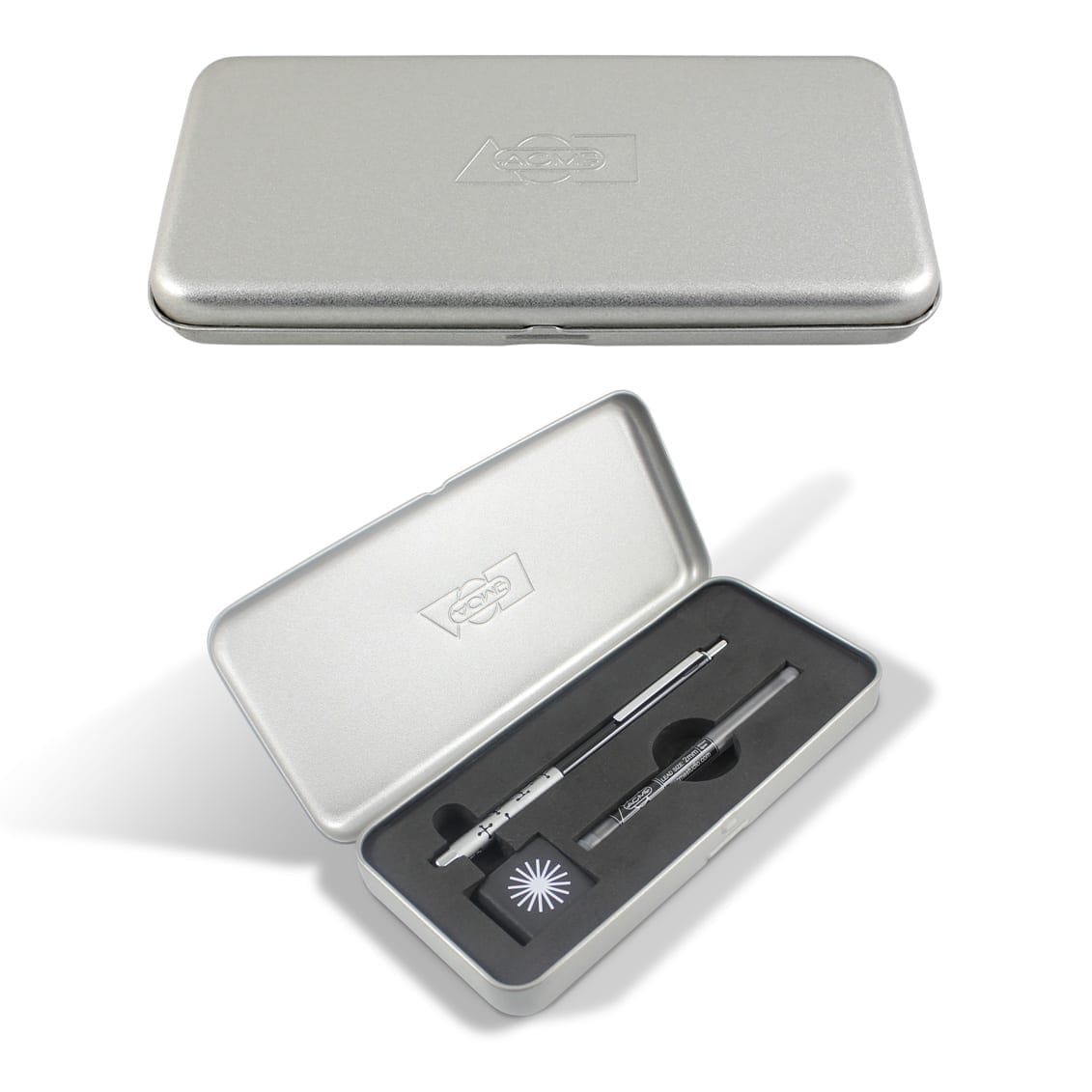
The Dots Mechanical Pencil is presented in an extraordinary metal case. Inside, a perfectly fitted foam rubber houses the mechanical pencil, a tube with spare leads and a black eraser with a white asterisk. A small diptych on Charles and Ray Eames as well as a small book with writing instruments from Acme Studio complete the set.
In hand, like its two predecessors, it is perfect for sketching freehand plans and even for certain uses of linear drawing. Its dimensions (140x7mm.) make it agile in any hand, allowing very defined strokes on any occasion. The eraser, due to its hardness, seems designed only for strong paper or cardboard surfaces.
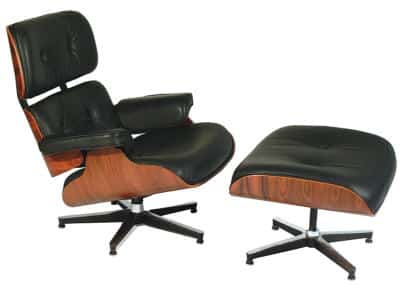
In short, an architect’s mechanical pencil designed for architects. A perfect gift and an indelible memory of this couple of designers who remain “very alive” in their creations (Aluminium chair, Eames lounge and Ottoman, etc…).
Of the three mechanical pencils that we have developed in this article, the Dots Mechanical Pencil is currently discontinued, with very few units for sale. We can proudly say that encyclobjects.com is one of those few sites where you can still buy it (we have 1 unit left). Reissued in 2014 by Acme Studio, it sold out its production again in 2020. At this time its estimated value is €250.00 or more. Take advantage of this last unit.
Information, bibliography and media:
We use our own means and other means with the availability allowed by current legislation and free access to the World Wide Web. (See Terms and conditions)
Texts (source): Wikipedia, Acme Studio, Fondation Le Corbusier, The Frank Lloyd Wright Foundation, Eames Foundation and own.
Images: Commons License (Unsplash, Flickr, Wikimedia Commons), Acme Studio. (See Legend in each image)
Vídeos: s. n.